

Starlink Mini review: internet when the towers and the power go down
A small dish that keeps a household online when the local lines are cut — provided you have solved the power problem first. Honest notes from a Philippine wet season.
Current
We buy our own gear. Prices checked Sept 2026.

Overview
The Starlink Mini is a flat satellite dish about the size of a laptop, with the router built into it. One cable in, Wi-Fi out. I bought ours before the 2024 storm season because we had spent one too many nights after a typhoon with a phone showing one bar of nothing, waiting for a text from family that never arrived.
The reason it is on this site is simple: it is the only piece of kit I own that does not care whether the barangay has power, whether the fibre line down the street is lying in the road, or whether the nearest cell tower is on its last hour of battery. It only cares whether it can see the sky and whether you can feed it electricity.
That second condition is the whole review, really. Everything below is about that.
Why it matters in Philippine conditions
When PAGASA raises signal number three and the wind actually arrives, three things tend to fail in order. Mains power goes first. Then fixed broadband, because the same poles carry both. Then mobile data, usually a few hours later, when the tower backup batteries run flat and the generator cannot be reached for refuelling.
That third failure is the one people are not ready for. Most families assume that if the lights go out, they will still have load and a signal. Sometimes you do. After the worst of it, in the low-lying areas and the towns nearest the track, you often do not — and you find out at exactly the moment you need to tell your mother you are alive.
The Starlink Mini sidesteps the local part of that chain. It talks to satellites, and those satellites talk to ground stations somewhere else entirely. If Metro Manila is dark, that does not stop the dish on your balcony in Quezon City from working. If you are on the sixteenth floor with no lift and no water, you still have a way to reach the outside.
It is not magic, and I will not pretend otherwise. It needs power, and it needs a clear view of the sky. But those are problems you can solve in advance, sitting at your kitchen table, which is more than you can say for a downed cell tower.
Key specs: what you get
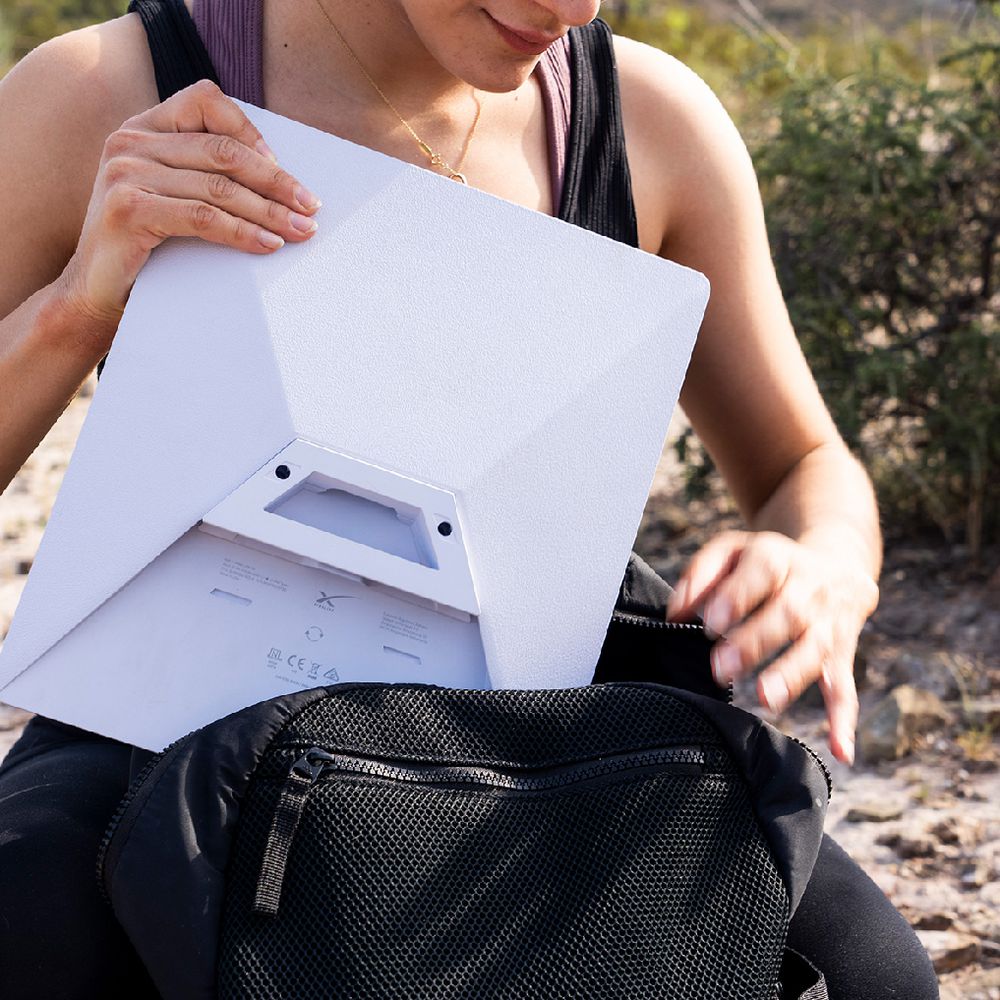
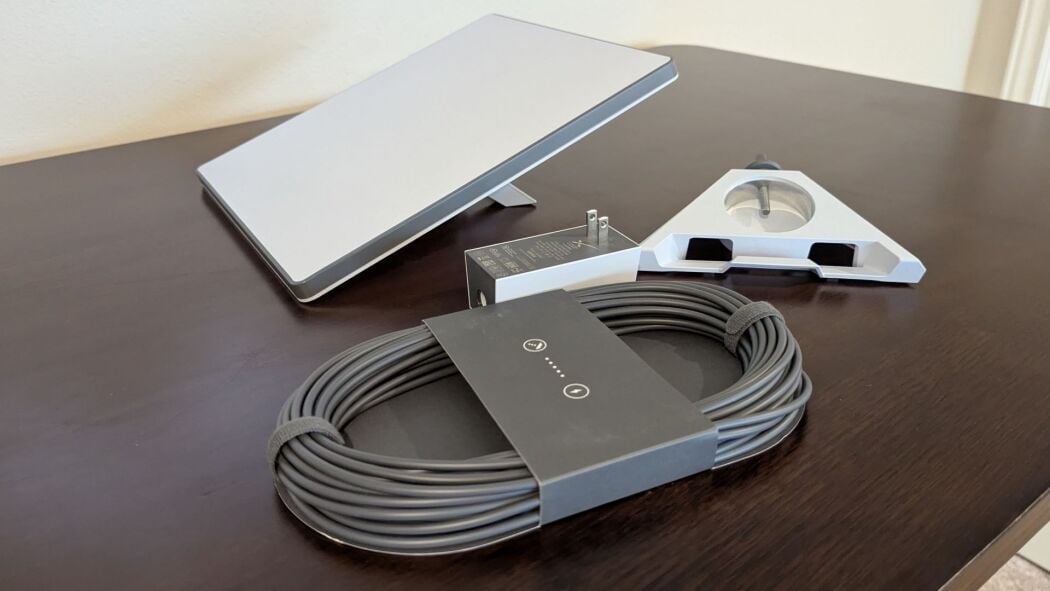
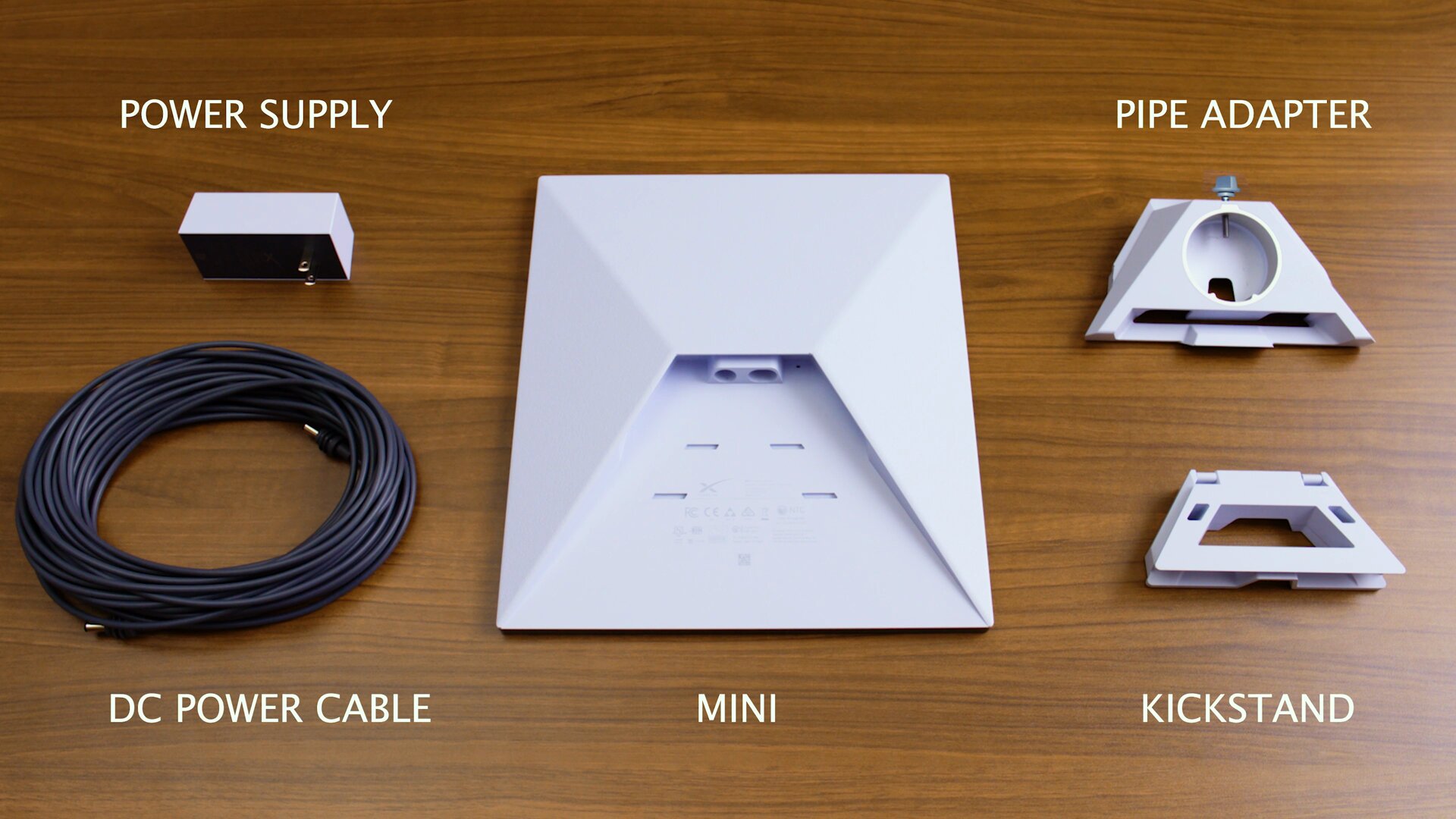
The kit is the dish itself, a kickstand built into the back, a mains power supply, and a cable. That is it. There is no separate router box to find a shelf for — the Wi-Fi is inside the dish.
The important numbers, translated:
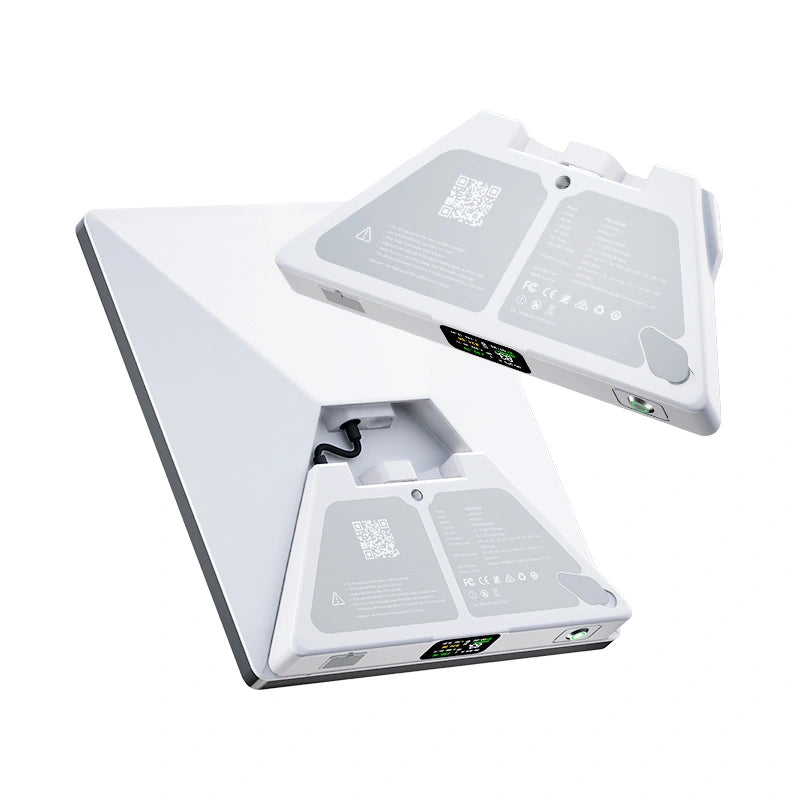
Power draw, roughly 25 to 40 watts. In plain terms, a 20,000 mAh power bank (about 74 watt-hours of real usable energy) runs it for around two hours. A 300 watt-hour portable power station gets you seven to nine hours. A day of running it continuously needs a proper battery and ideally a solar panel. Plan for this before you buy, not after.
Runs on 12 to 48 volts DC. This is the quietly useful bit. It will run straight off a car battery with the right cable, off a portable power station’s DC output, or off a 100 W USB-C power bank with a suitable adapter. You are not tied to mains and an inverter.
IP67 rated. Sealed against dust, survives being submerged briefly. Rain is not a problem for the hardware. Rain is a problem for the signal, which is a different thing — see below.
About 1.1 kg for the dish, a little over 1.5 kg for the whole kit. It fits flat in a rucksack. That matters if the plan is ever to leave with it rather than shelter with it.
Typical speeds here: 50 to 150 Mbps down, 10 to 20 Mbps up, latency in the 30 to 60 ms range. More than enough for video calls, maps, news, and uploading photos of what the flood did. Speeds drop when the network is busy.
You need an active plan. The hardware alone does nothing. Roam plans, which are the ones most preparedness-minded people want because they work anywhere, ran around ₱1,600 a month for a 50 GB allowance and roughly ₱4,000 a month for unlimited when I last checked. You can pause and unpause Roam month to month, which is the honest way to own one of these if you only want it for the wet season.
How it performs
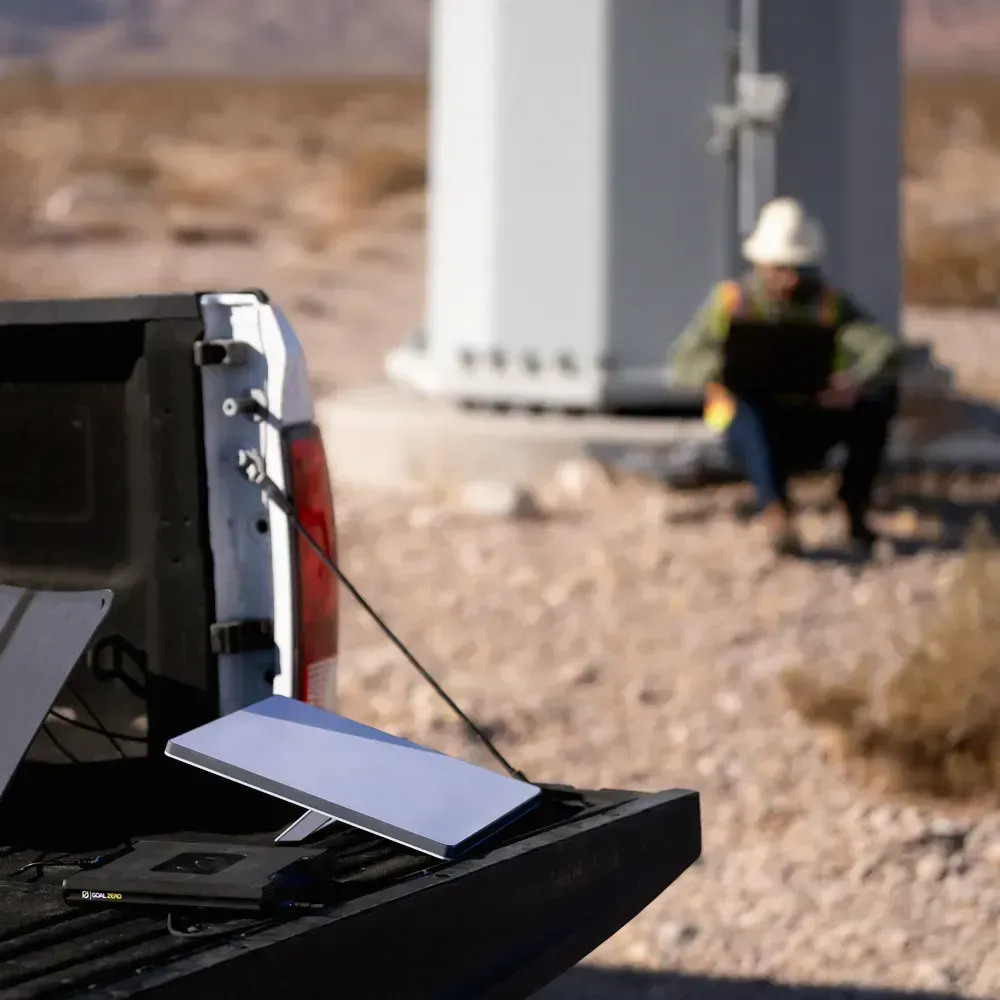
Setup the first time took me about ten minutes, most of which was the app updating itself. After that, deploying it takes under two minutes: stand it up, point it roughly at open sky, plug it in, wait for it to find itself. The app has an obstruction checker that uses the phone camera to tell you whether your chosen spot will work. Use it. Trees and building overhangs are the real enemy, not distance.
On our balcony, with about two-thirds of the sky visible, we get brief dropouts of a few seconds every hour or so as satellites pass behind the building. Annoying on a video call, invisible when messaging. Moved out to open ground, it is rock solid.
Heavy rain is the honest limitation. During the thickest rain bands of a passing storm — the sort where you cannot see the next building — throughput drops and you will get dropouts of a minute or two. It comes back. It has never gone down for an entire storm in my experience, but I would not promise anyone a stable video call at the height of one. Text messages get through. That is usually what matters.
Wind is a hardware problem, not a signal problem. The kickstand is light and the dish is a flat panel, which is to say a sail. Ours sits weighted down with a sandbag and a strap through the kickstand. In genuinely destructive wind, bring it inside and put it back out when the worst has passed. Nothing is gained by donating it to the neighbourhood.
The power side is where most people come unstuck. We run ours off a 500 Wh power station, which gives comfortably over a day of on-and-off use if you do not leave it running all night. A folding solar panel tops that up during the breaks in the cloud. Without that chain, the Mini is a 40-watt hole in your battery and you will be offline by the second evening.
In search-and-rescue we never built a comms plan around a single path — you carried the radio, you carried the phone, and you agreed a time and a place to meet if both failed. The same logic applies here. The Mini is an excellent primary path. It should not be your only one. Keep a charged phone with a second network’s SIM, and agree with family now where you will meet and when you will check in, so that nobody’s safety depends on a dish finding a satellite.
Pros and cons
The short version of both is in the product card below. The longer version: the thing works, it works when the local infrastructure does not, and it is small enough that owning one is not a lifestyle decision. Against that, it is expensive to buy, it costs money every month you keep it active, and it converts your power problem into a bigger power problem.
Who it’s for
Families who have already sorted water, light and a battery, and who have found that the missing piece is information — whether the road is passable, whether relatives in the province are safe, whether the office expects you tomorrow. People who work remotely and cannot afford three days offline after every storm. Anyone living somewhere that loses connectivity routinely rather than rarely, which in this country is a great many barangays.
It also suits people who travel to the province, where there is no fixed line to lose in the first place.
Who it’s not for
If you do not yet own a decent power station or a large power bank, buy that first. A Starlink Mini with nothing to run it on is an expensive paperweight, and I have seen exactly that happen to a neighbour.
If your outages are short — a few hours of brownout, network intact — you do not need this. Your phone already does the job.
If you live under a mature mango tree or in a unit with a narrow slot of sky, check with the app before you spend a peso. No amount of good intent gets a signal through a concrete overhang.
And if the budget is tight, this is not where the first ₱20,000 of your preparedness money should go. Water, light, a stocked cupboard and a way to leave early all rank above it.
Budget alternative
A dual-network approach covers most real outages for a fraction of the cost: a phone or pocket Wi-Fi with both a Globe and a Smart SIM, plus a 20,000 mAh power bank, for somewhere around ₱2,500 to ₱3,500 all in. When one network’s tower is down, the other is often still up. It fails in the same storms where everything fails — but it handles the ordinary week-long brownout perfectly well.
The verdict
The Starlink Mini does the one thing nothing else in my kit does: it restores a connection that the local grid can no longer provide. It is well made, sensibly small, quick to deploy, and honest about needing a clear sky. It is also costly, hungry for power, and it will stutter in the heaviest rain.
Buy it with your eyes open and a battery already in the house, and it is one of the few pieces of gear that genuinely changes what a bad week looks like. Buy it as the first thing on your list and it will disappoint you.
4.5 out of 5. Half a mark off for the power appetite and the rain-fade honesty, not for anything it does badly.
Where to buy
Indicative price for the Mini kit is around ₱19,999, with the hardware occasionally discounted heavily during promotions — it has been as low as ₱9,999 in past sales, so it is worth waiting if you are not in a hurry. The monthly plan is separate and is the real long-term cost.
A word of caution: buy the hardware from Starlink directly or from a genuinely authorised seller. There are grey-market kits on Lazada and Shopee, and a dish tied to another account or another region is a very expensive lesson.