

What to pack in your bag for flash floods and typhoons
A practical typhoon commute bag checklist for Filipino commuters: dry bag, cash, power bank, dry socks — stay ready when floods strand you away from home.
What you’ll be able to do — and why it matters
Habagat season in Metro Manila does not care what time your shift ends. One minute you are closing your laptop, the next the group chats are full of screenshots of chest-deep water in Cubao, and the MRT has suspended operations “due to flooding on the tracks.” You are not home. You are not even close to home. And the jeepney line outside is three blocks long and not moving.
This guide is about the small kit that lives in your everyday bag — the one you carry to the office, to school, to your shift — so that a flash flood commute becomes an inconvenience instead of a crisis. It is not a go-bag. A go-bag assumes you are heading into 72 hours of disruption from home. This is smaller and lighter: just enough to keep your phone charged, your documents dry, your feet from rotting in wet socks, and your fare money in your pocket when GCash servers buckle under everyone else trying to do the same thing you are.
Related reading, if you want the bigger picture: our go bag guide covers the 72-hour kit for home, and flood ready covers preparing the house itself. This article sits next to those, not on top of them — think of it as your EDC for wet season.
What you need
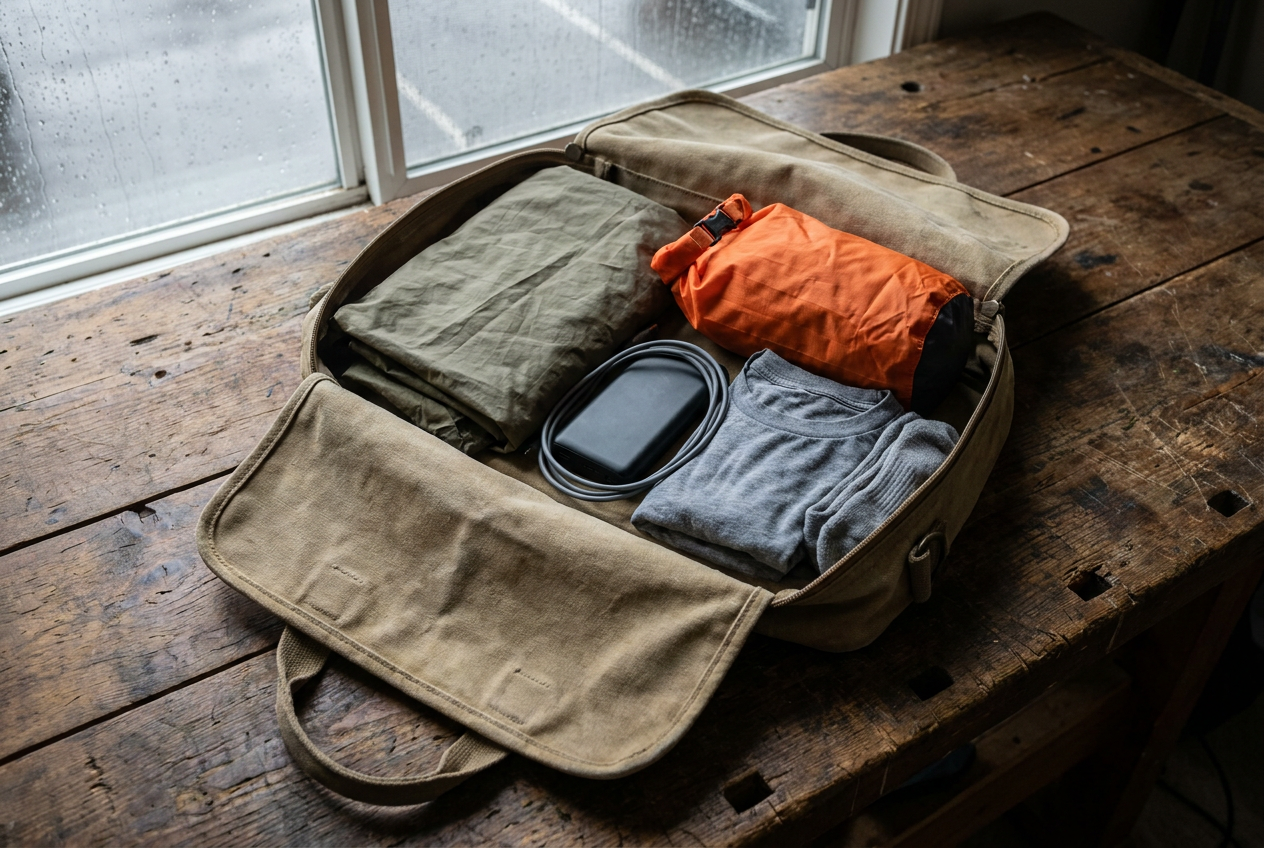
You are adding maybe half a kilo to a bag you already carry every day. Everything here should fit in a pouch about the size of a pencil case, or a gallon ziplock, tucked into whatever bag you already sling over your shoulder.
- A small dry bag (5–10L) or a heavy-duty ziplock for your phone, wallet, and any papers you cannot afford to have turn to pulp. A basic roll-top dry bag runs ₱150–₱350 on Lazada or Shopee; a pack of thick freezer ziplocks does the same job for under ₱100 if you are not fussy about brand.
- A change of clothes and dry socks — the “pamalit” habit. A cheap shirt, shorts or leggings, and one pair of dry socks rolled tight into a produce bag. This is not about looking fresh. It is about not spending six hours in soaked footwear, which is its own quiet misery and, as below, a real infection risk.
- Cash, in small bills — ₱20s, ₱50s, coins. When the power flickers or networks get overloaded during a storm, GCash and Maya can go down at the exact moment every jeepney and tricycle driver needs exact change and cannot break a ₱500 bill. Keep ₱300–₱500 in small denominations separate from your regular wallet, wrapped in its own ziplock.
- A power bank, 10,000mAh is plenty. This is a pocket top-up for getting through a long, delayed commute and staying reachable — it is not a house battery and it will not run your router. ₱500–₱900 buys a decent one from Anker, Baseus, or a reputable local brand; be wary of unbranded “20,000mAh” bricks on marketplace flash sales that weigh nothing and deliver less than half what they claim.
- A compact rain poncho, not an umbrella. Umbrellas are useless in the kind of sideways habagat wind that flips them inside out on EDSA. A poncho packs into a fist-sized pouch and costs ₱80–₱200.
- A small first-aid pouch — a few alcohol pads, a strip of assorted bandages, a small tube of antiseptic, and any personal medication you take daily. This is not a trauma kit. It is for the blister, the small cut, the headache that turns a bad commute into a miserable one.
None of this needs to be premium gear. It needs to be reliable and small enough that you will actually carry it every single day of wet season, not just the days you remember the forecast.
The method
Before you leave the house, check PAGASA for the day’s rainfall advisory, not just the general forecast. A “yellow” rainfall warning for your area means expect flooding in low-lying, flood-prone spots — worth knowing before you commit to a route.
Pack in this order, so the kit stays usable even if your whole bag gets soaked:
- Phone, wallet, ID, and any documents go into the dry bag or ziplock first, sealed properly — squeeze the air out, fold the top over twice.
- The change of clothes and socks go into their own separate bag, so a leak in one doesn’t ruin the other.
- Cash pouch goes somewhere on your body, not just in the bag — a zipped pocket or a cross-body bag you keep in front of you, not slung behind.
- Power bank and cable go in an outer, easy-to-reach pocket. You want to top up your phone without unpacking everything on a jeepney seat.
- Poncho stays at the very top or in an external pocket. If you have to dig for it, you will already be wet by the time you find it.
When the rain turns serious mid-commute, this is where the “patila” strategy earns its keep. Patila — waiting it out — beats rushing. If the water is rising and traffic has stopped moving, find a covered spot: a mall entrance, a covered walkway, a sari-sari store with an awning, a jeepney terminal with a roof. Buy a bottled water, sit down, and let the worst of the surge pass. Flood levels on Metro Manila roads often peak and then drop within one to two hours once the rain lets up. Gridlock does not reward urgency — the commuters who push into rising water usually end up wetter, later, and occasionally in real danger, while the ones who waited twenty minutes for the worst to pass walk out onto a road that has already started to drain.
Avoid wading. If you truly have no choice, keep footwear on rather than going barefoot — cuts and abrasions on bare feet in floodwater are exactly how infections get in. This matters more than people realize: floodwater carries leptospirosis risk, and it is a real, well-documented hazard in Philippine flood season, not a scare story. If you did wade, wash with soap and clean water as soon as you can and see a doctor within 24–48 hours, even without symptoms; don’t self-medicate. Our leptospirosis article has the background — worth five minutes before the rains start.
Variations & conditions
Day commute vs. night commute. A daytime flash flood is inconvenient but visible — you can see how deep the water is, where the current is moving, which streets are impassable. At night, the same flood is far harder to judge safely, and drivers and pedestrians alike are harder to see. If you are caught out after dark in a flooded area, lean more heavily toward patila. Waiting until first light or until the water visibly recedes is not overcautious; it is just sensible when you cannot see what you are stepping into.
Habagat vs. a named storm. Regular habagat rains bring localized, fast-rising floods that often drain within hours. A named typhoon under a PAGASA signal is a different animal — expect prolonged disruption, possible transport suspensions, and advisories to stay put rather than travel at all. On signal days, the better plan is often to leave work early or not travel, if your employer allows it, rather than lean on a commuter kit to get you through worsening conditions.
MRT/LRT vs. jeepney vs. tricycle. Rail transport suspensions during flooding are common and happen with little warning — this is exactly why cash for jeepneys and tricycles matters, since they can sometimes navigate around a flooded rail line when the trains cannot run at all.
Common mistakes
Relying entirely on GCash or Maya. Digital wallets are convenient until the exact moment everyone else in the barangay is also trying to use them during a network strain. Physical small bills are the boring, reliable backup.
Carrying an umbrella instead of a poncho. It feels like the sensible choice until the wind turns it into scrap metal on your walk to the terminal.
Skipping the dry socks because “it’s just a change of shirt anyway.” Wet feet for six to eight hours is one of the most common commuter complaints in wet season, and it is one of the easiest to prevent.
Powering through instead of patila-ing. The instinct to just push forward and get home is strong, especially when you are tired and it is late. But rushing into water you cannot judge the depth or current of is how minor stranding turns into a genuine emergency. Waiting is not weakness; it is the faster option more often than it feels like in the moment.
Packing once and forgetting it. A power bank left uncharged in your bag since June is not a power bank, it is dead weight. Check it monthly during wet season.
How to practise safely
You do not need a drill for this — you need a habit. Before the first heavy rains of the season, pack the kit and carry it for a week on your normal commute, even on dry days. Notice what you actually reach for and what just sits there unused; adjust the pouch accordingly. Test the power bank on an ordinary day so you know its real capacity, not the number on the box. And the next time a light habagat shower catches you on the way home, treat it as a low-stakes rehearsal for patila — find your covered spot, wait it out, and notice how much less stressful the walk home is twenty minutes later once the worst has passed. By the time a real flash flood catches you far from home, none of this will be new.
Galing Gear shares general preparedness and first aid information based on sources such as the DOH, WHO and the Philippine Red Cross. It is not a diagnosis or prescription, and it does not replace a doctor, nurse, pharmacist or trained responder. We never give medicine doses. Follow the latest advice of the DOH, your local health office and your medicine’s label. In an emergency, call 911. Philippine Red Cross: 143. Mental health crisis (NCMH): 1553 (landline). When unsure, get checked.