Emergency cash envelope: amount, storage, and when to use it
How much emergency cash to keep at home, in what bills, and how to store it safely for brownouts, typhoons, and network outages in the Philippines.
What you’ll be able to do — and why it matters
You’ll set up a simple cash envelope at home so that a brownout, a network outage, or a GCash server hiccup doesn’t leave your family unable to buy rice, water, or medicine.
Most of us barely touch physical cash anymore. Palit is Maya, groceries are GCash, load is auto-debit. That’s fine on a normal Tuesday. But typhoons don’t care about your normal Tuesday. When the grid goes down, so does the cell site backing it up — most run on batteries that last only a matter of hours before generator fuel becomes the priority for someone else. ATMs need power and a network connection to dispense anything. Payment terminals at the grocery need the same. And the one sari-sari store still open on your street, doing pabili by flashlight, isn’t running a GCash QR code that night — it’s making change out of a biscuit tin.
This isn’t about distrust of digital money. I use it every day, same as you. It’s about redundancy — having a second way to pay that doesn’t depend on electricity or a signal bar. In an actual emergency you don’t want to be the household discovering this gap for the first time while the PAGASA bulletin is telling you a signal has just gone up.
What you need
You don’t need a safe or a special gadget. You need three things:
- A dedicated amount of cash, kept apart from your everyday wallet money, sized to your household’s actual weekly essentials — not a guess, not “whatever’s left after payday.”
- A mix of small bills — ₱20s, ₱50s, and ₱100s, with a handful of coins. Large bills are close to useless in a real disaster because the sari-sari store or wet market vendor selling candles, canned goods, or drinking water often can’t break a ₱500 or ₱1,000 note even on a good day, let alone during a rush after a storm.
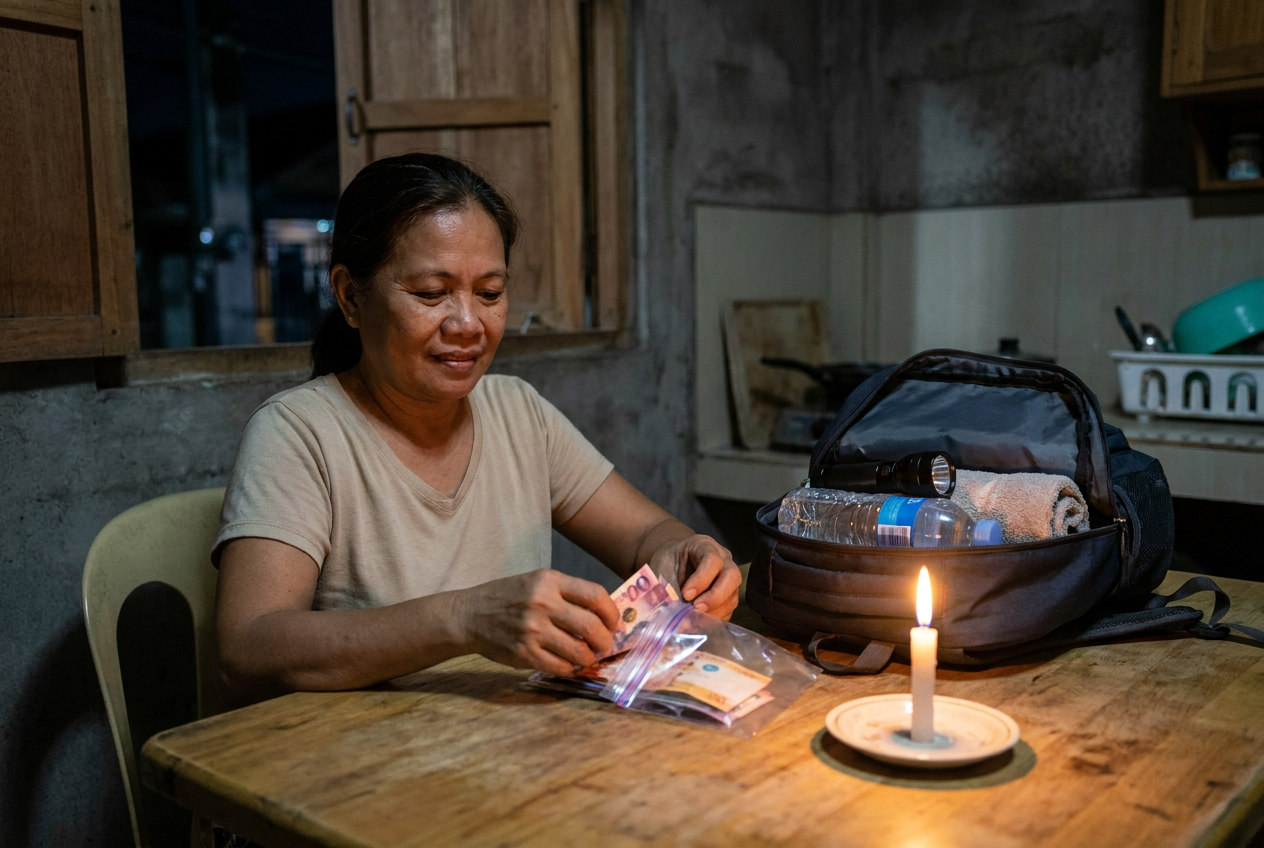
- A waterproof, low-profile pouch to keep it dry and out of sight. A simple zip-lock dry bag or a small waterproof document pouch works. This is the same category of storage you’d use for the physical copies in your go-bag alongside your IDs — see our digital document vault guide for the paperwork side of this; this article is about the cash side.
This cash envelope lives inside your go bag, or wherever your family keeps its grab-and-go kit for flood ready or typhoon season situations — not loose in a drawer, and not mixed in with your regular wallet.
The method
1. Work out one week of essential spending. Not your whole household budget — just the non-negotiables: drinking water, basic food, transport fare, phone load, and any regular medicine. Add it up as if the ATMs, payment apps, and your workplace payroll are all down at once. That number is your target. For most households this lands somewhere in the ₱3,000–₱8,000 range, but yours may be different — this is a household decision, not a rule I can hand you.
2. Break it into small bills. Convert as much of that amount as you reasonably can into ₱20s, ₱50s, and ₱100s. Keep a modest stack of coins too, for jeepney fare or exact change at a sari-sari store that’s watching its own coin supply carefully. Skip ₱500s and ₱1,000s for this envelope — save those for your regular wallet, not the emergency stash.
3. Store it in the waterproof pouch, inside the go-bag. Seal it. Don’t store it loose in a bag pocket where it can get wet, torn, or simply forgotten in the scramble to leave. If your go-bag lives on a high shelf or a top floor, remember that a high floor loses the elevator in a brownout just like everything else — you may be carrying that bag down several flights of stairs, so keep the pouch somewhere you can reach without digging.
4. Note the amount and date on a small slip inside the pouch. This sounds fussy, but it matters for step six — replenishment. A one-line note (“₱5,000, small bills, packed June 2024”) tells whoever opens the bag exactly what’s there without needing to count it under pressure.
5. Leave it alone. This is the hardest part. The money is not for a shortfall two weeks before payday, and it’s not for an impulse Shopee sale. It comes out only when you’re genuinely responding to an emergency — a storm bearing down, a brownout that’s stretched past a day, a flood cutting off your barangay. Treat opening that pouch the same way you’d treat pulling a fire alarm: a real trigger, not a convenience.
6. Replenish it the same week you spend it. As soon as things are back to normal — power’s on, ATMs are dispensing, stores are taking GCash again — top the envelope back up to its target amount before you do anything else with your first available cash. An emergency fund that quietly stays half-empty for six months because nobody got around to refilling it isn’t actually ready.
Variations & conditions
If you live in a flood-prone or low-lying area, consider doubling up your waterproof storage — a sealed pouch inside a sealed dry bag. Floodwater doesn’t respect a single layer of plastic, and cash that’s turned to pulp is cash you’ve lost.
If your household evacuates often (coastal, riverside, or landslide-prone barangays under regular PAGASA advisories), keep the cash pouch permanently packed in the go-bag rather than moving it in and out. The households that get caught out are usually the ones who “meant to put it back” after borrowing from it for something else.
If you’re in a high-rise or a building that loses its lift in a brownout, factor that into where the go-bag — and this cash — is stored. Ground floor or low floor storage of at least a portion of your kit is worth considering if climbing down ten flights with kids is part of your realistic evacuation picture.
By season: review and top up the envelope at the start of typhoon season each year, not after the first storm signal is already up. Cash you meant to set aside is not cash you have.
Common mistakes
- Only having big bills. A ₱1,000 note is dead weight if nobody nearby can change it. This is the single most common gap I see — households that have “emergency cash” that’s actually unusable at the point of sale.
- Storing it with your everyday wallet. It gets spent on ordinary things without anyone deciding to spend it. Separate storage is what makes the discipline possible.
- No waterproofing. A brownout is often a flood, too. Cash in a plain envelope in a backpack side pocket doesn’t survive being carried through ankle-deep water.
- Treating it as untouchable forever and never checking it. Damp, humidity, and silverfish are real in Philippine storage conditions. Open the pouch every few months just to confirm the bills are intact and still there — then reseal it.
- Forgetting to replenish. The envelope you emptied during the last storm and never refilled is an envelope that will fail you at the next one.
I’ll say plainly what this isn’t: it’s not a savings plan, it’s not an investment, and it’s not a substitute for having a bank account or emergency fund in the fuller financial sense. It’s a small, boring, physical buffer for the specific hours or days when digital money simply cannot move. Keep it that narrow and it’ll do its one job well.
How to practise safely
Once a year — typhoon season is a good trigger — do a five-minute drill with the whole household. Find the go-bag, find the pouch, open it, count it against the note inside, and put it back. This does two things: it confirms the cash and the pouch are still in good condition, and it makes sure more than one adult in the house actually knows where it is. In a real evacuation, you don’t want the only person who knows the pouch’s location to be the one who isn’t home.
If you replenish after using it, treat that replenishment itself as part of the drill — don’t just restore the number, restore the habit of checking the bag as a whole. A go-bag is only as reliable as the last time someone actually looked inside it.
No amount of cash on hand replaces leaving early when PAGASA or your local barangay tells you to. This envelope is for the practical hours around a disruption — it isn’t a reason to wait one out that you shouldn’t be waiting out at all.