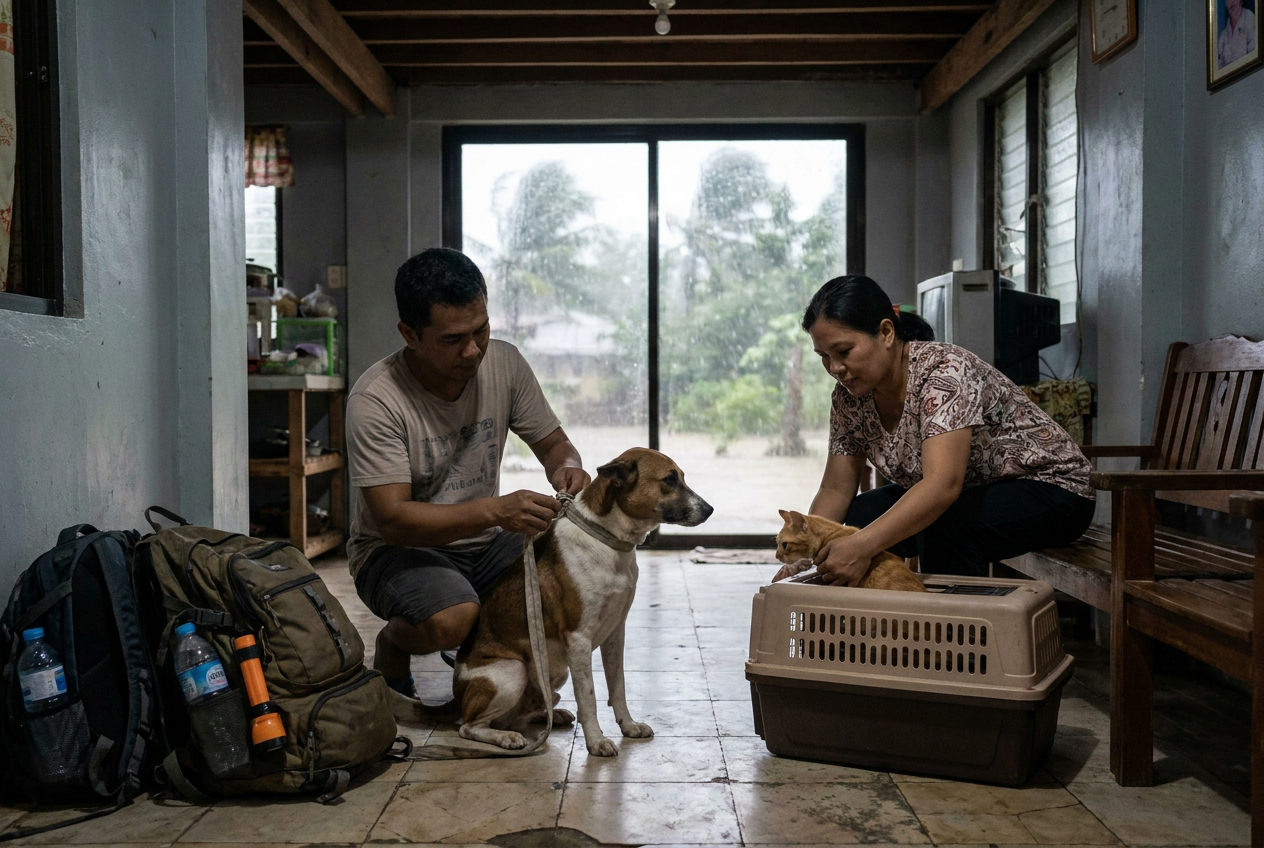
Evacuating with pets in the Philippines: what to prepare
Barangay evacuation order? Here's how to prepare your dog or cat: pet-friendly shelters, a pet go-bag checklist, and calming tips for the road.
What you’ll be able to do — and why it matters
When the barangay tanod comes through with the megaphone telling everyone to evacuate, you have minutes, not hours, to decide what happens to your dog or cat. This guide is about that exact moment — the forced-evacuation scenario, not the ride-out-the-storm-at-home scenario. If you’re looking for how to keep pets safe while you shelter in place, that’s covered in our Keeping dogs and cats safe through typhoon season article. This one is about what happens when staying home is no longer the safe option and you have to move your animal somewhere else, fast, possibly on foot or by tricycle, possibly to a place that does not want it there.
I’ll be honest about the ugly part first: most evacuation centers in the Philippines are public school gymnasiums and covered courts, and most of them do not allow animals inside. That’s not cruelty — it’s usually about health regulations, shared sleeping space, and the fact that a room full of frightened people and frightened animals is a hard thing to manage. Knowing this now, before the water is already rising, is what lets you plan around it instead of discovering it while standing in the rain with a soaked cat carrier and nowhere to go.
What you need
You don’t need much. What you need is decided ahead of time, not improvised at the door.
A carrier or crate, sized for the trip, not just the house. A soft-sided carrier works fine for a calm cat on a tricycle ride. A dog that panics will test a soft carrier’s zippers, so for bigger or anxious dogs a hard plastic crate or a sturdy leash-and-harness combo is more honest about what it can hold. Budget ₱500–₱1,500 for a decent carrier from Shopee or Lazada — but buy it now and get your pet used to it in the weeks before typhoon season, not on the night you need it.
A pet go-bag, separate from your family go-bag. If you already have a go bag for your household, treat the pet bag as its own small pack that lives next to it, ready to grab together.
A collar with an ID tag that has your current mobile number. Not the barangay landline, not an old number — the one you actually answer. This is the cheapest, most important item on this list, and it costs under ₱200.
Printed or photographed vaccination records, especially rabies. Some pet-friendly shelters or boarding arrangements will ask for this before they let an animal in, and a phone screenshot is faster to produce than digging through a drawer at home.
A leash, even for cats. A carrier can pop open. A leash on a harness is your backup.
The method
Step one: call your barangay DRRMO before the season starts, not during it. Ask directly — does the designated evacuation center accept pets, is there a separate holding area for animals, or is the policy no animals at all. Write the answer down. Barangays vary a lot on this, and some have quietly set up a covered area outside the gym specifically for pets because enough residents asked. You won’t know unless you ask, and asking in June is a completely different experience than asking while the floodwater is already at your gate.
Step two: pack the pet go-bag alongside your family bag. Food for at least three days in a sealed container or resealable bags, a collapsible bowl, a liter or two of water, any regular medications with dosage written on the label, a copy of vaccination records, a favorite small toy or blanket that smells like home, and waste bags or litter in a small container for a cat. This bag should weigh little enough that carrying it doesn’t slow down the person also carrying the animal.
Step three: decide the transport method before you’re doing it under pressure. On a jeepney or tricycle, a carrier is far easier for everyone — the driver, other passengers, and your pet — than an animal on a leash trying to bolt in a moving vehicle. Put the carrier on your lap or wedge it low and stable, not on a seat where it can slide. Cover it loosely with a thin cloth. Covering the sides (not the front, animals still need airflow) cuts down on visual stimulation and often calms a panicked animal faster than talking to it does.
Step four: keep your own voice low and steady. Animals read tone before they read words. In my search-and-rescue years we learned that a calm, even voice does more to settle a frightened creature — human or animal — than any amount of reassurance said in a rushed or high pitch. Speak to your dog or cat the way you’d want someone speaking to you in a crisis: slow, low, unhurried, even if you don’t feel that way inside.
Step five: if the shelter won’t take the pet, have a fallback already arranged. This means, ahead of time: a relative or friend on higher, safer ground who has agreed to take the pet; a boarding facility or vet clinic outside the flood zone that offers emergency boarding (call and confirm this in advance, and ask about their evacuation plan too); or a known, trusted neighbor who is not evacuating and can care for the animal temporarily. Arrange this before typhoon season, the same way you’d arrange where your family goes.
Variations & conditions
If you have a cat instead of a dog: cats hide when frightened, which is dangerous during an evacuation because you may not have time to find one that’s bolted under the bed. Get your cat into its carrier at the first sign of a storm watch from PAGASA, well before the barangay order comes, rather than waiting and chasing.
If you have more than one pet: don’t assume one trip covers everyone. Decide in advance who carries which animal, and don’t split a bonded pair between two different fallback locations if you can help it — the separation adds stress on top of an already stressful move.
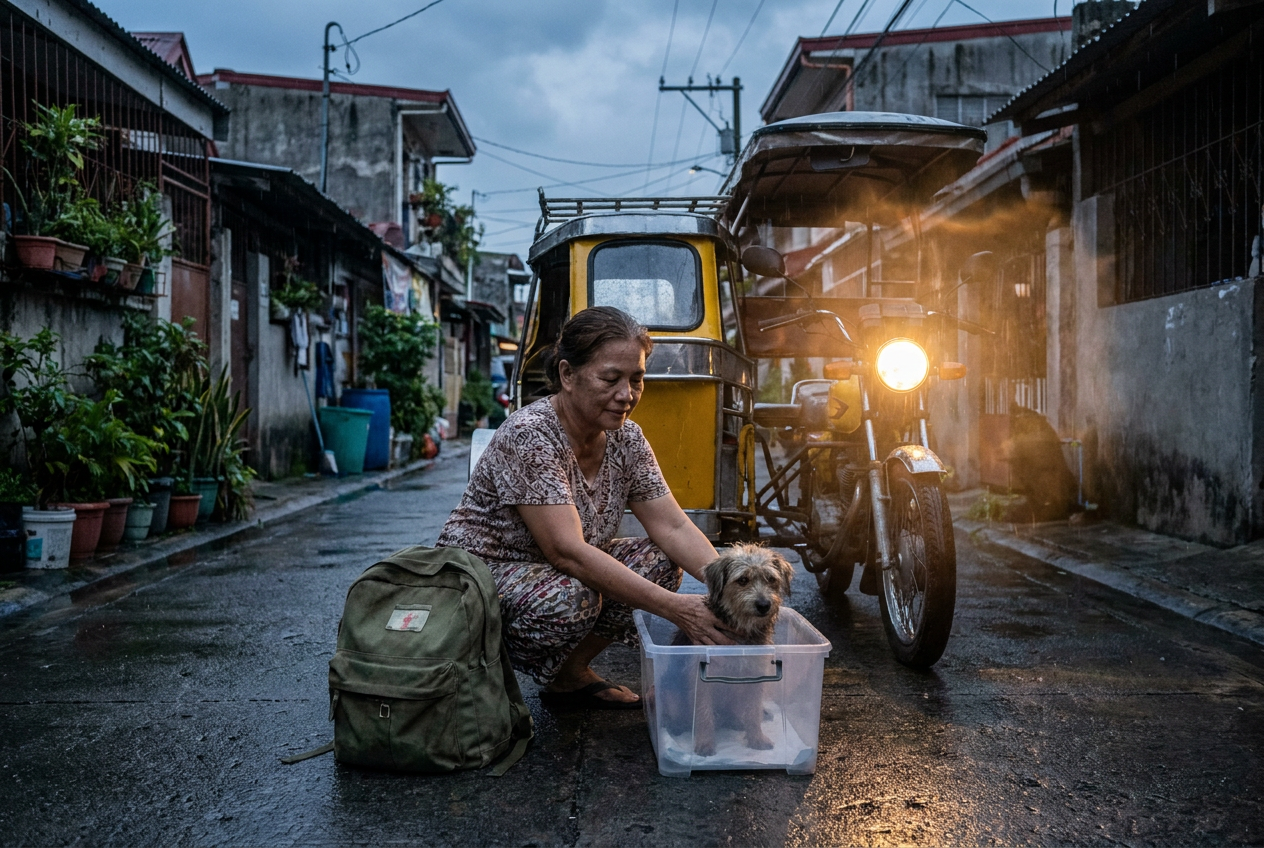
At night, in heavy rain: visibility is low, footing is bad, and a panicked animal is more likely to slip a collar or fight a leash. This is exactly when a secure carrier earns its keep over a leash alone.
If you’re on foot rather than in a vehicle: a backpack-style carrier or a crossbody sling for a small dog or cat frees up your hands for the rest of your go-bag and for your own safety on flooded or debris-covered ground.
Common mistakes
Assuming the evacuation center will “probably be fine” about pets. Most aren’t. Confirm it, don’t guess it.
Leaving a pet behind chained, caged, or tied up “just to be safe” while you evacuate. Please don’t do this. An animal that cannot free itself or move to higher ground in a flood will drown. If you cannot bring your pet with you, it needs to go to a fallback location with a person, not be left secured in place at home.
Packing the pet go-bag with only food, and forgetting the ID tag and vaccination records. Food keeps an animal fed. Records and ID are what get a lost or surrendered animal back to you.
Waiting for the barangay order to test the carrier. The first time your dog or cat is ever inside that crate should not be during a flood evacuation. A carrier that’s a familiar, comfortable space gets used calmly. A carrier that’s a strange box gets fought.
Not confirming the fallback plan with the actual person who’ll take the pet. “I’m sure my cousin won’t mind” is not a plan. Call your cousin now and ask.
How to practise safely
Do a dry run before the season gets serious — most families never do, and it shows the moment things get real. Put the pet in the carrier and walk it to the end of the street and back, the same route you’d take toward the evacuation center or your fallback location. Time how long it takes. Notice what makes your pet anxious in that ten-minute walk, because that’s exactly what will be worse in the rain, in the dark, with the whole household also trying to move at once.
Call your barangay DRRMO and your fallback boarding contact once a year, ideally at the start of typhoon season, just to confirm the arrangement still stands. Plans made a year ago quietly go stale — the clinic changes hands, the cousin moves house, the barangay’s pet policy changes with a new captain. A five-minute phone call each year is cheap insurance against finding out the plan fell apart on the night you needed it.
No bag, carrier, or plan removes the hard truth that sometimes the safest, fastest choice is to leave early, before the order comes and before the roads are underwater. That’s true for your family, and it’s true for the animal depending on you to make the call for it.