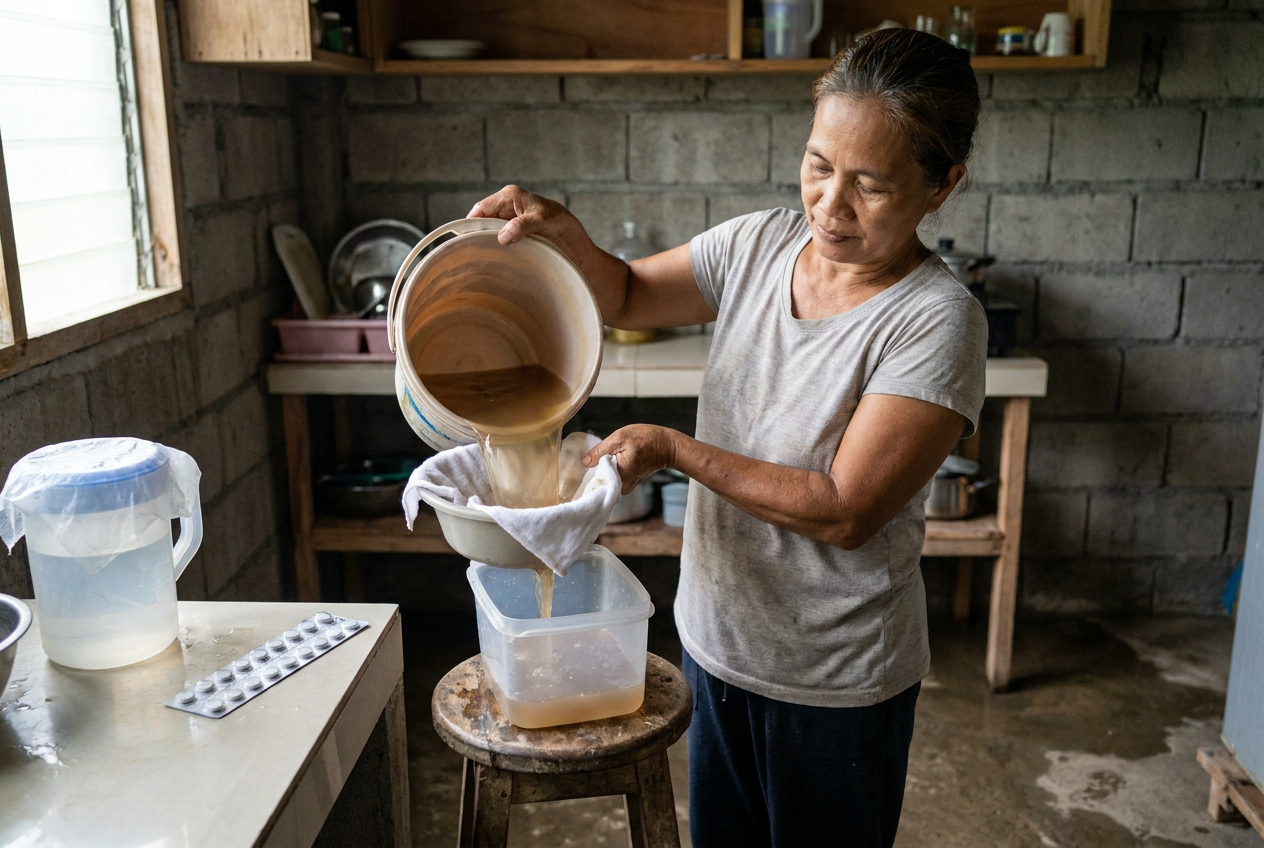
Chlorine tablets or filters: what your go-bag really needs
Chlorine tablets, iodine, straw, squeeze, or gravity filter? A plain guide to picking the right water purifier for your Philippine go-bag or home kit.

Overview
Every typhoon season I get some version of the same question from neighbors packing their go-bags: “Do I need one of those filter straws, or are the tablets enough?” The honest answer is that they solve different problems, and most households end up needing a little of both. This is not the article about how to treat floodwater step by step — we cover that ground in floodwater to drinking water: pre-filter, treat, store. This one is about the products themselves: what the tablets and filters on Lazada and Shopee actually protect you from, what they quietly don’t, and which one deserves a spot in your bag.
I’ve sorted through the categories that matter for a Filipino household: chlorine tablets, iodine tablets, straw-style filters, squeeze filters, and gravity filters. None of them is “the best” in isolation. Each is fit for a different scenario — a three-day evacuation is not the same problem as two weeks sheltering in place with the tap running brown.
Why it matters in Philippine conditions
Boiling water for 2 minutes and letting it cool with the lid on, as the Department of Health advises, is still the gold standard, and if you have a working stove and fuel, use it. But boiling assumes you have a heat source, a pot, and time — none of which is guaranteed during a brownout, a flooded kitchen, or a rushed evacuation to a covered court. Once floodwater gets into the water system, or your barangay’s supply gets cut, you’re choosing between thirst and drinking something questionable. PAGASA advisories can give you hours or a day or two of lead time before a named storm makes landfall — that’s your window to check your kit, not to start building it.
Chemical treatment and filters are the backup for when boiling isn’t practical: a go-bag grabbed on the way out the door, a shelter-in-place stretch with no gas, or a relative’s house on a high floor where the elevator (and sometimes the water pressure) is out. Having the right product, already in the bag, already understood, is what makes that backup real instead of theoretical. When you suspect a supply may carry viral contamination — a piped system that’s been compromised after a major flood, for example — the Department of Health and Red Cross guidance is to boil water for 2 minutes and let it cool with the lid on. If you can’t boil, our advice is to use a filter and a chemical tablet together rather than relying on either one alone, since between them they cover more of the pathogen range than either does by itself.
Key specs: what you get
Chlorine tablets (e.g., Aquatabs and similar sodium dichloroisocyanurate tablets). These are small, foil-wrapped tablets you drop into water and wait before drinking. The safety-critical number here isn’t just time — it’s dosage. Every product is labeled with a specific number of tablets (or mg of active chlorine) per liter, calibrated to the concentration printed on the strip, and that dosage is what actually determines whether the water is safe, not the clock alone. Always follow the manufacturer’s printed dosage per liter rather than guessing. Follow the waiting time printed on your tablet’s label too; if the water is cold or cloudy, the label tells you what to do. They kill bacteria and viruses effectively at the correct dose and contact time. They do less against protozoan cysts like Cryptosporidium, which are more chlorine-resistant, and they do nothing about sediment, silt, or heavy metals — you still need to pre-filter cloudy floodwater through a cloth or coffee filter first. Aquatabs specifically are the easiest to find in the Philippines: Mercury Drug, The Generics Pharmacy, and Generika all carry them as a reference point, usually in strips of ten. Shelf life is long — several years unopened, stored somewhere cool and dry — which makes them a “buy once, forget about it, replace before expiry” item.
Iodine tablets. Similar mechanism, similar kill profile against bacteria and viruses, weaker against protozoa. Follow the waiting time on the manufacturer’s label. The real difference is the aftertaste (stronger than chlorine) and the health caveats: iodine tablets are not recommended for pregnant women, people with thyroid conditions, anyone with a known iodine allergy, or for continuous long-term use. I mention them mainly because they’re still sold locally and some older kits default to them; for most families, chlorine tablets are the better everyday choice and iodine is the fallback if that’s what’s on the shelf.
Straw-style filters. A hollow-fiber membrane you suck water through directly from the source. Most are rated around 0.1 to 0.2 microns, fine enough to physically screen out bacteria and protozoa and most sediment. That pore size, though, is generally too large to reliably catch most viruses, which are smaller still — so treat “removes bacteria and protozoa” as the honest claim for a standard straw filter, and check the product’s own rating carefully before assuming it also handles viruses (a few premium models add a virus-rated stage, but that’s the exception, not the rule, and usually costs more). They also don’t chemically treat anything, so a straw filter and a chlorine tablet cover each other’s blind spots rather than duplicating them. No batteries, nothing to charge — that matters more than it sounds. In an outage, anything that depends on a battery or a power bank is one more thing that can quietly fail you when you need it most; a straw either works or it’s blocked, and you can tell which immediately.
Squeeze filters. Same hollow-fiber technology as the straw, same general pore size range, but the water passes through a pouch or bottle into a bag or clean container instead of straight into your mouth — meaning you can filter a batch for the whole family, or into a pot before boiling. Filtration performance against bacteria and protozoa is similar to straw filters; virus removal is still generally outside their range unless the product specifically states a virus rating (rare and pricier). Note that squeeze filter models are often rated for total lifetime liters filtered rather than volume-per-session — a squeeze filter processes a batch faster per sitting than sipping through a straw, even if its total rated lifespan on the spec sheet looks similar to or lower than some straw models. Check the specific manufacturer rating rather than assuming bigger price means bigger lifetime-liter number.
Gravity filters. A larger bag or rigid reservoir you fill with untreated water, hang up, and let drain through a filter element into a clean container below — no squeezing, no sucking, and it can process several liters unattended while you do something else. Pathogen removal (bacteria, protozoa, most sediment; generally not most viruses without a specific rating) mirrors the straw and squeeze categories, since most use the same hollow-fiber membrane technology at a larger scale. This is the category built for a household sheltering in place for days, not an individual grabbing a straw on the way out.
How it performs
For a short evacuation — grab the bag, go to the barangay evacuation center or a relative’s house for a night or two — the straw filter and a strip of chlorine tablets together cover almost every realistic scenario: cloudy water from a questionable tap, a shared container of unknown origin, or floodwater you have no choice but to draw from. The tablets are the redundancy; if the filter gets dropped, cracked, or clogged with silt, you still have a chemical option, and vice versa.
For extended shelter-in-place — days without reliable piped water, several people to keep hydrated — a gravity filter earns its bulk. It’s heavier and takes up more room than a straw, which is exactly why it doesn’t belong in every go-bag, but for a household kit that stays in the house, it processes far more water per hour with less physical effort, which matters on day four of a brownout when everyone is tired.
Sediment is the piece people forget regardless of which product they buy. Filters clog faster and tablets work less reliably in cloudy, silty water — floodwater almost always is. Pre-filtering through a clean cloth, t-shirt, or coffee filter before treating with tablets, or before running it through any filter, extends the life of the filter and improves how well the chemical treatment actually works. That prep step is covered in more detail in our floodwater to drinking water piece, and it’s worth reading once, not just skimming.
Pros and cons
Across all five, the trade-off comes down to speed versus certainty. Tablets are cheap, tiny, and long-lasting, but they make you wait and they don’t touch protozoa well. Filters are instant and physical — no waiting, no aftertaste — but none of the hollow-fiber options here reliably removes viruses on their own. Straw filters are the lightest option but only serve one drinker at a time; squeeze filters trade a bit of weight and price for the ability to fill a container for the whole family; gravity filters trade portability entirely for hands-free volume. No single product on this list is a complete solution by itself — that’s really the point of this whole comparison. The combination that closes the gaps is chlorine tablets plus a filter, chosen by scenario: straw or squeeze for a go-bag, gravity for the home kit.
Who it’s for
Every household preparing a go bag or a flood-ready kit should have chlorine tablets in it — they’re cheap, light, and last for years untouched. Families expecting to draw water from questionable sources during a flood, or anyone whose barangay has a history of water service interruptions during typhoon season, should add a straw or squeeze filter as the physical backup. A household that has weathered extended outages before — the kind where the water restoration takes longer than the power does — is the one that benefits most from stepping up to a gravity filter as part of a broader clean-water plan.
Who it’s not for
If your area rarely floods and your water service is reliable, a full stack of all four categories is overkill — a strip of chlorine tablets and a basic straw filter is a reasonable, inexpensive floor, not a reason to buy everything reviewed here. Iodine tablets are not for pregnant women, people with thyroid conditions, people with a known iodine allergy, or anyone planning to rely on them for more than short-term use — check the packaging, and default to chlorine tablets if you have the choice. And nobody should treat any filter or tablet here as complete protection against viruses on its own; if you suspect viral contamination — a compromised piped supply after a major flood, for instance — boil (2 minutes, then let it cool with the lid on) if you’re able to, and if you’re not, pair a filter with chemical treatment rather than using either alone.
The verdict
There’s no single winner here because the categories aren’t competing for the same job. My actual recommendation for most Filipino households is a small stack: chlorine tablets as the cheap, long-shelf-life backbone of every go-bag, a straw or squeeze filter as the physical companion that handles what tablets don’t, and a gravity filter reserved for the home kit if you have the space and the history of extended outages to justify it. Skip iodine unless it’s genuinely what’s available. None of this replaces boiling when boiling is possible — it exists for the hours and days when it isn’t.
Where to buy
Aquatabs and similar chlorine tablet strips are stocked at Mercury Drug, The Generics Pharmacy, and Generika, and are also listed on Lazada and Shopee from various sellers — buy from official or well-reviewed store pages, since counterfeit and expired stock does circulate on marketplace listings. Straw filters, squeeze filters, and gravity filters are mostly imported items in the Philippine market rather than pharmacy-shelf goods — brands like Sawyer and LifeStraw are the names you’ll most commonly see turn up in local hobbyist and outdoor-gear groups and on Lazada/Shopee, and they’re a reasonable reference point for checking whether a listing’s claimed specs are plausible. Check current listings before ordering, as filter model availability shifts with supply.
Galing Gear shares general preparedness and first aid information based on sources such as the DOH, WHO and the Philippine Red Cross. It is not a diagnosis or prescription, and it does not replace a doctor, nurse, pharmacist or trained responder. We never give medicine doses. Follow the latest advice of the DOH, your local health office and your medicine’s label. In an emergency, call 911. Philippine Red Cross: 143. Mental health crisis (NCMH): 1553 (landline). When unsure, get checked.