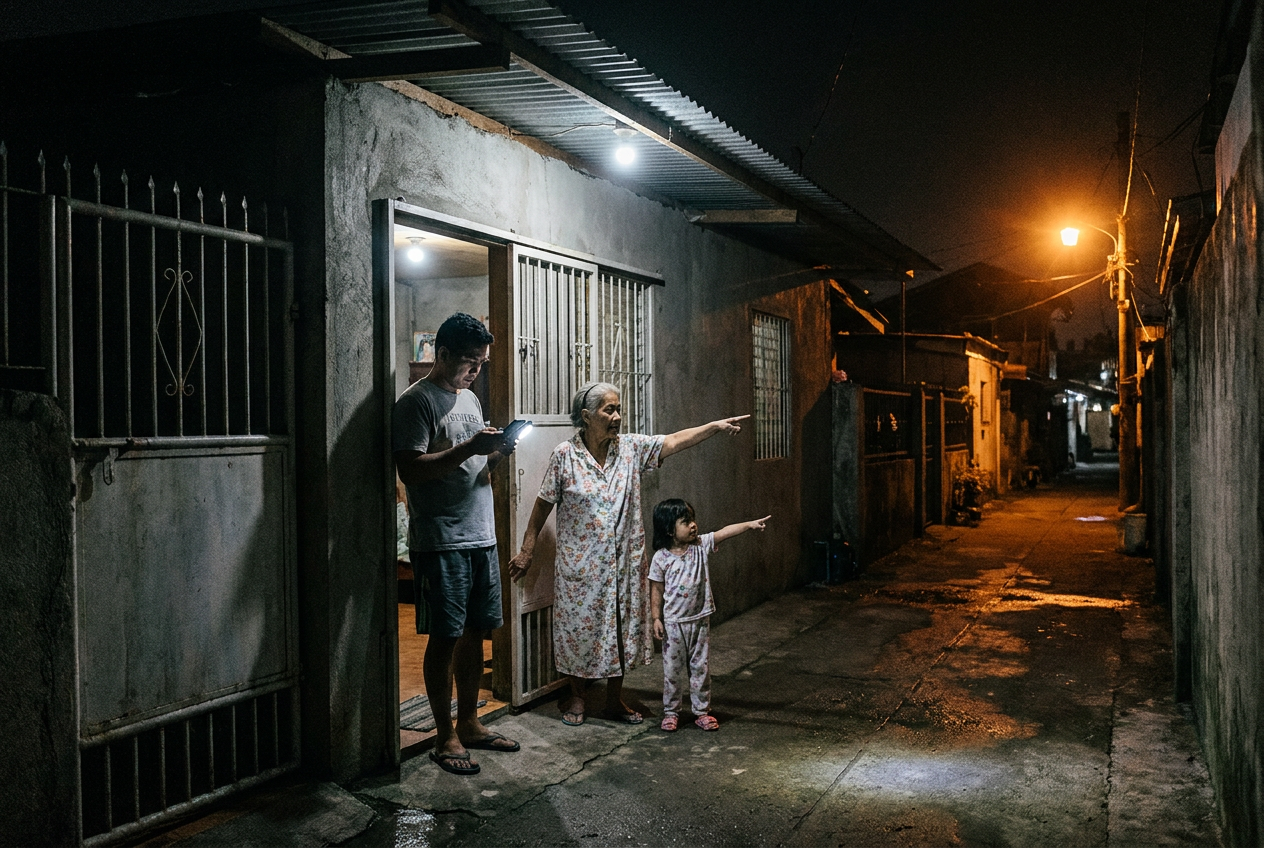
How to choose a fire extinguisher for your PH home
How to choose the right fire extinguisher for your Philippine home: ABC dry chemical type, correct kg size, mounting spot, and BFP rules explained.
What you’ll be able to do — and why it matters
By the end of this, you will know exactly which fire extinguisher to buy, what size makes sense for your kitchen or your living room, where to mount it, and how long it is actually good for before it becomes dead weight under the sink. That is the whole job of this guide. It will not teach you how to build a full home fire safety plan — we already have our fire safety article for that, and it covers the two-exit rule, smoke alarms, and running a drill with your family. This one goes narrow and deep on a single decision a lot of households keep putting off: buying the extinguisher itself.
Here is why it is worth doing properly instead of grabbing whatever is cheapest at the checkout counter. Most home fires start small — a pan that flares up, a wire that overheats behind the fridge, a small gas leak that catches. In that first thirty seconds, the right extinguisher, reachable and understood, is the difference between a scorched pot and a call to the Bureau of Fire Protection. The wrong one, or the right one buried in a closet, does nothing.
What you need
An ABC-rated dry chemical extinguisher. For a Philippine home, this is the only type worth considering, and I say that plainly because the hardware store will offer you a few options and the labels can be confusing. “ABC” means it is rated for three fire classes:
- Class A — ordinary combustibles: paper, wood, fabric, curtains, the trash bin that catches from a cigarette.
- Class B — flammable liquids and gas, including LPG. This matters a lot here, since most Filipino kitchens run on a gas tank.
- Class C — electrical fires: a wiring fault, an overloaded extension cord, an appliance that shorts out.
A single ABC unit covers all three, which is exactly why it is the standard household choice. You do not need a separate CO2 extinguisher (common in server rooms and labs) or a foam type (more of a commercial/industrial tool) — those are out of scope for a home, and buying one just adds confusion about which extinguisher to grab in a panic.
Sizes: 1kg, 2kg, 4.5kg. The number is the weight of the dry chemical powder inside, not the size of fire it can handle in some fixed way — but in practice, weight does translate to spray duration and reach, so bigger is more forgiving. Here is how I’d think about it for a household:
- 1kg — small, light, easy for anyone in the house to lift and aim, including an older parent or a teenager. Good as a second unit for a bedroom or a home office, but on its own it is thin insurance for a kitchen fire — it empties in a few seconds.
- 2kg — the practical sweet spot for most kitchens. Enough powder to fully knock down a stovetop or wastebasket fire, still light enough to grab and use one-handed under stress.
- 4.5kg — better for a garage, a sari-sari store, or a household that specifically wants more margin — more spray time, more reach. The tradeoff is weight: a 4.5kg unit is awkward for someone small or elderly to lift and aim quickly, so it is only the right choice if whoever is most likely to grab it can actually handle it.
For a typical condo unit or small house, I would put a 2kg ABC in the kitchen and consider a 1kg for upstairs if the home has more than one floor.
The method
Step 1 — Buy the right size for the right room. Kitchen: 2kg ABC. Living area or bedroom, if you want a second unit: 1kg ABC. Garage or storeroom: 4.5kg if someone capable of handling it is usually home.
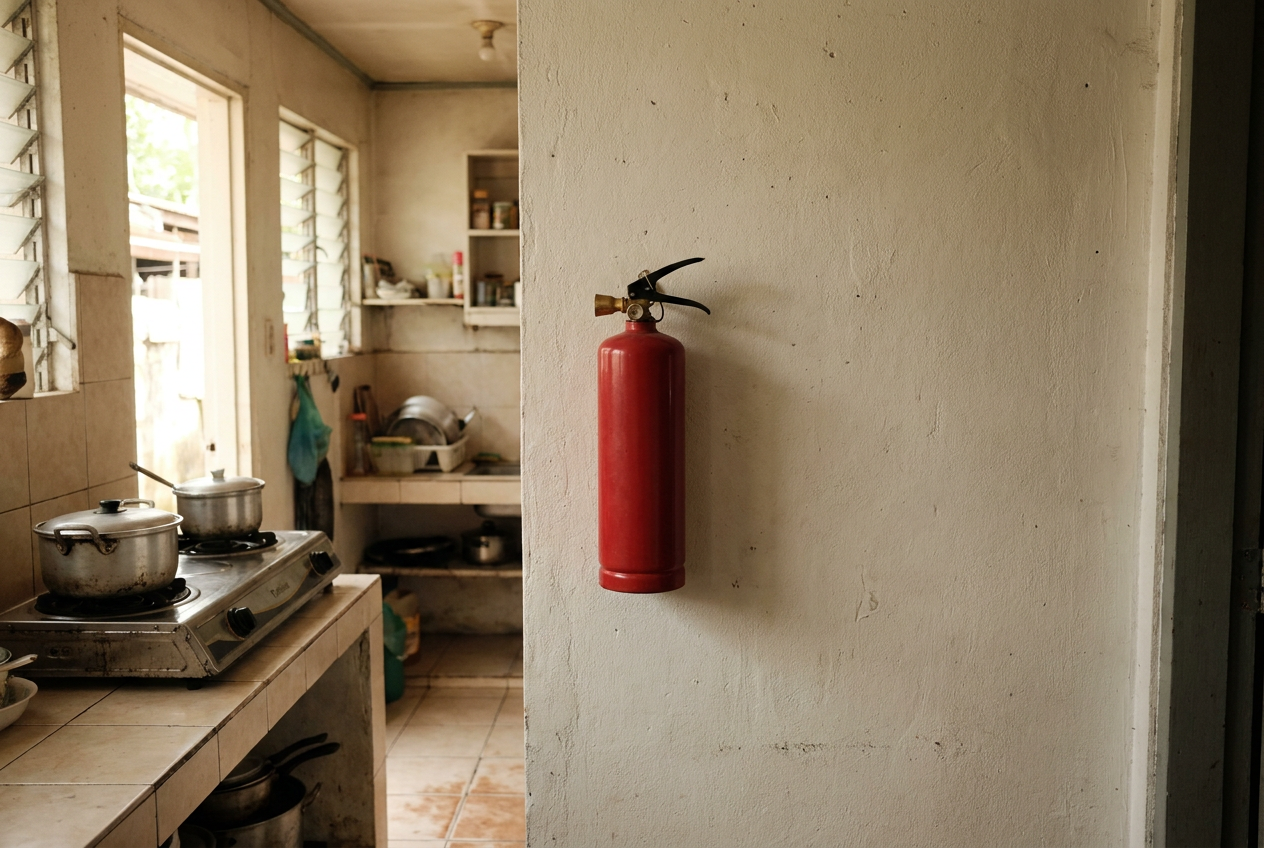
Step 2 — Place it correctly. This is the part people get backwards. The extinguisher goes near the exit path, not next to the stove. If a grease fire flares up right where the extinguisher is mounted, you cannot reach it. Mount it on a wall between the kitchen and the door, at a height anyone in the household can reach without a step stool — roughly chest height for the average adult. For a multi-storey home, one unit per floor is the standard, placed near each floor’s main exit or stairwell landing, not tucked into a bedroom closet where nobody will remember it under stress.
Step 3 — Learn P.A.S.S. before you need it. This is the whole technique, and it is genuinely simple:
- Pull the safety pin at the top of the handle.
- Aim the nozzle at the base of the fire, not at the flames themselves — you are trying to smother the fuel, not the fire’s tip.
- Squeeze the handle firmly and evenly.
- Sweep side to side across the base of the fire until it is out.
Stand a comfortable distance back — a couple of meters is fine for a small extinguisher — and keep an exit behind you, never in front of you or to the side where the fire could cut you off.
Step 4 — Check the pressure gauge every six months. Every ABC extinguisher has a small gauge near the handle with a colored zone, usually green for “charged and ready,” red or yellow for “needs attention.” Glance at it twice a year — tie it to something you already do, like when you flip your mattress or check your emergency go-bag. If the needle has drifted out of the green zone, the unit needs a recharge or replacement.
Step 5 — Know the BFP inspection requirement. The Bureau of Fire Protection requires fire extinguishers in buildings and establishments to be inspected and tagged annually as part of the Fire Safety Inspection Certificate process. Most single-family homes are not routinely inspected the way a business is, but if you live in a condo, apartment building, or run a small shop out of your home, this is worth knowing — your building administration or barangay may ask for proof of a current, tagged extinguisher. Even for a private home with no formal inspection requirement, treating “annual check” as your own household rule is a reasonable habit to borrow from the BFP standard.
Variations & conditions
Renters vs. owners. If you are renting, a 1kg or 2kg unit is portable enough to bring with you when you move — it is a piece of gear, not a fixture. Do not assume your landlord has one that actually works; check the gauge yourself on move-in day.
Homes with an LPG tank. Because Class B coverage includes gas fires, an ABC extinguisher is appropriate near an LPG setup — but the extinguisher is a backup, not your first line of defense. Check your LPG hose regularly for cracking or brittleness, make sure the regulator is seated properly, and replace the hose on the schedule your supplier recommends rather than waiting for it to fail. An extinguisher is what you use if something already went wrong; a good hose is what keeps something from going wrong in the first place.
Small unit vs. no unit. Even a 1kg extinguisher is far better than nothing, especially in a small studio or dorm-type space where a 2kg unit feels bulky. The point is to have something rated ABC, mounted where you can reach it in the dark, not to hold out for the “ideal” size and end up with nothing.
Common mistakes — and how to avoid them
Mounting it next to the stove. This is the single most common mistake I see. If the stove is what catches fire, the extinguisher needs to be reachable from a different angle — near the kitchen exit, not directly above or beside the burner.
Buying based on price alone. A no-name extinguisher from an unfamiliar Shopee seller at half the going rate is not automatically a bad buy, but it is worth a careful look at reviews and seller ratings before you trust your life to it. Counterfeit or underfilled units do exist in the market — a unit that feels too light for its stated weight, or has a gauge that never seems to move, is a warning sign.
Forgetting it exists. An extinguisher bought once and never checked again is a gamble. Six months is long enough for a seal to weaken or a gauge to drift without anyone noticing — build the habit of checking it.
Trying to fight a fire that is already too big. This is the most important thing in this whole guide, so I will say it plainly: an extinguisher is for small, contained fires only — something about the size of a wastepaper basket or a pan on the stove, caught early. If the fire is already climbing a curtain, spreading across a room, or filling the space with heavy smoke, the extinguisher is not going to save the situation. Get everyone out, close the door behind you if you can, and call for help. No extinguisher replaces leaving early. That full escape-plan thinking — two exits, a smoke alarm, a practiced drill — is exactly what our fire safety article covers, and it is worth reading alongside this one.
How to practise safely
Buying the extinguisher and mounting it on the wall is only half the job — the other half is making sure everyone old enough to use it actually knows how, before there is smoke in the room.
If your extinguisher came with a practice option (some hardware stores or barangay fire brigades run demo days), take it. If not, at minimum walk every adult and older child in the house through the physical motion: point to the pin, mime pulling it, mime aiming low, mime the sweeping motion. It takes two minutes and it means nobody is reading a label for the first time while a pan is on fire.
Once a year, when you check the gauge, also do a quick verbal walk-through with the household: where is the extinguisher, where is the nearest exit from each room, and at what point does everyone agree to stop trying and just leave. Deciding that threshold calmly, in advance, is what keeps a small kitchen accident from becoming a bigger story.
What this costs
Prices move around, but as a rough guide: a 1kg ABC dry chemical extinguisher typically runs somewhere around ₱800 to ₱1,200 at local hardware stores or on Shopee. A 2kg unit, the practical kitchen size, is usually in the ₱1,200 to ₱2,000 range. A 4.5kg unit, and branded options from a store like Ace Hardware with a recognized nameplate and a clearer warranty, can run ₱2,000 to ₱3,500. Refilling or recharging an existing unit at a certified refiller is generally cheaper than buying new, and is worth doing once the gauge shows it is due — as long as the cylinder itself is not dented, rusted, or past its stamped service life, in which case replacement is the safer call.