Holiday fire safety: cooking, lights, and LPG tips
Avoid holiday house fires: safe noche buena cooking, DTI-marked Christmas lights, and LPG handling tips every Pinoy household needs this December.
What you’ll be able to do — and why it matters
By the end of this, you will know how to get through the whole December run — noche buena, media noche, the office Christmas party you’re hosting at home, the string of visitors between Christmas and New Year — without your house being one of the ones the Bureau of Fire Protection counts in its holiday fire statistics.
I want to be upfront about what this article is not. It is not a repeat of our home fire safety plan or our guide on how to choose a fire extinguisher. If you have not read those yet, go read them first — this piece assumes you already have a working smoke alarm and a fire extinguisher you know how to use. What we’re covering here is narrower and more seasonal: the specific things that spike in December and only in December. The BFP runs an annual holiday fire safety alert every year for a reason — their own data, year after year, shows residential fires climbing through December and peaking around Christmas Day and New Year’s Eve. It is almost always the same three things: unattended cooking, faulty electrical connections from holiday lights and decorations, and LPG mishandling during long cooking sessions. None of these are exotic risks. They are ordinary risks that happen more often in December because we are cooking more, plugging in more, and celebrating more, often while tired and distracted.
Knowing this pattern in advance is most of the battle. A fire that starts because the lechon was left on the stove while everyone stepped out to greet a visitor is not bad luck — it is a completely predictable, completely preventable event. Let’s go through it properly.
What you need
You don’t need to buy anything new for most of this — it’s about how you use what you already have. A few things are worth having on hand specifically for the season:
- A working smoke alarm and a checked fire extinguisher. Covered in depth in our home fire safety plan and fire extinguisher guide — if you don’t have these sorted yet, that’s step zero, not this article.
- A single-gang or heavy-duty extension cord rated for the load, rather than several small ones daisy-chained together. More on why below.
- A working flashlight or headlamp near the kitchen, in case a breaker trips mid-cook and you need to see what you’re doing without fumbling for a phone.
- The LPG tank’s hose and regulator in good condition, checked before the season starts, not after you smell gas at 11 p.m. on the 24th.
None of this is about “holiday gear.” It’s about making sure the ordinary things in your kitchen and living room are ready for a month when they’ll be worked harder than usual.
The method
Understand why December is different
Fires don’t spike in December because Filipinos suddenly become careless. They spike because December compresses more cooking, more visitors, more decorations, and more distraction into the same number of hours. A stove that’s normally on for twenty minutes at dinner is now on for three or four hours for a noche buena spread. A living room that normally has one or two things plugged in now has a string of lights, a Christmas tree with blinking bulbs, a karaoke machine, and a phone charger all sharing one overworked outlet. The BFP’s annual holiday campaign exists because this pattern repeats every single year — the biggest jump in residential fire calls typically starts in the week before Christmas and holds through New Year. Treat that not as a scare statistic but as a planning fact: December is the month your fire risk is structurally higher, so your habits need to be structurally tighter to match.
Never leave the stove — especially during long holiday cooking
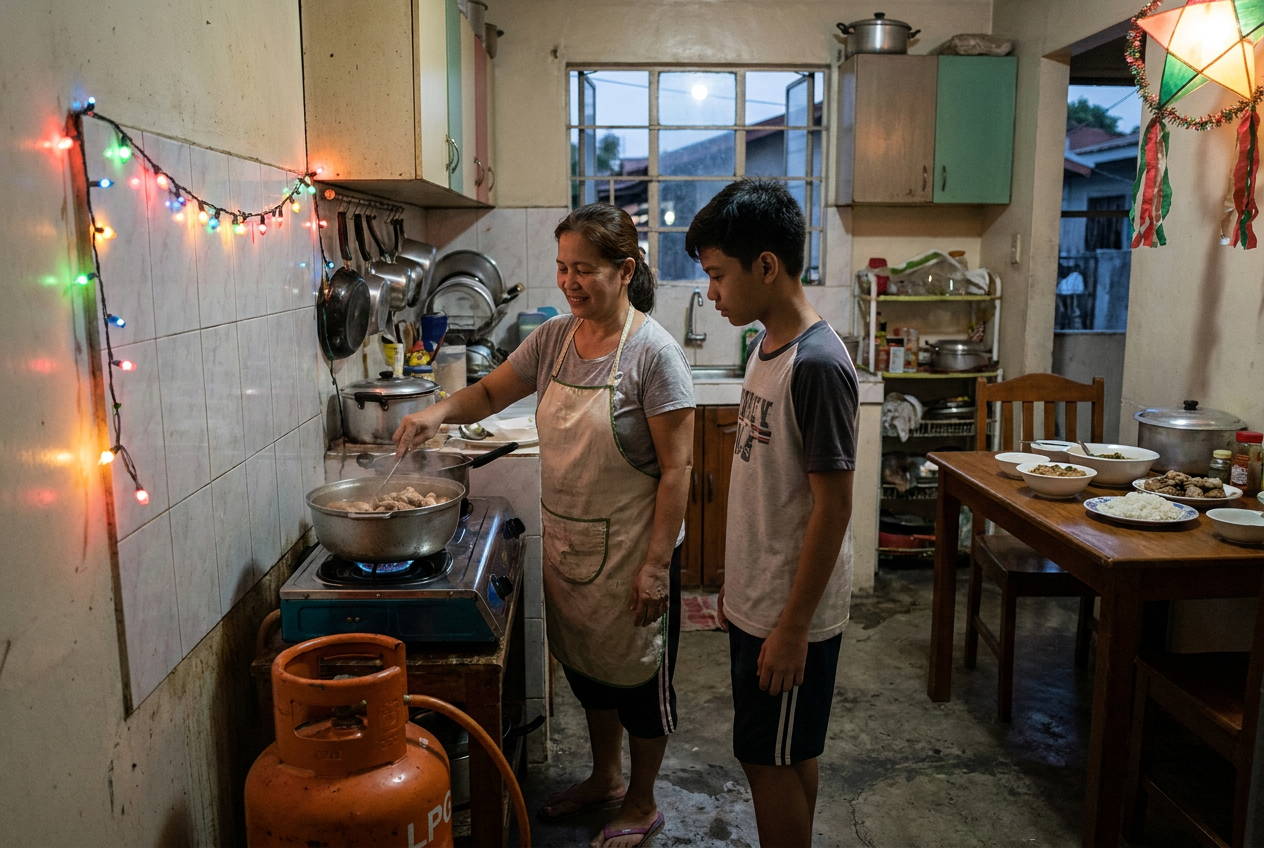
This is the single rule that matters most, and it is the one that gets broken most easily during the holidays, because holiday cooking is social. Someone arrives, you step out to greet them. The rice is done, you go wrap gifts “for five minutes.” The lechon needs another hour of roasting so you figure it’s safe to lie down.
It isn’t. Unattended cooking is consistently the leading cause of home fires, and noche buena and media noche are exactly the kind of long, multi-dish, multi-distraction cooking sessions where it happens. If you are frying, roasting, or simmering something that needs more than a few minutes of cook time:
- Assign a person, not an intention. “I’ll keep an eye on it” evaporates the moment guests arrive. Instead, literally hand the job to one family member — “you’re on stove duty until the lechon’s done” — and rotate if needed.
- If you must step away, turn it off first. A pot of rice keeping warm on low is fine to leave for a minute; an open flame under oil is not, ever, even for a phone call.
- Keep the stove area clear of decorations. Paper decor, cloth runners, and dangling curtains near the cooking area are a December-specific hazard — they weren’t there in October.
- Watch the oil. Deep-frying lumpia or chicken for a crowd means more oil, heated longer, often refilled mid-session. Overheated oil that catches fire cannot be put out with water — if this happens, smother it with a lid or use your extinguisher’s proper technique from our extinguisher guide, never douse it.
Check every string of Christmas lights before you plug it in
Every year, cheap decorative lights bought in bulk from stalls and online marketplaces cause house fires because of substandard wiring, undersized wire gauge, or connectors that overheat under load. Before you string anything up, check two things printed on the packaging or molded into the plug itself:
- The DTI PS mark (Philippine Standard mark) — this means the product has been tested against Philippine safety standards for that category of goods.
- The ICC mark (Import Commodity Clearance) — this applies to imported electronic and electrical products and confirms it has cleared the Department of Trade and Industry’s import safety checks.
If a set of lights has neither mark, it hasn’t been verified as safe, no matter how cheerful it looks in the listing photo. This matters more on Lazada and Shopee than in a physical store, because it is much easier for an unverified seller to skip the marks entirely on an online listing. If you’re buying decorative lights online this year, zoom in on the product photos for these marks before you order, and be skeptical of listings with no clear photo of the plug or packaging at all.
Beyond the marks, a few physical checks matter every year regardless of where you bought them:
- Uncoil last year’s lights fully and inspect the entire length for cracked insulation, exposed wire, or a plug that feels loose or warm.
- Never leave lights plugged in and unattended overnight or while you’re out of the house. A timer plug is a cheap way to enforce this automatically.
- Don’t link more than the manufacturer’s stated maximum number of sets end to end — check the packaging, not your memory of what “seems fine.”
Stop “octopussing” your extension cords
“Octopussing” — plugging multiple extension cords and adapters into each other and into a single outlet until it looks like a tangle of tentacles — is one of the most common causes of electrical fires during the holidays, and it is almost always driven by exactly the kind of setup December creates: tree lights, karaoke machine, extra fridge or freezer for holiday food, phone chargers for visiting relatives, all converging on one wall outlet that was never designed for that load.
The fix is not complicated, but it does mean spending a little before the season, not during it:
- One heavy-duty cord for heavy loads, not several light ones stacked together. A single-gang extension made for a rice cooker or induction stove is rated for that load; a cheap multi-socket adapter usually is not.
- Spread your holiday load across different outlets and circuits, rather than concentrating everything at the one outlet nearest the tree.
- Feel the plug and cord after an hour of use. Warm-to-hot is a sign of overload — unplug something, don’t wait for it to get worse.
- Never run extension cords under carpets, rugs, or through doorways where they’ll be stepped on repeatedly — the insulation degrades faster than it looks like it would.
If you only change one habit this December, changing how you set up power for the tree and the entertainment corner is probably the highest-value one, because it’s the setup most households build once in early December and never touch again for a month.
Handle LPG carefully during extended cooking sessions
LPG tanks that are perfectly safe for daily cooking get pushed harder in December — longer burn times for lechon or pancit, tanks swapped mid-party when one runs low, sometimes a second stove or turbo broiler borrowed for the occasion and connected in a hurry. A few things worth being deliberate about:
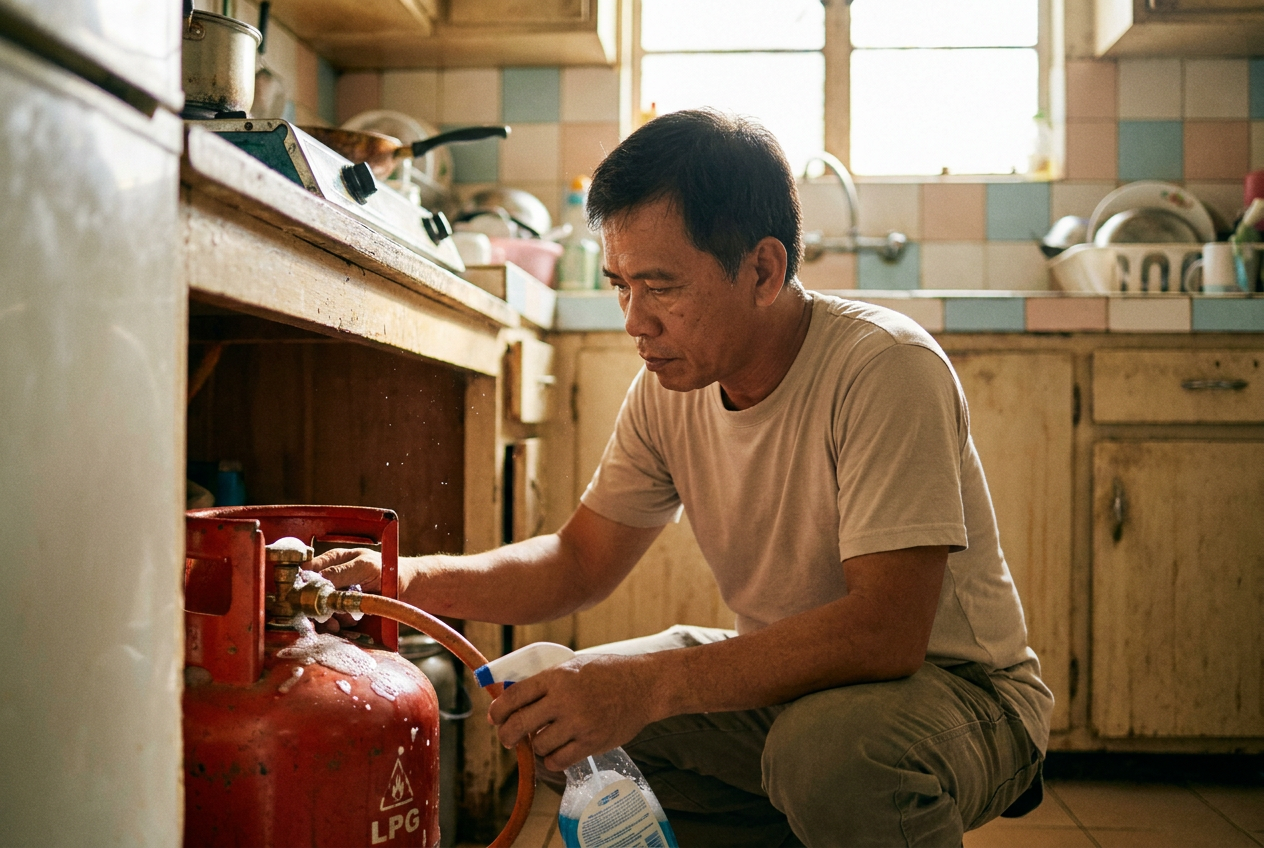
- Check the hose and regulator before the season, not during it. Look for cracking, brittleness, or a loose connection at the regulator. If it’s more than a couple of years old and you can’t remember the last time you checked it, replace it — a new hose and regulator cost far less than the alternative.
- Never swap or connect a tank near an open flame or lit stove. If you’re changing tanks mid-party, turn off the stove first, and do the swap in a ventilated area.
- If you smell gas, don’t turn on lights or use anything with a switch. Turn off the tank valve, open windows and doors, and get everyone outside before you investigate further. A spark from a light switch is enough to ignite a leak.
- Keep the tank upright and away from heat sources, including away from the stove itself and away from direct sun if it’s stored outdoors.
- Long cooking sessions mean more heat buildup in the kitchen — make sure there’s ventilation, both for carbon monoxide from extended burning and to keep the area from becoming an oven itself.
None of this is unique to December on paper — it’s just that December is when LPG gets used harder, longer, and by more people in the household (including relatives helping out in the kitchen who may not know your setup), so the margin for a small mistake gets thinner.
Variations & conditions
If you’re hosting a party rather than just a family meal, the same rules apply but the stakes go up because there are more people, more distraction, and often more alcohol involved by the time media noche rolls around. Assign your stove-duty person before the drinks start, not after.
If it’s raining or a typhoon is active, outdoor lights and extension cords running to a garage or terrace need to be rated for outdoor use and kept away from pooling water — a shorted outdoor light string is a real risk during Amihan season downpours. Check PAGASA updates before committing to an outdoor light display that will run unattended overnight in bad weather.
If you live in a condo or apartment, your LPG setup is likely smaller, but the extension cord and Christmas light risks are identical or worse — shared walls and stacked units mean a fire spreads to neighbors faster, and building management may have specific rules about decorative lighting and open flames on balconies. Check your building’s fire safety guidelines before assuming your usual setup is fine.
If the power is out and you’re cooking on a backup stove or grill, that’s a different hazard set — never burn charcoal indoors or in a garage, even with the windows open, because carbon monoxide can kill; and a butane stove needs good ventilation as well as care with fire. That’s worth its own read in our power outage guide rather than folding it in here.
Common mistakes
- Assuming “someone” is watching the stove. Unless you named that someone out loud, no one is watching the stove.
- Reusing lights year after year without inspecting them. A set that worked fine last December can have a cracked wire from storage that only shows itself under load this year.
- Trusting a listing photo instead of checking for the DTI PS mark or ICC mark yourself before you buy, especially online.
- Treating extension cords as infinitely expandable because “it’s just for December.” The load doesn’t care that it’s temporary.
- Waiting until noche buena night to check the LPG hose. By then, a cracked hose is a party problem, not a maintenance task.
- Pouring water on an oil fire. It doesn’t put it out — it throws burning oil further. Smother it or use your extinguisher.
How to practise safely
Before the season gets busy, walk through your own kitchen and living room once, deliberately, the way you’d walk a route before relying on it in the dark. Turn on everything you plan to run simultaneously this December — tree lights, karaoke, stove, any extra appliance — and feel every plug and cord after thirty minutes. Warm is normal for some things; hot is not.
Do this with whoever else cooks or hosts in your household, so more than one person understands the setup and the “never leave the stove” rule isn’t something only you remember. If you have household help or visiting relatives who’ll be cooking too, walk them through it as well — a fire doesn’t ask who caused it.
None of this replaces a working smoke alarm or a fire extinguisher you know how to use — if you haven’t set those up yet, that’s genuinely the more urgent task, and our home fire safety plan and fire extinguisher guide will walk you through it properly. What this guide gives you is the seasonal layer on top: knowing that December asks more of your stove, your outlets, and your LPG setup than the rest of the year does, and adjusting your habits to match before the first guest arrives.
Galing Gear shares general preparedness and first aid information based on sources such as the DOH, WHO and the Philippine Red Cross. It is not a diagnosis or prescription, and it does not replace a doctor, nurse, pharmacist or trained responder. We never give medicine doses. Follow the latest advice of the DOH, your local health office and your medicine’s label. In an emergency, call 911. Philippine Red Cross: 143. Mental health crisis (NCMH): 1553 (landline). When unsure, get checked.