LPG tank safety: leak checks, storage, and regulators
Learn to check LPG tanks for leaks, store them safely, and connect regulators right — plus what to do if you smell gas at home in the Philippines.
What you’ll be able to do — and why it matters
By the end of this guide, you will be able to check your own LPG tank and hose for leaks, connect and disconnect the regulator the right way, store the tank so it isn’t sitting next to a heat source, and know within seconds what to do if you smell gas in the house. None of this is complicated. Almost all of it takes less than five minutes, and almost none of it costs anything.
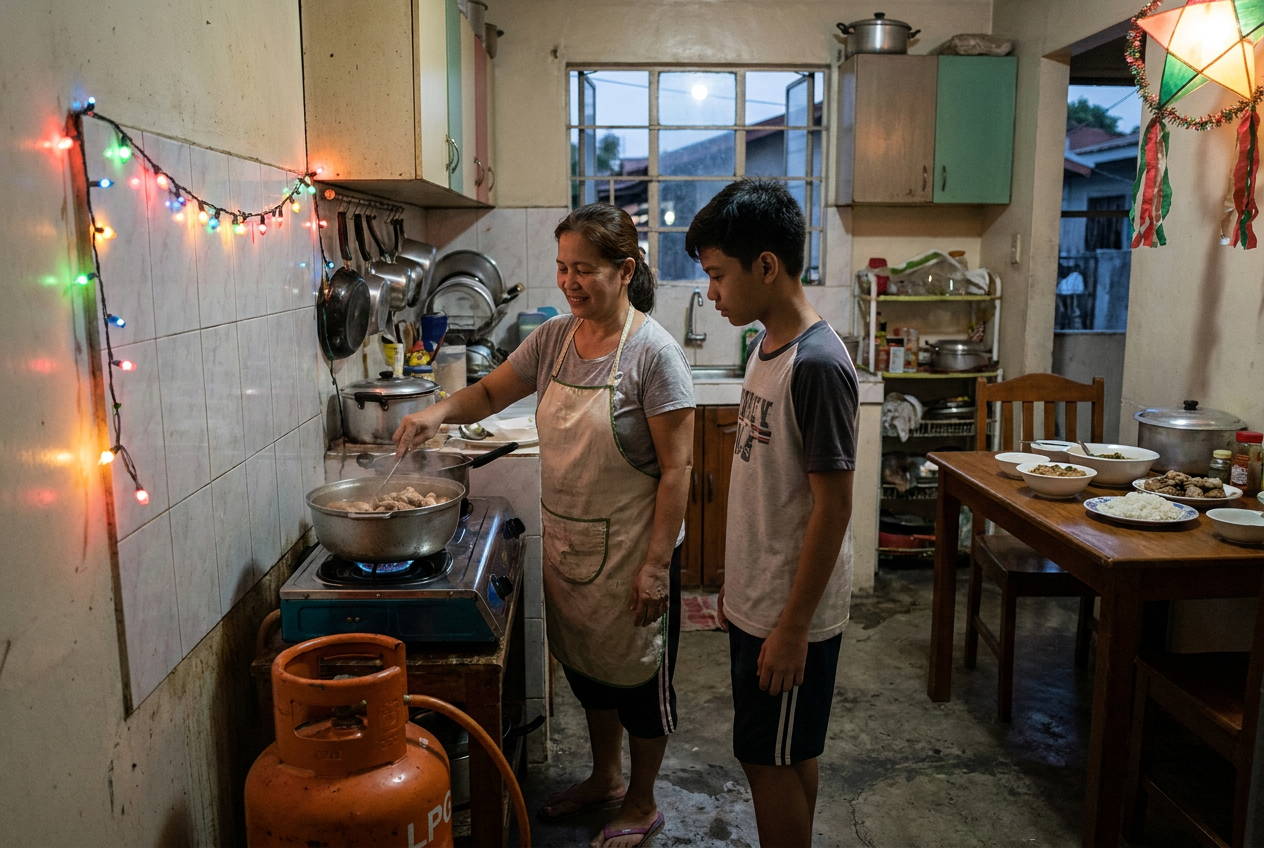
LPG is what cooks most Philippine meals — a tank under the sink or beside the stove, refilled every few weeks from the corner store or the delivery truck. It’s also one of the most common causes of house fires and small explosions in the country, and nearly every case I’ve read about traces back to the same handful of preventable things: a hose that was never checked, a tank stored somewhere it shouldn’t have been, or someone reaching for a light switch after smelling gas instead of opening a window and walking out. This isn’t about fear. It’s about five habits that take almost no time and remove almost all of the risk.
This guide covers leak checking, safe storage, regulator connection, and what to do if you smell gas. It does not cover using a fire extinguisher on a kitchen fire — we cover that separately in our guide to choosing a home fire extinguisher — and it does not cover planning your way out of the house, which is in our fire safety at home guide. Read this one alongside those two, not instead of them.
What you need
You don’t need to buy anything special to keep your LPG setup safe. A few things help:
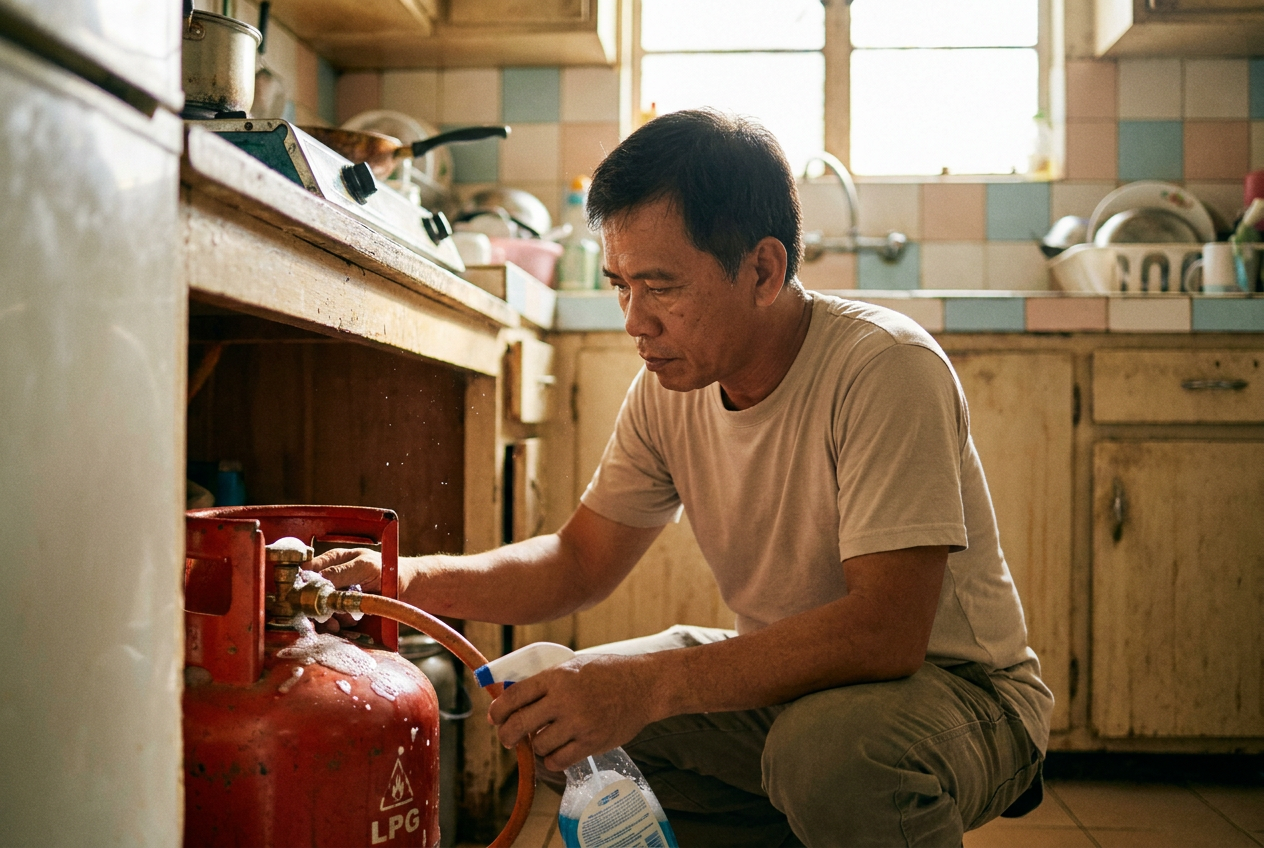
- Dish soap and water in a small spray bottle or cup. This is your leak detector. A rough mix of about one part dish soap to three parts water bubbles up well — it doesn’t have to be exact, just soapy enough to form bubbles that hold their shape for a few seconds.
- A rag or old toothbrush, for wiping down the tank valve and hose fittings before you inspect them.
- A torch or headlamp for checking the tank in a dim storage area — never a lighter or candle, for reasons that will be obvious in a moment. If you don’t have one, our review of a basic headlamp covers a decent low-cost option.
- A regulator and hose rated for LPG, bought from a hardware store or your LPG dealer, not improvised from parts meant for something else. If yours is old, cracked, or came with the tank when you bought it secondhand years ago, that’s worth addressing before anything else in this guide.
That’s genuinely it. The method matters far more than the equipment here.
The method
Checking for leaks — soapy water, never a flame
This is the single most useful habit in this whole guide, and it takes about two minutes.
- Open a window or door first, so the area has airflow before you start. LPG is heavier than air and pools low if it leaks, so you want somewhere for it to go rather than checking in a sealed room.
- Make sure the stove is off and the tank valve is closed.
- Mix roughly one part dish soap to three parts water — it doesn’t need to be exact, just soapy enough to bubble.
- Open the tank valve so gas is flowing to the regulator, but leave the stove burners off.
- Wipe or spray the soapy water along the regulator connection, the hose, and the hose clamps at both ends.
- Watch for bubbles. A steady stream of small bubbles growing at a fitting means gas is escaping there. No bubbles, no smell, no hiss — you’re fine.
- Close the tank valve again when you’re done.
Do this check every time you connect a new tank, and again every couple of months even if nothing has changed. It costs you two minutes, a squirt of dish soap, and an open window.
Never test for a leak with a flame, a lighter, or a lit match. I know this sounds obvious written down, but it is still a real cause of accidents — someone smells a faint hint of gas, isn’t sure, and holds a lighter near the hose “just to check.” Soapy water works because soap and water don’t ignite. It’s a physical test, not an electrical or a spark-based one — you’re watching for bubbles, not testing with anything that could spark.
Connecting and disconnecting the regulator
The regulator is the part that clips or screws onto the tank valve and steps the gas pressure down to something your stove can use safely. Getting this connection right matters more than people think.
To connect: make sure the stove and tank valve are both off first. Fit the regulator squarely onto the tank valve — clamp-type regulators need the lever pushed down firmly until it clicks or seats fully; screw-type ones need to be turned on straight, not at an angle, so the threads don’t cross. A regulator that’s sitting slightly crooked is one of the more common causes of a slow leak that nobody notices until the soapy-water test catches it.
Once it’s connected, do the soapy water check before you light the stove for the first time on a new tank. This is the moment leaks are most likely — right after a tank swap — so it’s the moment worth checking every single time, not just occasionally.
To disconnect: turn off the stove burners, then close the tank valve, then release the regulator from the valve. That order matters because it stops gas flow at the source before you open any connection — if you released the regulator first while the valve was still open, you’d be disconnecting a fitting with gas actively flowing through it. If your regulator or dealer’s instructions specify a different sequence for your particular model, follow those — but for the common clamp-type and screw-type regulators sold with household tanks in the Philippines, stove off, valve off, then regulator off is the safe order.
If the regulator feels loose, if the lever won’t seat properly, or if the hose looks perished, cracked, or swollen — stop and replace the part. Don’t force a bad connection to “just work for now.” A regulator or hose costs a few hundred pesos. It is not worth gambling on.
Safe tank storage
Where the tank lives when it’s not in use matters almost as much as the connection itself.
- Keep it upright, always. LPG tanks are built with the valve and pressure-relief device at the top, designed to vent safely in that orientation if internal pressure rises. Laid on its side, liquid LPG can reach the valve instead of vapor, and the relief device may not work the way it’s meant to. Upright, always — this isn’t a minor preference.
- Keep it ventilated. LPG is heavier than air — if it leaks, it pools low and doesn’t just drift away like a lighter gas would. A tank in an open, airy spot under a counter with gaps at the bottom is far safer than one sealed inside a tight cabinet with no airflow.
- Keep it away from heat. Not near the stove itself, not near a water heater, not in a spot that gets direct sun through a window all afternoon, not next to anything with a pilot light or exposed flame. Heat raises pressure inside the tank; you don’t want to be testing how much margin it has.
- Keep a working distance from the stove. Most households in the Philippines keep the tank connected via a hose that reaches from a spot beside or below the counter to the stove on top. That’s fine, as long as the tank itself isn’t tucked directly under the burners.
- If you store a spare tank, treat it exactly the same way — upright, ventilated, away from heat — even though it isn’t connected. A full spare tank in a hot, closed storage room is still a full tank of pressurized gas.
Variations & conditions
Apartments and small kitchens. If your kitchen is tight and the tank has to sit in a cabinet, prop the cabinet door open a crack or drill a couple of low vent holes if you own the unit — trapped, unventilated space is the main risk, not the tank itself.
High floors and condo living. A leak in a high-rise unit with no cross-ventilation is more dangerous, not less, because the gas has nowhere to go. If you’re on a high floor with limited windows, it’s worth being even more disciplined about the soapy-water check and never skipping it after a tank swap.
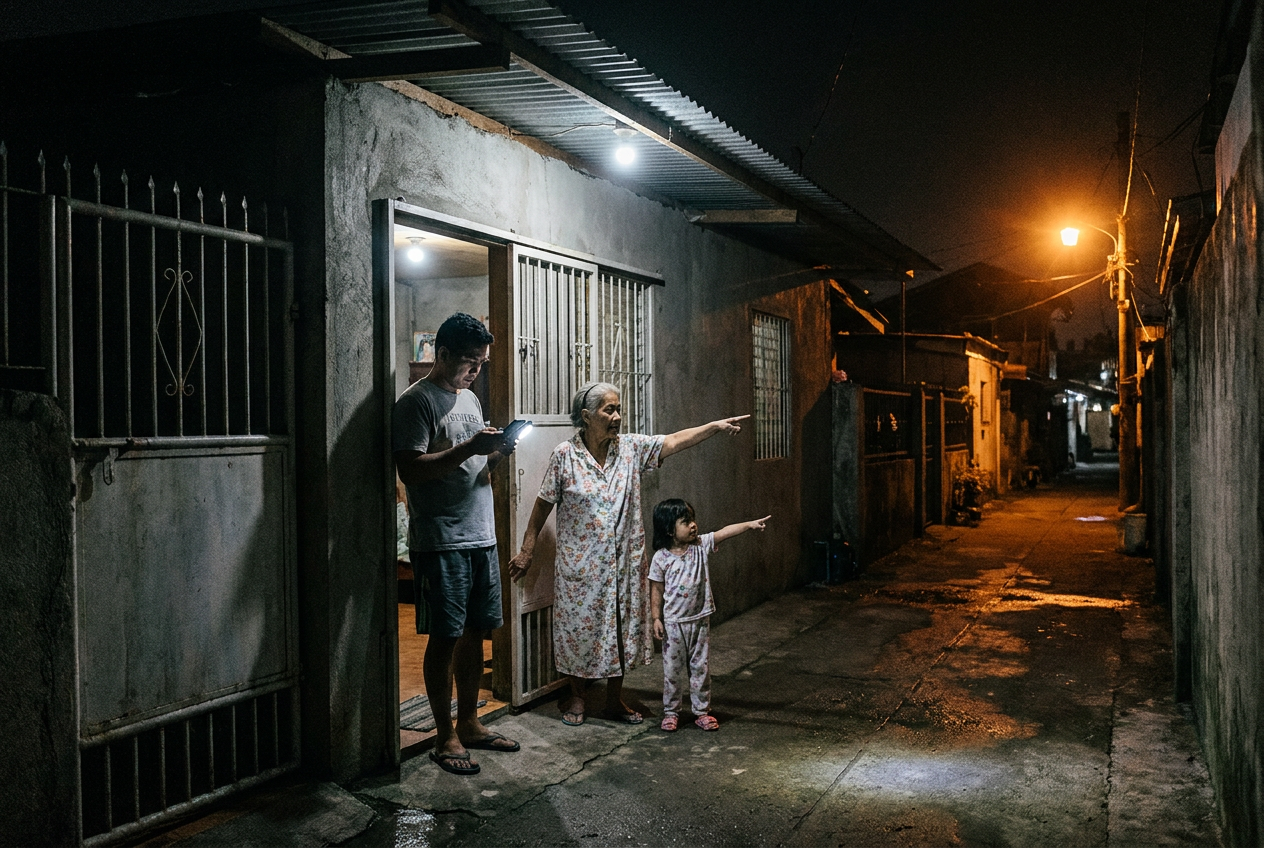
During a brownout. This is one of the few times LPG safety actually gets more dangerous, not less. In the dark, people reach for a lighter to see, or flick a light switch out of habit. If you smell gas during a power outage, the “no flame, no switch” rule in the next section matters even more — use a torch, not a lighter, and don’t touch the breaker.
Secondhand or unbranded tanks. Refilling from unfamiliar sources or using tanks with no visible brand markings or valve seal is a known source of accidents in the Philippines — underfilled and tampered unsealed tanks are a recurring theme in fire investigations. Stick to accredited LPG dealers and branded tanks with an intact valve seal.
What to do if you smell gas
Treat this as calm, immediate action — not panic, but not hesitation either.
- Do not switch on or off any light, appliance, or breaker. A spark from a switch is enough to ignite pooled gas. This includes not using your phone while still inside the room.
- Do not light anything, including a lighter to see by. Use natural light or step outside first.
- Get everyone moving toward an exit. Getting people out is the priority — don’t linger to investigate or gather belongings.
- Open windows and doors on your way out if you can do it without stopping or lingering in the room. Don’t go out of your way to reach one.
- Only close the tank valve if it is directly on your way out and you can do it in a few seconds without lingering. If reaching it means walking further into the gas or spending real time in the room, skip it — getting people out safely comes first. The valve can be closed later by someone qualified, or from outside if it’s accessible from there.
- Get outside and stay outside.
- Once outside, call for help — your barangay, the Bureau of Fire Protection, or your LPG dealer for a proper inspection before anyone goes back in.
- Don’t go back inside until you’re sure the gas has cleared and the source has been found and fixed by someone qualified.
No bag, no extinguisher, and no amount of confidence replaces getting people out first. That instinct — get out, then sort the problem — is the same one search-and-rescue teams train into people who have to make fast calls with incomplete information: act on the smell, not on your certainty that it’s probably nothing.
Common mistakes — and how to avoid them
- Testing for leaks with a flame. Always soapy water. Always.
- Checking for leaks in a sealed room with no airflow. Crack a window first — LPG pools low, and you want it somewhere to go.
- Storing the tank on its side, or in a sealed, unventilated cabinet. Upright and airy, every time.
- Ignoring a faint gas smell because “it’s probably nothing.” It costs you thirty seconds to open a window and check. It costs a lot more to be wrong.
- Reaching for a light switch in the dark when you smell gas. Use a torch from a safe distance, not a switch, and not your phone while still inside the room.
- Trying to close the tank valve before getting people out, if reaching it means lingering in a gas-filled room. Evacuation comes first. Close the valve only if it’s quick and on your way out.
- Using a hose or regulator well past its condition, because replacing it feels like a hassle. A perished, cracked, or brittle hose is not something to wait out. Replace it.
- Repairing a leaking valve, regulator, or tank yourself. If a soapy-water check shows a leak at the tank valve itself, or the tank has a dent, rust, or damage, don’t try to fix or reseal it. Bring it back to your dealer or call an accredited technician. Tanks and valves are pressure equipment — this is exactly the kind of job worth paying someone qualified to do.
- Buying refills from unmarked or unofficial sources. Underfilled and tampered tanks are a known, recurring cause of accidents. Stick to accredited dealers and branded tanks with an intact valve seal.
How to practise safely
You don’t need a drill for this the way you’d drill a fire escape route, but there are a few things worth doing on purpose rather than leaving to memory:
- Do the soapy-water check right now, on the tank you currently have connected, even if nothing seems wrong. Get familiar with what “normal” looks and sounds like so you’d notice if something changed.
- Walk through the disconnect order out loud once — stove off, valve off, regulator off — until it’s automatic. This is the kind of small sequence that people get wrong exactly when they’re rushing, which is usually when it matters most.
- Physically check your tank’s storage spot for ventilation and distance from heat sources today, not on your next grocery run.
- Talk to everyone in the house about the “smell gas, don’t touch a switch, get out first” rule — kids included, if they’re old enough to be in the kitchen unsupervised. This is worth as much repetition as your fire escape plan.
Pair this with our guides on fire safety at home and choosing a home fire extinguisher for the fuller picture. LPG safety keeps the fire from starting in the first place — the other two guides cover what to do if, despite all this, one starts anyway.