How to keep insulin cold during a brownout (PH guide)
Keep insulin cold during a brownout: a simple cooler bag and gel pack system for Filipino homes, plus when to stop improvising and get medical help.
What you’ll be able to do — and why it matters
If someone in your house depends on insulin, or any medicine that has to stay refrigerated, a brownout is not just an inconvenience. It is a small, specific emergency with a clock attached. The good news is that this is one of the most manageable risks in the whole preparedness list — if you set it up before the outage, not during it.
By the end of this guide you will have a small, always-ready cold chain that can keep going for hours without electricity: a dedicated cooler bag, a rotation of frozen gel packs, and a clear line for when home improvisation is no longer enough and you need to call the barangay health center or go to a hospital.
This is not about keeping the whole fridge cold, and it is not about phones or lights — that side of a long outage is covered in our power outage guide. This one is just about the medicine.
What you need
You do not need anything fancy. In fact, fancy is usually the wrong instinct here — a giant camping cooler is overkill for a few vials or pens, and it takes longer to get cold in the first place. What works is small and always ready:
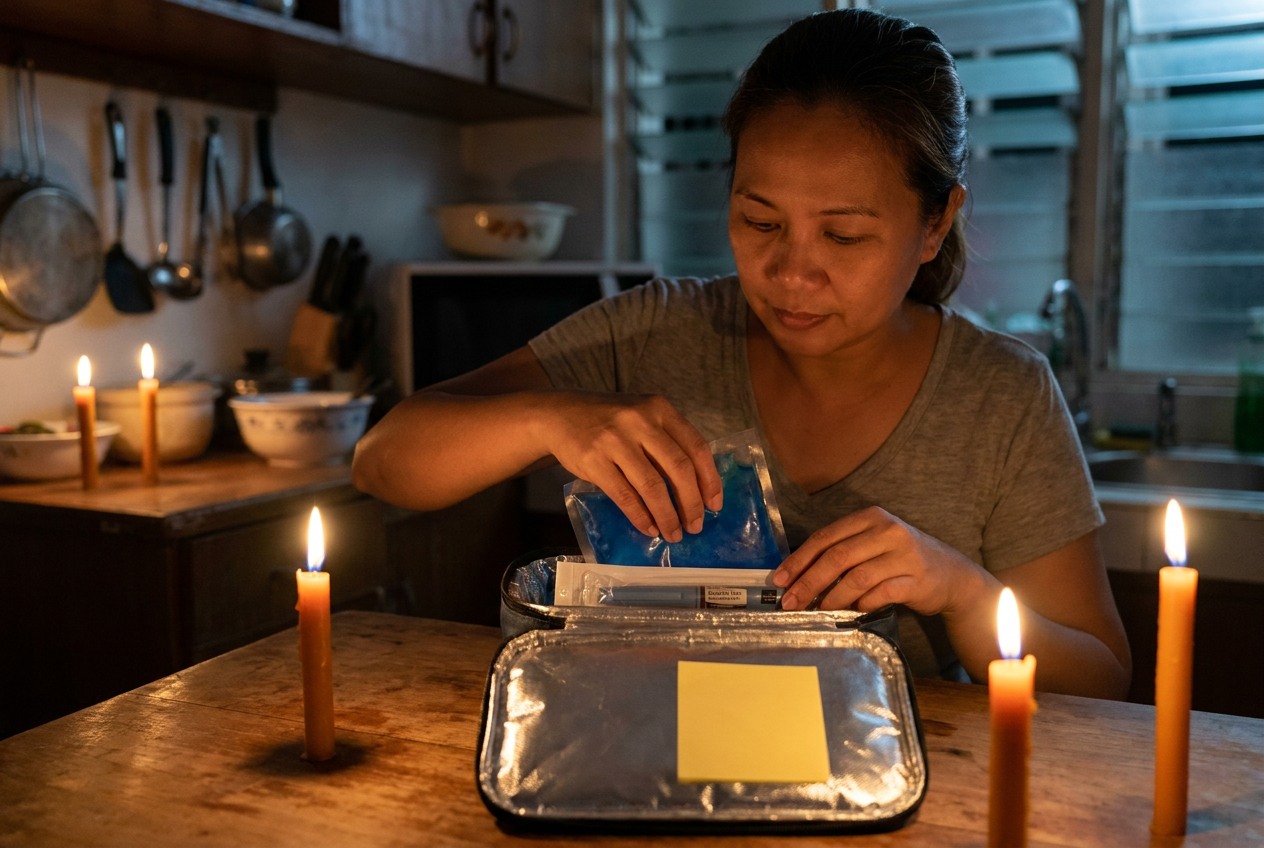
- A small insulated cooler bag or thermal lunch bag, sized just for the medicine, not for snacks or leftovers. The smaller the air space around the medicine, the longer the cold holds.
- Two to three reusable gel packs, sized to fit that bag, kept in the freezer permanently — not “in there since last Tuesday,” but genuinely always frozen and ready to grab.
- A backup option: small frozen water bottles work when gel packs run low or you need extra capacity. They melt a bit slower than most cheap gel packs.
- A thermometer strip or small fridge thermometer, if you want to check the inside temperature of the bag rather than guess by feel. Not essential, but reassuring.
- The medicine’s packaging insert, or written notes from your doctor or pharmacist, kept with the cooler bag itself — more on why below.
We are not scoring individual cooler bags in this guide, but if you are shopping, look at our go bag coverage for insulated pouch options that double well for this purpose.
The method
1. Pre-freeze before you need it, not after. The whole system depends on the gel packs already being solid when the brownout starts. Keep at least two in the freezer at all times, permanently, the way you’d keep ice for visitors. During typhoon season, when PAGASA is already flagging a system that could affect your area, freeze a third as backup. Do not wait until the lights flicker.
2. Move the medicine into the cooler bag as soon as the power drops, not after an hour of “let’s see if it comes back.” Line the bag with one gel pack, place the medicine in the middle wrapped in its usual packaging, and close it with the second gel pack on top. Keep the bag closed as much as possible — every time you open it to check, you let the cold out.
3. Rotate the gel packs. A single small gel pack in a lunch-bag-sized cooler will not hold cold indefinitely. If the outage runs long, rotate: when a pack starts to feel soft rather than hard, swap it for your frozen backup. If you have any power at a neighbor’s house, a nearby store, or a generator-run appliance nearby, that’s the moment to refreeze the spent pack. Frozen water bottles work as a stretch measure if you are down to your last hard pack and don’t yet have power back.
4. Track time, not temperature guesses. Every insulin brand and every temperature-sensitive medicine has its own tolerance for time outside the fridge — this varies by product, and guessing is exactly what you don’t want to do here. The packaging insert that comes with the medicine states this plainly, and your prescribing doctor or the pharmacist who dispensed it can tell you in specific terms for your exact medicine. Write that number down — literally, on a sticky note kept with the cooler bag — so that during an actual outage, at 2 a.m., with the lights out, you are reading a note you already prepared, not trying to remember or search for it on a phone with 8% battery.
5. Know your stopping point before you reach it. Decide in advance, using your doctor’s guidance, what the cutoff is: if the cold chain cannot be maintained past a certain point, where do you go? Having that answer settled ahead of time turns a stressful decision into a simple checklist item.
Variations & conditions
Short brownouts (a few hours): A well pre-frozen gel pack in a small, dedicated cooler bag will comfortably outlast this. This is the everyday case in most of Metro Manila and nearby provinces during a normal summer brownout or line maintenance.
Extended outages during typhoons: This is where rotation matters. If the barangay is without power for a full day or more — not unusual in the aftermath of a major storm — plan on cycling through your full stock of frozen packs and topping up wherever you can find a working freezer: a relative’s house on a different grid line, a neighbor with a generator, or a nearby store. Some households keep a spare pack or two at a relative’s place specifically for this reason.
Heat and humidity: Philippine heat works against you twice over — it melts your gel packs faster, and it raises the risk if cold storage lapses. In peak summer heat, treat your rotation schedule as tighter than you would in cooler, rainy-season weather, and check the bag more often.
Traveling or evacuating: If a flood or evacuation order means the household has to move, the cooler bag comes with you as a priority item, packed the same way as it would be during a brownout at home. Don’t leave it behind assuming you’ll be back soon.
No freezer access at all: If your barangay has been without power long enough that no one nearby has a working freezer, this stops being a logistics problem and becomes a “seek help now” situation — see below.
Common mistakes
Using a big cooler instead of a small one. A bigger insulated bag means more air to keep cold, which means your gel packs work harder for a shorter payoff. Match the bag to the medicine, not to convenience.
Forgetting to keep the freezer stock genuinely frozen. A gel pack that’s been sitting half-thawed for two days because someone moved it to make room for ice cream is not ready. Check it periodically, the way you’d check a fire extinguisher gauge.
Opening the bag “just to check” too often. Every open-and-close cycle lets warm air in. Trust the setup, check on a schedule (say, every couple of hours), not out of anxiety.
Guessing at the time limit instead of reading it. This is the one that matters most. Every product is different, and manufacturers print this information for a reason. Do not rely on general internet advice, including this article, for the specific number — that comes from the packaging insert or your doctor or pharmacist.
Not deciding the stopping point in advance. Waiting until the medicine has already been out of the fridge too long before deciding what to do is how a manageable situation turns into a rushed one. Decide the plan while calm, not mid-outage.
Where to find the supplies
None of this requires anything exotic or expensive. Small insulated lunch-bag-style coolers and reusable gel packs are widely available on Lazada and Shopee, usually priced from around ₱150 to ₱400 depending on size and brand — search for “insulin cooler bag” or “medicine cooler pouch” and you’ll find purpose-made options alongside general lunch coolers, which work just as well. Drugstores (Mercury Drug, Watsons, Rose Pharmacy) sometimes carry small insulated pouches near the diabetic supplies section, and it’s worth asking your pharmacist directly — many can point you to what other patients use. General suppliers of household and office goods, the kind that also sell lunch boxes and school supplies, often carry basic gel pack sets cheaply as well. As with anything ordered online, buy from sellers with real reviews and a reasonable price — a suspiciously cheap “medical grade” cooler bag is usually just a lunch bag with a nicer label.
When to seek help
There is no shame in reaching out early, and doing so is part of managing this well, not a failure to cope. If a brownout is stretching on and you cannot maintain cold storage — no more frozen packs, no neighbor with a working freezer, no ice available — contact your barangay health center. Many keep refrigeration running on backup power specifically for community medicine storage, or can direct you to the nearest facility that does. If the situation is more urgent, or you’re unsure whether the medicine is still safe to use, a hospital or your prescribing doctor is the right call, not a guess.
This is also worth raising with your barangay health worker before a typhoon hits, not during one: ask whether they offer emergency cold storage for residents’ insulin during outages. Some do. It costs nothing to ask, and knowing the answer in advance means one less decision to make when the power is actually out.
How to practise safely
Before typhoon season starts, or even just this weekend, run a dry drill. Pre-freeze your gel packs, pack the cooler bag exactly as you would during a real outage, and leave it closed for a few hours without opening it. Check the temperature inside partway through, if you have a thermometer strip, just to get a feel for how long your specific bag and pack combination actually holds. Note it down.
Do this once with your actual doctor’s guidance on hand, and once you’ll know two things cold: how long your setup realistically buys you, and what your family’s exact time limit is for the medicine involved. Between those two numbers is where your rotation plan lives — and it’s much better to learn that on a calm afternoon than during the fourth hour of a storm-driven brownout.