Volcanic ashfall guide: what Filipino families must do
Volcanic ashfall guide for Filipino families: seal your home, protect water, pick the right mask, and know when to evacuate. Lessons from Taal and Mayon.
The situation
Ashfall does not feel like an emergency while it is happening. There is no wind tearing at your roof, no water rising past your knees. It just gets dark in the middle of the day, and then everything — your car, your plants, your neighbor’s tsinelas by the door — is covered in gray. That quietness is exactly why it catches families off guard.
When Taal Volcano erupted in January 2020, ash fell as far as Quezon City and parts of Metro Manila, more than 60 kilometers away. Batangas, Cavite, and Laguna got the worst of it — roofs collapsing under wet ash, water systems fouled, thousands moved into evacuation centers overnight. Mayon in Albay is a slower, more familiar threat to Bicolanos — it has had smaller ashfall and lava dome activity multiple times in the last decade, and communities there have built a kind of hard-earned routine around it.
Volcanic ash is not like the ash from a bonfire. It is ground-up rock and glass, sharp under a microscope, and it does not dissolve or soften in the rain the way you would hope. It gets into lungs, engines, water tanks, and roof gutters, and it stays there until someone physically removes it. That is the whole problem in one sentence: ashfall is a cleanup and containment event, not a wait-it-out event.
What actually matters
A few things decide whether an ashfall event is an inconvenience or a genuine danger to your family.
Sealing your indoor air. Ash finds every gap — window frames, door jambs, aircon vents, exhaust fans. Once it is inside, it is nearly impossible to fully clear out of soft furnishings, and it keeps getting kicked back into the air for days.
What you put over your nose and mouth. This is not a place for compromise. A cloth mask or an ordinary surgical mask will stop droplets, but the fibers are too loosely woven to catch fine volcanic particles, which are sharp-edged and small enough to reach deep into the lungs. An N95 (or better) respirator, properly fitted with no gaps at the sides, is the only mask type that actually filters ash at that size. If your family cannot get genuine N95 masks, treat that as an urgent gap to fill, not a minor one — the counterfeit N95s sold cheap on Lazada and Shopee during past eruptions were a real problem, so buy from a pharmacy or hardware supplier you trust, not the lowest listing you can find.
Your roof’s actual limit. Dry ash is deceptively light. Wet ash is not. A layer of wet volcanic ash a few centimeters thick can add hundreds of kilograms of load across a roof, and older nipa or light G.I. sheet roofing was never designed for that. This is what caused most of the structural collapses during Taal — not the eruption itself, but ash-laden rain sitting on roofs for days afterward.
Your water supply. Ashfall can settle directly into open tanks, cisterns, and rainwater catchments, and it carries sulfates and other compounds that make water unsafe to drink even after the visible ash looks like it has settled out. Covered, sealed water storage matters more during ashfall than almost any other hazard we cover.
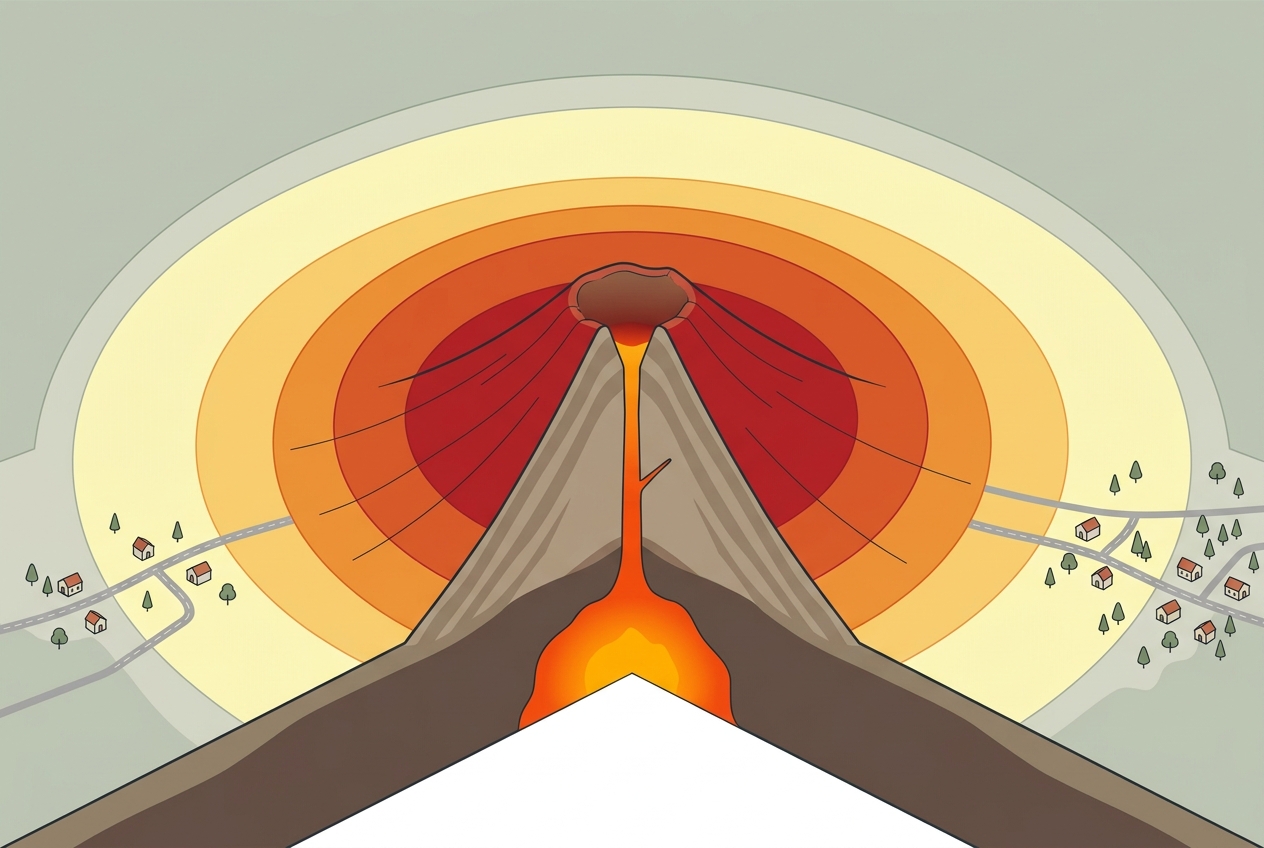
Lahar risk in the weeks after. This is the part families forget. Once heavy rain falls on loose ash deposits on a volcano’s slopes, it can turn into lahar — a fast-moving slurry of ash, rock, and water that follows river valleys and can travel far from the volcano itself, long after the eruption is over. Areas downstream of Mayon and Taal have dealt with lahar damage well after the ashfall itself had stopped being the headline.
What to do (and what not to)
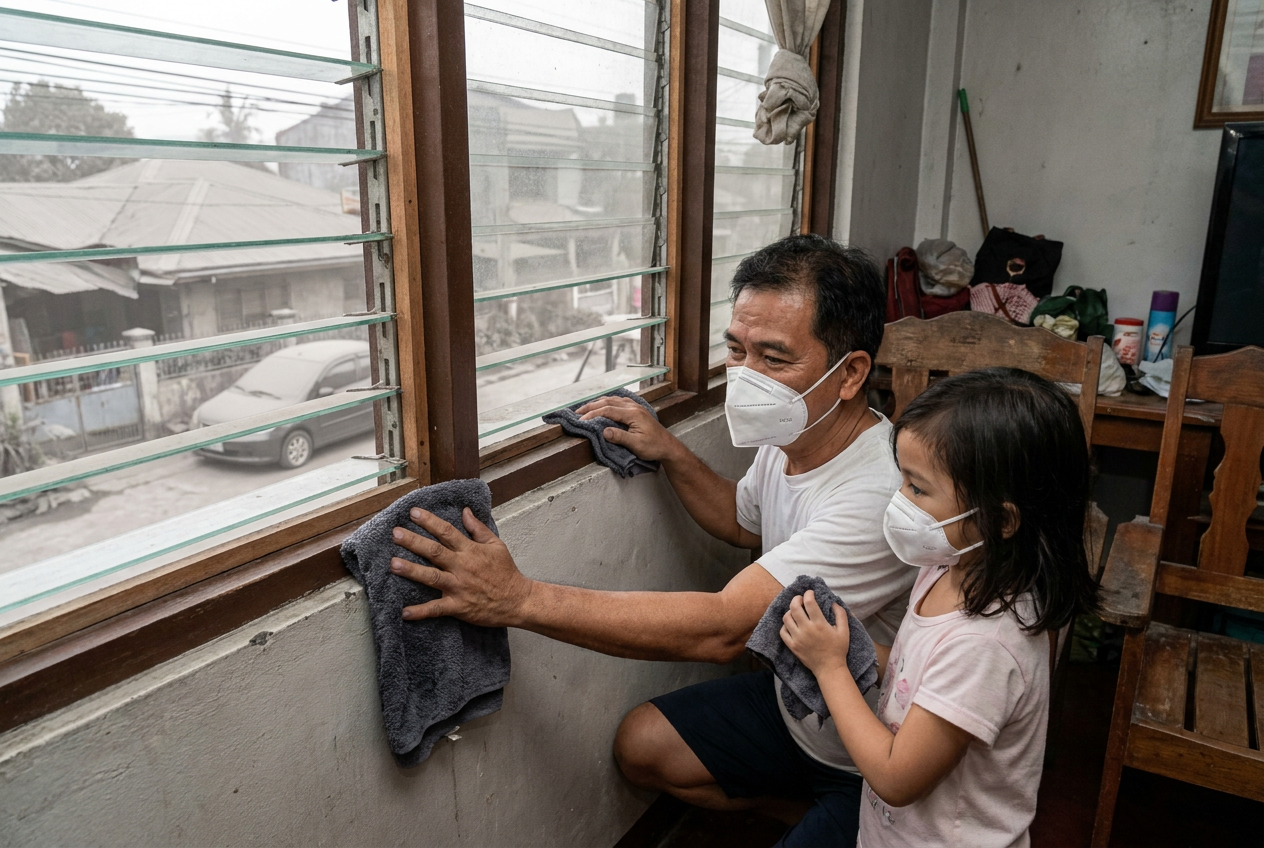
Do seal your home before ash arrives, if you have any lead time. Wet towels or damp cloth along window sills and door gaps work as a real barrier — the moisture helps trap fine particles that would otherwise drift through. Packing tape along frame edges helps too, and it comes off cleanly enough afterward. Turn off aircon units and exhaust fans; they pull ash straight into the room.
Do cover water tanks and containers before the ashfall starts, or as early into it as you can manage. A tarp, a fitted lid, anything that keeps ash from settling directly into open water. If ash has already gotten into your main supply, do not assume boiling fixes it — boiling deals with biological contamination, not sulfates and mineral particles. Switch to sealed bottled water or a stored reserve until the supply can be tested or replaced.
Do wear an N95, not a cloth mask, any time you are outside or clearing ash. If you only have surgical or cloth masks on hand, minimize outdoor exposure until you can get proper respirators — this is not the event to make do.
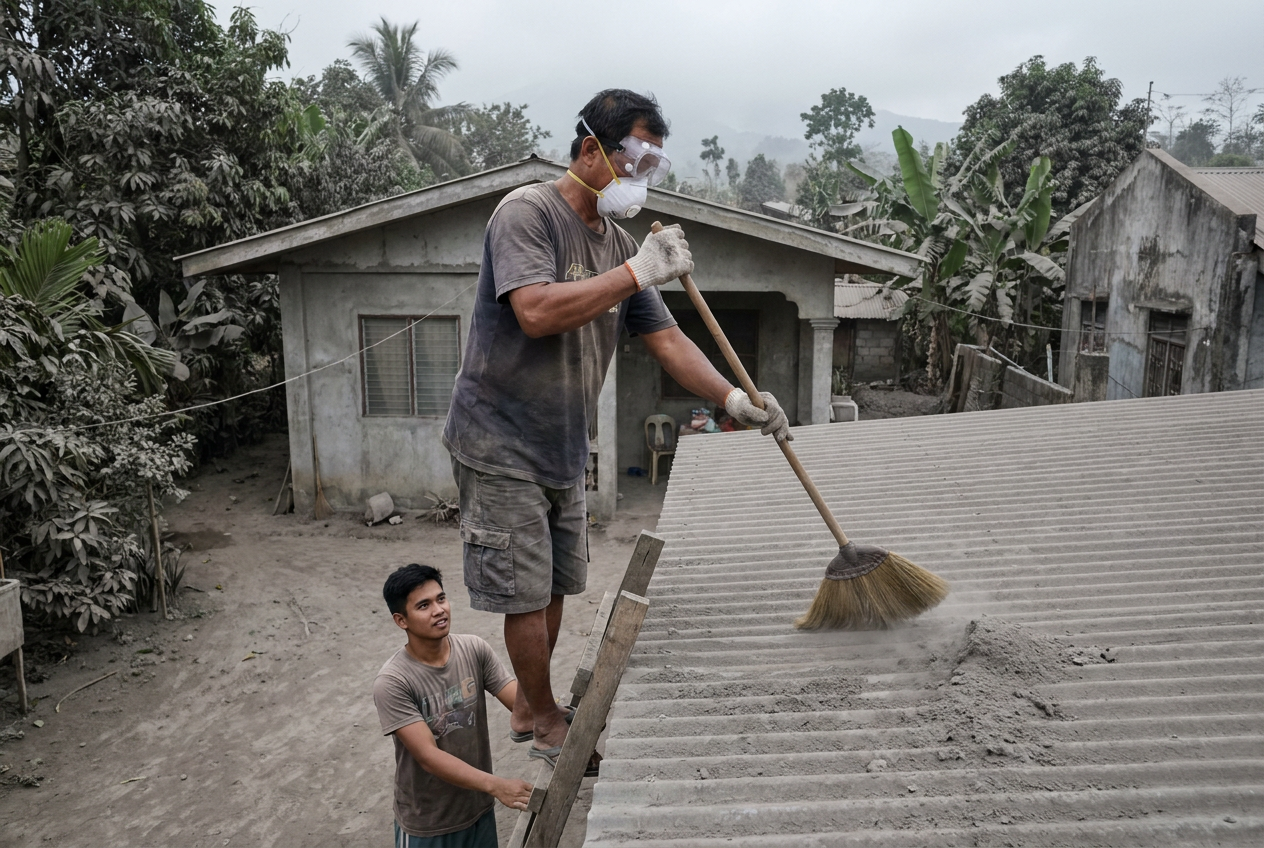
Do clear ash off your roof if it is safe to do so, especially once rain starts falling on it. Wet ash is heavier than dry ash, and it keeps accumulating weight the longer it sits. If your roof already sounds like it is straining, or ash has built up thickly, that is not a sign to wait and see — it is a sign to get everyone off the floor below it.
Do not drive unless you have to. Ash reduces visibility fast, and once it is airborne, it is brutal on engines and windshields — it acts like sandpaper against glass and clogs air filters quickly.
Do not wait for ashfall to stop before deciding whether to evacuate. That decision should be led by the PHIVOLCS alert level for the specific volcano, and by your local barangay and DILG-coordinated evacuation orders, not by how the sky looks from your window.
PHIVOLCS alert levels, in plain language
PHIVOLCS issues alert levels from 0 to 5 for active volcanoes. Roughly, in family terms:
- Alert Level 0–1: Normal to low-level unrest. No cause for evacuation, but a reason to know your area’s risk zones ahead of time.
- Alert Level 2: Increasing unrest. Good time to check your go-bag and confirm your family’s evacuation route, without panic.
- Alert Level 3: Magma is close to the surface, an eruption is possible within weeks. This is when families in high-risk zones should be packed and ready to move on short notice.
- Alert Level 4: A hazardous eruption is possible within days. Evacuation of high-risk zones is typically already underway or ordered — this is not a level to wait out at home if you are inside the danger zone.
- Alert Level 5: A hazardous eruption is in progress. If you are still in an active danger zone at this level, you should already be gone.
The number matters less than one habit: know which level your specific volcano is at, right now, from PHIVOLCS directly, not from a group chat forward.
Evacuate or shelter in place?
If you live within the officially declared danger zone (typically a set radius around the crater, larger for lahar-prone river valleys), evacuation orders from your local government are not optional guidance — follow them, and go early. Roads jam and visibility drops fast once ashfall is heavy, and leaving late is far more dangerous than leaving a few hours too early.
If you are outside the declared danger zone but experiencing ashfall from wind drift — which is what much of Metro Manila experienced in 2020 — sheltering in place, sealed indoors with N95 masks ready, is usually the right call. No bag replaces leaving early when you are in the zone that matters; but for everyone downwind, staying put and sealed in is usually the safer, calmer choice.
The gear that helps
A handful of specific items make the difference in an ashfall event, and none of them need to be expensive.
- Genuine N95 respirators, one per family member, plus spares — expect to pay roughly ₱30–₱80 per mask from a legitimate pharmacy or hardware supplier. Buy before an eruption is declared; prices and availability get ugly fast once one is.
- Sealed eye protection — swim goggles or basic safety glasses keep ash out of eyes, which is a more common complaint than people expect.
- A tarp or heavy plastic sheeting for covering water tanks and vulnerable roof sections, roughly ₱300–₱800 depending on size.
- Wide packing tape and old towels for sealing window and door gaps — items you likely already have.
- Stored, sealed drinking water — see our clean water guide for how much to keep on hand and how to store it safely.
- A broom and stiff-bristled brush rather than a hose, for early ash removal — water turns ash into a heavy, cement-like paste that is harder on your roof and your back.
- A dust mask upgrade for your go-bag — see our go bag guide for the full base list; ashfall just adds a few specific items on top of it.
Volcano-specific go-bag add-ons
On top of your family’s normal go-bag, for anyone living near an active volcano, add:
- N95 respirators, one per person, sealed in a zip bag so they stay dry and uncontaminated
- Sealed goggles or safety glasses
- A lightweight rain poncho — ash-laden rain is corrosive to skin and unpleasant to walk through
- A battery or hand-crank radio for PAGASA and PHIVOLCS updates if cell networks are congested
- A printed copy of your barangay’s evacuation route — ash can knock out visibility badly enough that familiar roads stop looking familiar
- Spare cloth or bandanas as a last-resort backup, understanding clearly that they are not a substitute for a real N95
All of this sits comfortably inside the ₱500–₱3,000 range most families are already budgeting for outage and flood prep — ashfall gear mostly overlaps with what you should already own.
Common mistakes
Trusting a cloth or surgical mask because it is what’s on hand. It genuinely will not filter fine ash. If N95s are not available, treat it as a real gap, not a minor shortfall.
Hosing ash off the roof. It feels productive, but wet ash is heavier and stickier — you can push a marginal roof past its limit trying to “clean” it. Dry sweeping first, then careful removal, is safer.
Assuming the danger ends when the ash stops falling. Lahar risk can persist for weeks or months after an eruption, triggered by ordinary heavy rain on loose ash deposits upslope. Families near river valleys below active volcanoes need to stay alert well past the eruption itself.
Ignoring water tanks until after the ash has already settled in. Once sulfate-laced ash is mixed into stored water, it is a much bigger problem to fix than covering the tank would have been.
Waiting for an official evacuation order if you are already watching conditions worsen and you’re in a known danger zone. Orders can lag slightly behind fast-moving conditions. If your own judgment says go, and you’re in a zone at real risk, that is reason enough to start moving.
The one thing to remember
Ashfall rewards preparation more than almost any other hazard we cover — a sealed home, a covered tank, and a proper mask turn a frightening event into a manageable one. The one thing worth remembering: if you are in a declared danger zone, no amount of sealing tape replaces leaving early. Everyone else can shelter, seal in, and wait it out. Know which one you are, before the ash starts falling.