Disaster prep for families with a member with a disability
Emergency plan tips for Filipino families with a deaf, blind, or disabled member: buddy systems, warning tools, and barangay registration steps.
The situation
Most emergency plans assume everyone in the house can hear the alarm, read the barangay tanod’s megaphone announcement, understand “evacuate now” the first time it’s said, and get themselves out the door. In a lot of Filipino households, that assumption is wrong for at least one person living there — and nobody adjusts the plan for it until the moment it matters.
If your household includes a family member who is deaf or hard of hearing, blind or low-vision, or living with an intellectual or developmental disability, a standard go-bag and a standard “just evacuate when told” plan isn’t enough. Not because the family doesn’t care — because nobody sat down and asked the specific question: how does this person actually receive a warning, and how do they actually move when one comes?
This matters more in Philippine conditions than people expect. Warnings here often arrive as noise — a siren, a barangay loudspeaker, neighbors shouting, a phone alert buzzing on a table across the room. During a typhoon, when PAGASA raises a signal and the barangay starts going house to house, a lot of that communication is verbal, fast, and one-directional. If a family member can’t hear it, can’t process it under stress, or can’t see the hand signals someone’s making at the door, they can be the last person to know the house is leaving — sometimes after everyone else already has.
This guide is about closing that gap ahead of time, calmly, while the sky is still clear. It covers deaf and hard-of-hearing family members, blind and low-vision family members, and family members with an intellectual or developmental disability. If the family member you’re planning for is bedbound or has a physical mobility limitation that affects lifting and transport rather than communication, our go-bag for a household with a bedbound or mobility-limited family member covers that ground in more depth.
What actually matters
Strip away the checklists and three things decide whether this goes well: someone specific is assigned to that person, the warning reaches them in a form they can actually receive, and the barangay already knows your household needs a hand.
Everything else — the go-bag contents, the ID cards, the apps — is in service of those three things. A visual alarm is useless if nobody’s assigned to walk the person to the door once it fires. A barangay registration is useless if the rescue team doesn’t know which house to check first. Get the three big things right and the details fall into place a lot more easily.
What to do (and what not to)
Assign a buddy, not a general hope. Every family member with a disability should have one specific person — not “someone,” a named person — responsible for getting to them, confirming they understand what’s happening, and moving with them. Agree who that is in calm weather, say it out loud as a household, and have a backup name in case the first buddy isn’t home. Practice it once, the way you’d practice a fire drill — walk through the motions at a normal hour, not just talk about it.
Agree on signals before you need them, not during. For a deaf or hard-of-hearing family member, decide together on a simple set of hand signals or written cue cards for “we are leaving now,” “wait here,” and “it’s safe.” For a family member with an intellectual disability, keep the signal and the language consistent every single time — the same phrase, the same gesture, practiced when nothing is wrong, so it isn’t a strange new thing to interpret under stress. For a blind or low-vision family member, agree on a verbal pattern (calling their name first, then a short fixed phrase) so they know a real evacuation instruction is starting and not just background chatter.
Don’t rely on one channel. If the plan is only “I’ll shout,” that plan fails the moment you’re not in the room, the moment the shouting is drowned out by rain on a tin roof, or the moment the person is asleep. Layer it — a shoulder tap plus a light, a phone alert plus someone physically checking, a chest tap in a code you’ve agreed on beforehand.
Don’t wait for the barangay to figure it out during the emergency. Register ahead of time, while things are calm — see below. Rescue teams and evacuation centers move faster and treat your household with more care when they already know before the typhoon signal goes up, not after.
Do rehearse it at night. A lot of real evacuations happen after dark, during a brownout, in the rain. If your only practice run was in daylight with the lights on, you haven’t actually tested the plan. Run it once with the lights off.
The gear that helps
None of this needs to be elaborate. It needs to be specific to the person.
For a deaf or hard-of-hearing family member: a battery or crank-powered strobe/visual alarm that pairs with your smoke detector or is triggered manually, a vibrating alert (a phone set to vibrate, tucked somewhere they’ll feel it, like under a pillow at night), and written cue cards in the go-bag with the household’s fixed evacuation phrases already printed out — useful for talking to rescue teams or barangay staff who don’t know sign language. A basic headlamp doubles as a visual signal in the dark if you don’t have a dedicated strobe.
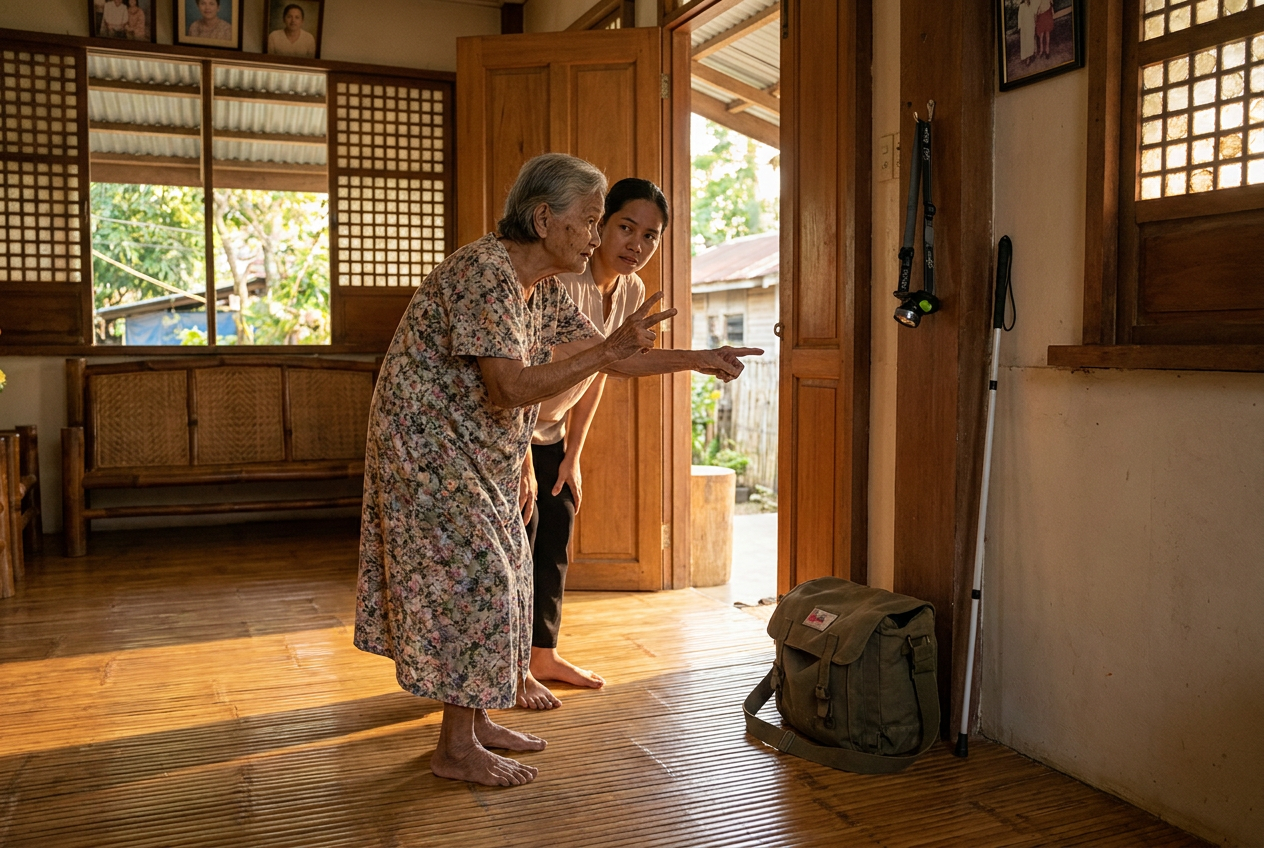
For a blind or low-vision family member: a talking or high-contrast, tactile-marked flashlight is less useful than a reliable one your buddy carries — the light is for the sighted helper to see the path, not for the family member. A cane that’s kept in a fixed, known spot near the go-bag (not buried inside it) so it’s grabbed by feel in the dark. Copies of medication lists and ID in large print or braille if that’s your family member’s normal format.
For a family member with an intellectual or developmental disability: a small comfort item that helps with the transition to an unfamiliar space (evacuation centers are loud, crowded, and disorienting), noise-reducing earmuffs if sound sensitivity is part of their day-to-day, and a laminated card with their name, your name and number, and a short line describing what helps them stay calm — handed to whoever is assisting if you get separated even briefly.
For every version of this household: a PWD ID copy in the go-bag (not just at home in a drawer), any assistive device chargers or spare batteries, and a printed contact card since a phone can die at the worst time. If mobility equipment is also part of your family member’s day-to-day — a wheelchair, cane for support, or a hospital bed — go through our go-bag for a household with a bedbound or mobility-limited family member for that side of the plan; this article intentionally doesn’t repeat it.
Registering with the barangay — and why it’s worth the trip
Most barangays keep, or are supposed to keep, a list of households with a PWD, senior citizen, pregnant member, or anyone needing extra assistance during a calamity. This is usually managed through the barangay’s DRRMO (Disaster Risk Reduction and Management Office) or the barangay health or social welfare desk. Registering means that when a rescue or evacuation team goes out, your household is already flagged — they know to check on you specifically, and they know roughly what kind of help to bring.
Bring a copy of your family member’s PWD ID when you register — issued by your city or municipal PWD affairs office — and ask specifically to be listed for priority assistance during typhoons, floods, or earthquakes. Do this on a normal afternoon, not the day a storm signal goes up. It takes one visit and it changes how fast help finds your door.
The DSWD also runs calamity assistance programs that PWD households can access after a disaster declaration — cash or relief assistance processed through local social welfare offices. Keep your PWD ID and a couple of ID photocopies in the go-bag; it’s one less thing to hunt for when you’re trying to process assistance while also trying to get your household back on its feet.
Common mistakes
Assuming “the family knows what to do” counts as a plan. Knowing in general and having a named buddy with a practiced signal are two different things. Stress erases the general knowledge first.
Putting the visual alarm or cue cards on a shelf instead of in the go-bag. If it’s not within reach in the dark during a brownout, it might as well not exist.
Registering the PWD ID at the city office but never mentioning it to the barangay. The two offices don’t always talk to each other. Tell both.
Only practicing during the day, in good weather, with the lights on. Real evacuations skew toward night, rain, and confusion. Test the plan under those conditions at least once.
Treating this as a one-time task. Needs change — a child with a disability grows, hearing changes, mobility changes. Revisit the plan every storm season, the same way you’d check your go-bag’s expiry dates.
The one thing to remember
No amount of gear replaces a person who knows they’re responsible for one specific family member and has practiced how to reach them. That’s the whole plan, really — everything else, the strobe light, the cue card, the barangay registration, just makes that one relationship work faster when it counts. Do that one thing well, and the rest follows.