Go-bag guide for a bedbound or mobility-limited family
Go-bag guide for Filipino caregivers of bedbound or mobility-limited lolo/lola: caregiver bag, care summary, mobility aids, and backup helper plan.
The situation
Most go-bag advice assumes a household of able bodies. Grab your bag, put on your shoes, walk to the evacuation center. That advice is fine until it isn’t — until the person you’re planning for is your lola who hasn’t walked unassisted in two years, or your father three weeks out of spine surgery, or a sibling with a disability who needs a specific chair, a specific routine, a specific person to help.
If that’s your household, you already know the standard checklist doesn’t fit. It tells you to move fast and travel light. But you can’t move fast, and you can’t travel light — not without leaving something essential behind. That gap is usually why families like yours end up not planning at all. The advice doesn’t apply, so nothing gets written down, nothing gets packed, and everyone hopes the worst won’t happen on a bad night.
It’s a solvable problem. It just needs a different plan than the one-bag-per-person model, and it needs to be written down before the water is already at the door.
What actually matters
A few things separate a workable plan from a hopeful one:
A second bag, carried by the caregiver, not the patient. The mobility-limited family member cannot carry their own bag and may not be able to carry anything at all. Someone else — you — carries it for them. That means your own bag now has a partner bag, and your packing list has to plan for two sets of hands doing the work of what would normally be two independent people.
A written care summary, not a mental one. In a rushed evacuation, in the dark, during a brownout, you will not remember every medication dose and every allergy correctly, and you may not be the one giving the information — a neighbor, a tanod, a nurse at the evacuation center might be. It needs to be on paper, in a waterproof sleeve, where anyone can find and read it.
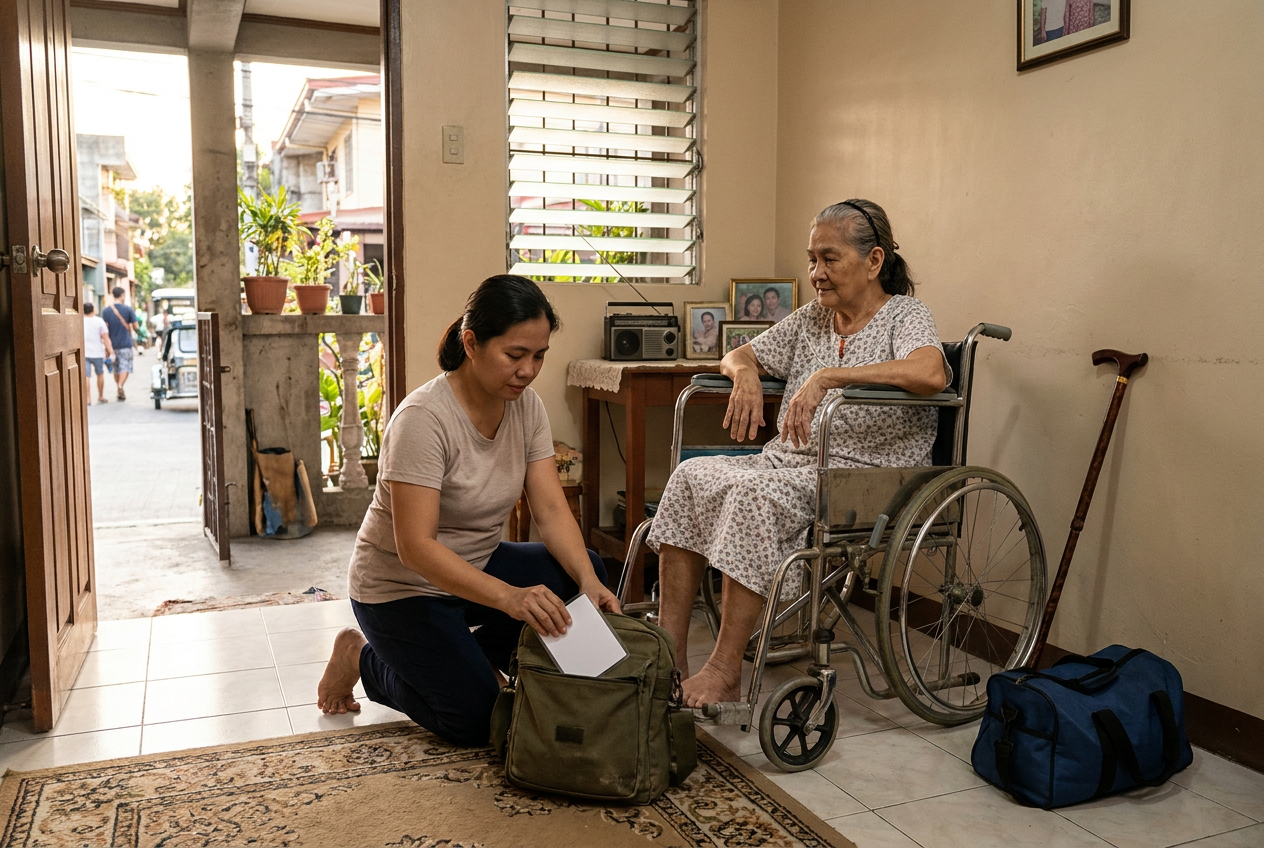
Mobility aids staged at the exit, not wherever they normally live. A wheelchair kept in a bedroom you’ll be moving through under stress, in the dark, past furniture, is a wheelchair you’ll waste precious minutes hunting for. Keep it, and any cane, walker, or transfer board, near the door you’ll actually use.
A second person, arranged in advance. One caregiver often cannot lift, carry, or wheel a family member alone, especially down stairs when the elevator is out — a real risk on the higher floors of a Quezon City condo during a brownout. You need a neighbor, a relative living nearby, or a barangay tanod who has already agreed to help, not one you’re meeting for the first time while the floodwater is rising.
A real decision about whether to move at all. Sometimes the safer choice is to stay put. Moving a bedbound or fragile family member is itself a risk — the trip can do harm the flood or wind hasn’t done yet. This decision needs to be made ahead of time, with clear triggers, not improvised in the moment.
What to do (and what not to)
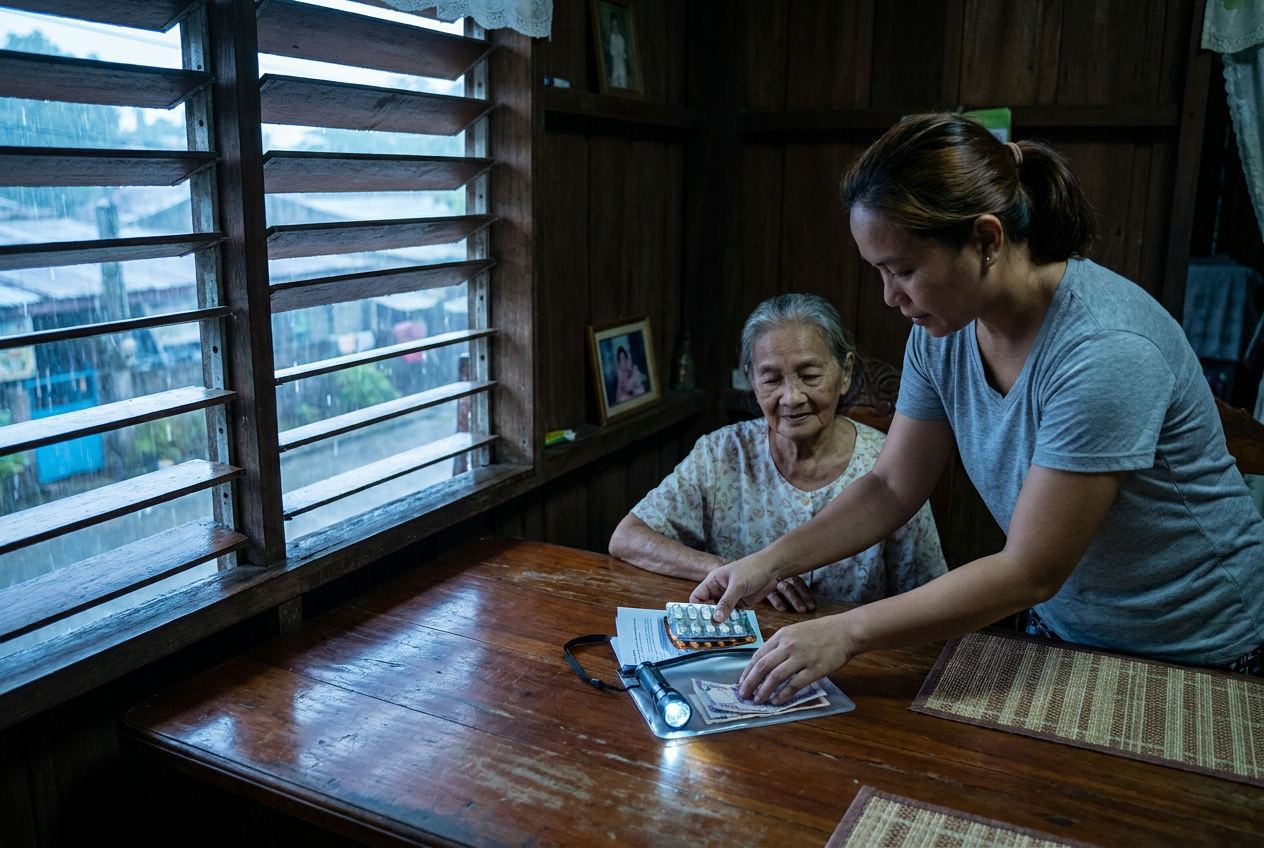
Start with the care summary card. One page, laminated or in a zip-lock sleeve, listing: full name, birth date, key medical conditions, current medications with dosages, allergies, blood type if known, attending doctor’s name and contact number, and an emergency contact who isn’t in the house. Keep a copy in the go-bag and a second copy taped inside a kitchen cabinet or wherever the household naturally looks in a crisis. Update it every time a medication changes — a stale list is worse than no list, because people trust it.
Pack a second bag specifically for the caregiver to carry on behalf of the mobility-limited member: a change of clothes, adult diapers or hygiene supplies if needed, a pillow or cushion for pressure relief, any feeding tube or catheter supplies, a battery-powered fan if heat is a factor, and spare eyeglasses or hearing aid batteries. Don’t try to fold this into one shared bag — you will run out of room, and you will run out of hands.
Handle medication continuity separately and take it seriously — it deserves its own planning, not an afterthought bullet here. We’ve laid out how to keep a maintenance-medication supply going through a disruption, prescription renewals, and pharmacy runs in our maintenance medication guide; read it alongside this one.
Store mobility aids — wheelchair, walker, cane, hospital bed rails if relevant — as close to the exit path as your home allows. If the usual chair is heavy or won’t fit through a doorway under pressure, know in advance what the backup carry method is: a sturdy chair two people can lift, a blanket carry, or a borrowed community wheelchair kept at a barangay hall.
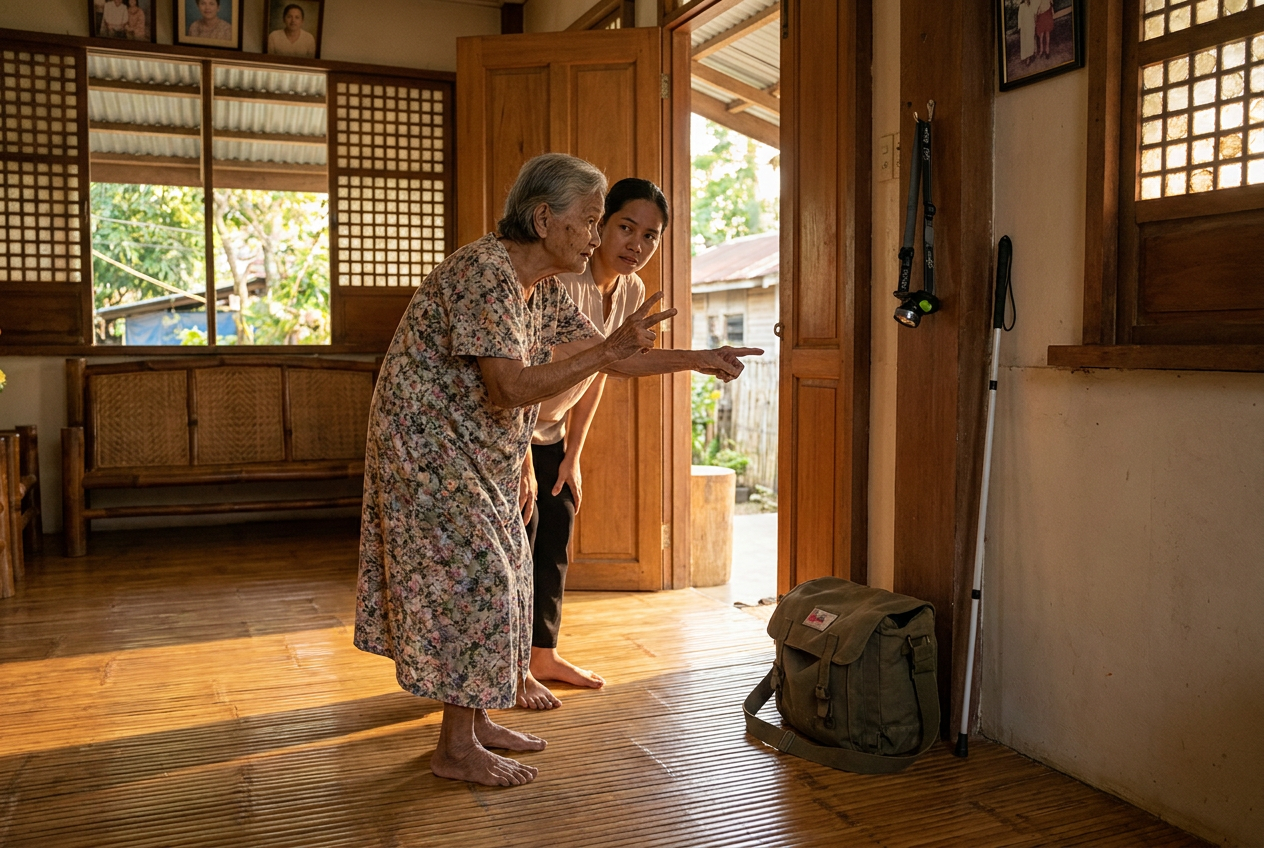
Arrange your second person now, not later. Talk to a neighbor you trust, a relative in the next block, or your barangay tanod. Tell them plainly what help you’d need and roughly how much time it takes. Most people say yes when asked directly and are far less useful when asked for the first time mid-emergency.
Register with your barangay’s list for persons with disabilities and senior citizens if you haven’t. Many barangays keep this exact list for the purpose of prioritizing evacuation assistance and welfare checks — it’s a real resource, not paperwork for its own sake, and it means officials already know your household needs help before disaster night arrives.
Decide, in advance, your shelter-in-place threshold. If your home is on a high floor, structurally sound, and not in a flood-prone or landslide-prone area — check your address against HazardHunterPH if you’re unsure — staying put with supplies may carry less risk than moving a fragile family member through wind, rain, and crowds. If you do decide to shelter in place, tell your barangay. A phone call or a message to your barangay hall, saying plainly “we are staying, here is who is in the house and why, here is our contact number,” means responders know where you are and don’t spend time looking for a household that already made its decision. Silence is what causes search delays, not the decision itself.
Don’t assume an ambulance or rescue boat will reach you in time to make the decision for you. Plan as if you’re the first responder, because for the first hours, you usually are.
The gear that helps
None of this needs to be exotic. It needs to be complete and staged where you can reach it without thinking.
A caregiver bag separate from your own go-bag, built specifically around the mobility-limited member’s needs — not a shared pile that has to serve two purposes at once.
A waterproof document sleeve or dry bag for the care summary card, ID copies, and any prescription documentation — the kind of small flat pouch reviewed in our go bag category, which covers the basics that apply to any household.
A headlamp or hands-free light, because moving, lifting, or wheeling someone requires both hands — you cannot be holding a flashlight and a wheelchair grip at the same time.
A battery pack or power bank sized for medical devices if any are in use — a CPAP, a nebulizer, a phone that needs to stay charged for coordination calls. Our power outage guide covers sizing one correctly for what you actually run.
If typhoon season is your household’s biggest recurring risk, our typhoon season guide covers the broader seasonal picture this plan sits inside.
Common mistakes
Packing one shared bag for the whole household and assuming it covers the mobility-limited member too — it won’t, and you’ll discover the gap at the worst time.
Keeping the wheelchair or walker in its everyday spot instead of near the exit, which costs minutes you don’t have during a fast-moving flood or a brownout on a high floor.
Relying on memory for medications and conditions instead of writing them down — under stress, in the dark, handing off to someone else, memory is the least reliable tool in the bag.
Never actually asking the neighbor or tanod for help in advance, so the “arrangement” only exists in your head and not in theirs.
Treating evacuation as the only acceptable choice, even when moving the person is itself dangerous, and never communicating a stay-put decision to anyone outside the household.
The one thing to remember
No bag replaces leaving early, and no bag replaces a decision made calmly instead of one made in a panic at 2 a.m. with the water rising. The one thing worth fixing this week, if nothing else: write the care summary card, put it in a waterproof sleeve, and tell one other person outside your house what your plan is. Everything else in this guide builds on that single act.