Earthquake drills for Filipino kids: a calm parent's guide
A calm, age-appropriate earthquake guide for Filipino kids: safe spots, fun family drills, and what to pack in their own go-bag.
What you’ll be able to do — and why it matters
By the end of this guide, your child will know three things cold: what to do the moment the ground starts moving, where to go in each room of your home, and where to meet you if you are not together when it happens.
That last one matters more than most parents realize. Earthquakes do not wait for the whole family to be under one roof. Tatay might be at work in Makati, Ate might be at school in Marikina, and Lola might be alone in the house in Batangas when the ground shakes. A child who has practiced what to do — calmly, more than once, like a game — will do the right thing even if no adult is there to tell them. That is the whole point of this guide.
I am not going to tell you how to explain plate tectonics or how to run your household’s full 72-hour response. That is the job of our Earthquake Ready guide, written for adults who need to think about the whole cycle — before, during, and after. This one is narrower and gentler. It is about a five-year-old, a nine-year-old, and a lola with bad knees, and what each of them needs to know and carry.
What you need
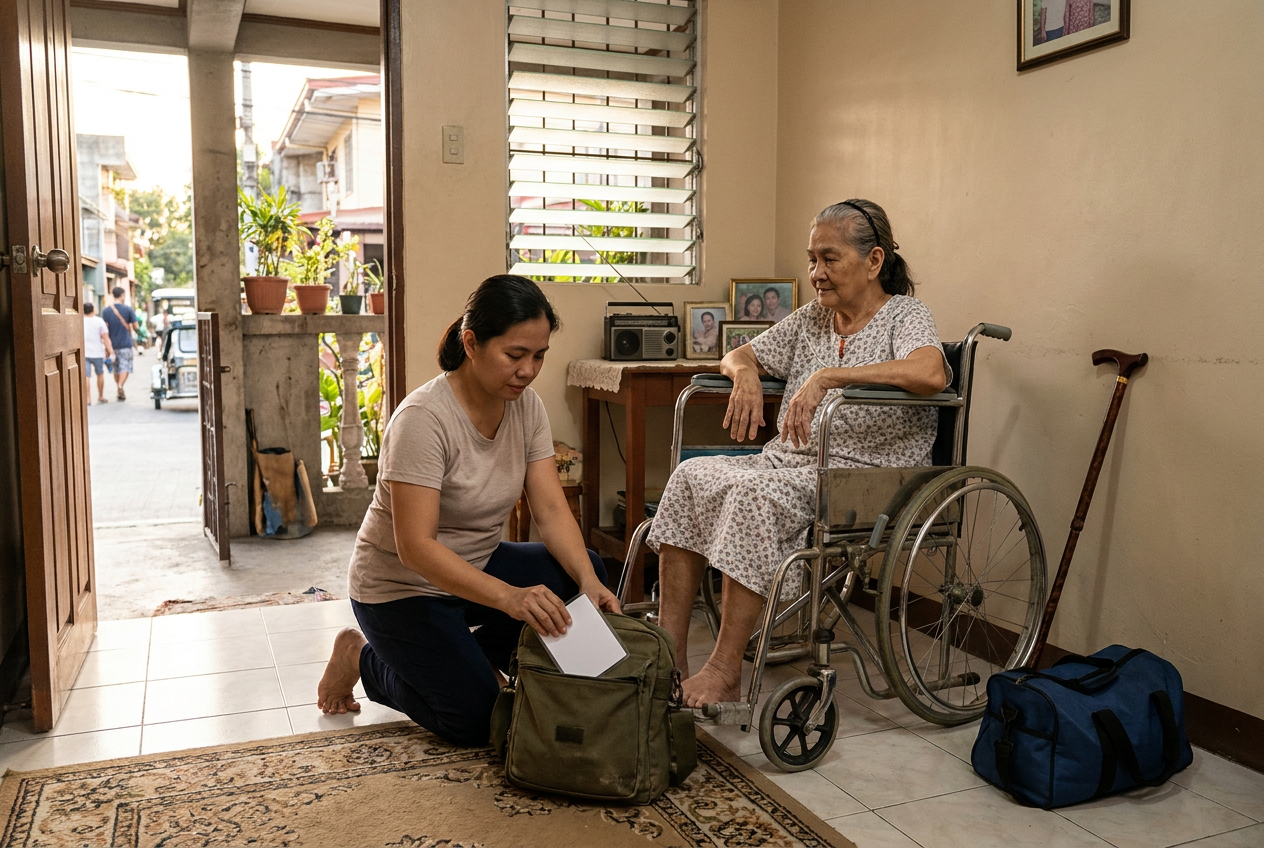
You do not need special gear to teach this. You need a few household items you probably already have, and one small bag per child.
- A sturdy table or desk in each main room — this is your “duck and cover” spot. If a room genuinely has none, know that in advance rather than discovering it mid-shake.
- A whistle for each child’s go-bag — small hands can blow a whistle far longer and louder than they can shout, and rescuers are trained to listen for three short blasts.
- A recent family photo and a laminated contact card with home address, parents’ numbers, and one out-of-town relative’s number.
- A child-sized backpack they can wear themselves — not one you carry for them. If they cannot lift it, it is too heavy.
- Our general go bag guide covers the adult version of this list if you want the fuller picture before scaling it down for a child.
The method
1. Explain it the way a child can hold onto
Little kids do not need geology. They need something they can picture. “The ground is made of giant puzzle pieces, and sometimes they bump into each other. That bump is what we feel as shaking. It usually only lasts a little while, and we know exactly what to do when it happens.” That is the whole explanation for a five- to seven-year-old. For eight- to twelve-year-olds, you can add a little more: the Philippines sits on a lot of these puzzle edges, which is why we practice for earthquakes the way other countries practice for snowstorms. It is just something we prepare for, not something to be afraid of.
Keep your own voice level when you say this. Kids read your tone more than your words.
2. Walk the house and name the safe spots together
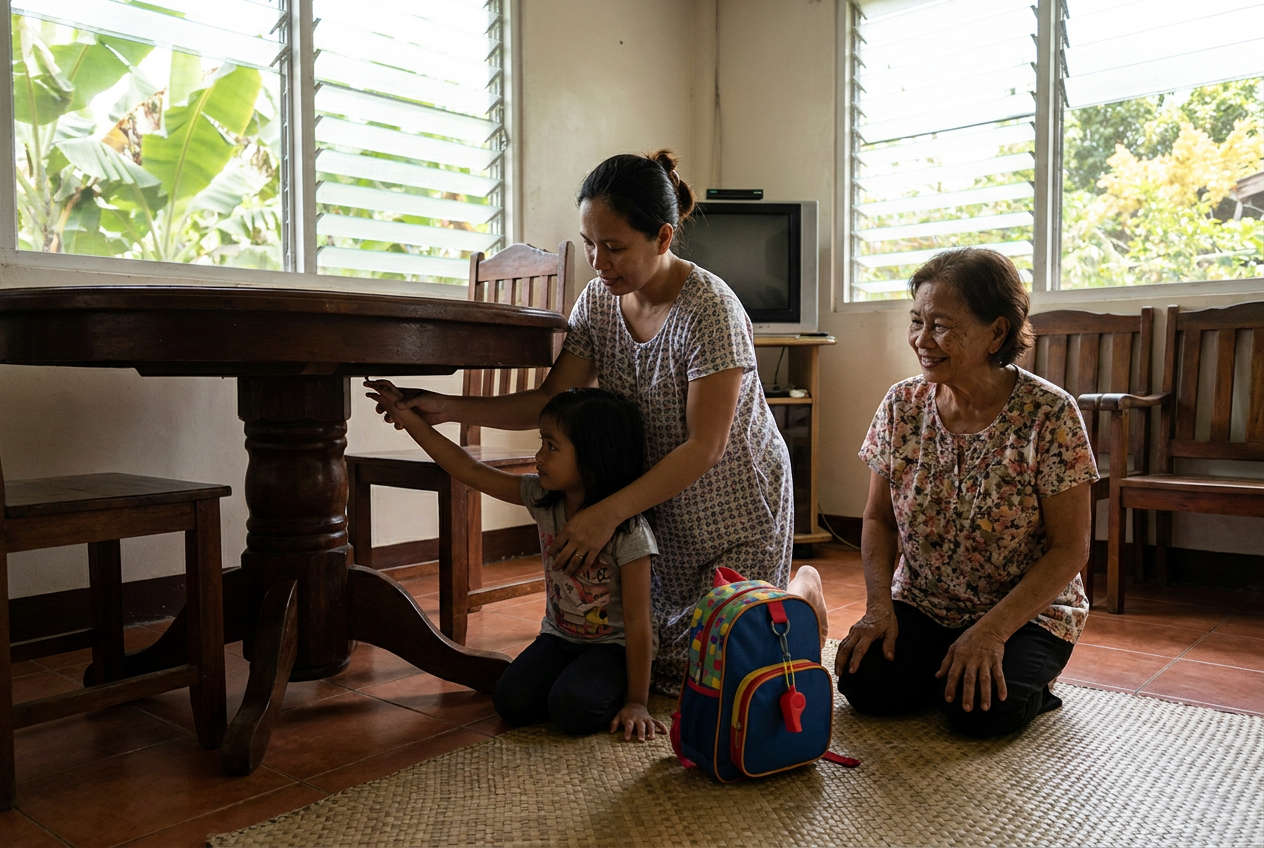
Go room to room with your child, like a treasure hunt. In each room, ask them: “Where would we hide if the floor started shaking right now?” Guide them toward sturdy tables, desks, or against an interior wall away from windows, tall shelves, and anything that can fall — televisions, cabinets, framed glass. Bedroom, sala, kitchen, and lola’s room should each have a named spot before you move on.
Teach the sequence DepEd uses in school earthquake drills, so what your child hears at home matches what they hear from their teacher: Duck, Cover, and Hold On. Duck low to the ground. Cover your head and neck, ideally under something sturdy. Hold on to it until the shaking stops. Schools also do a headcount and an evacuation to an open area once shaking ends — practice that second half at home too, walking calmly (not running) to your yard or the widest open space nearby, away from walls and posts.
3. Set the family meeting point and the out-of-area contact
This is the part that answers “what if I’m not home?” Pick a specific, physical meeting point your child can find without an adult — the sari-sari store on the corner, the barangay covered court, the gate of the school. Not “outside the house,” because “outside” is not specific enough for a nine-year-old under stress.
Then teach one phone number by heart: an out-of-town relative, ideally somewhere less likely to be affected by the same event. Local lines get jammed after a big quake; a relative in another province or region is often easier to reach than someone two barangays away. Write this number on the laminated card in their go-bag too, in case memory fails them in the moment — it happens to adults as well as children.
4. Run the drill like a game, not a rehearsal for disaster
For young children, frame the whole thing as a game with a name — “Duck-Cover-Hold,” said like a chant, works well. Call it out at a random moment during a quiet afternoon and see how fast everyone gets under their spot. Praise the response, not the speed alone; a calm seven-year-old under the table beats a panicked sprint across the room every time.
For older kids, add the full sequence: duck and cover, hold until you count to sixty, then calmly walk to the family meeting point. Time it, but keep the tone light. Do it every few months — after enrollment, after a long school break, after any real quake in the news — so it stays fresh without becoming a source of dread.
5. Pack the child’s own go-bag together
Let your child help pack it. A bag they helped choose and fill is a bag they understand and will actually use. Keep it light enough for them to wear on their own back:
- Whistle, attached where they can reach it without unzipping anything
- A small flashlight or headlamp they have practiced turning on themselves
- A comfort item — a small stuffed toy, a photo of the family
- One change of clothes and a light rain jacket
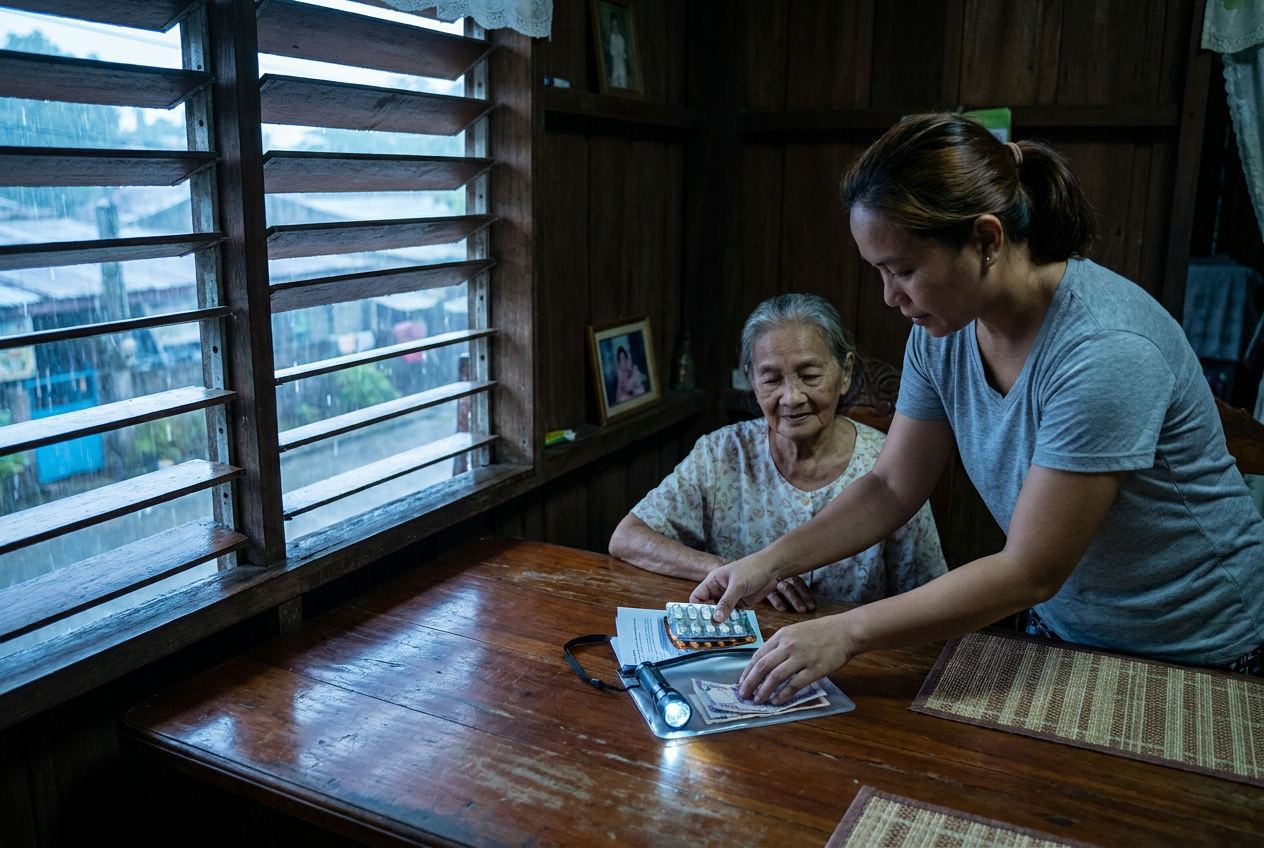
- A few days of any medication they need, clearly labeled
- Bottled water and a couple of familiar snacks
- The laminated contact card with the meeting point and out-of-town number
- A simple whistle or note in the bag written in your child’s own words, if they are old enough — kids remember what they wrote themselves
Variations & conditions
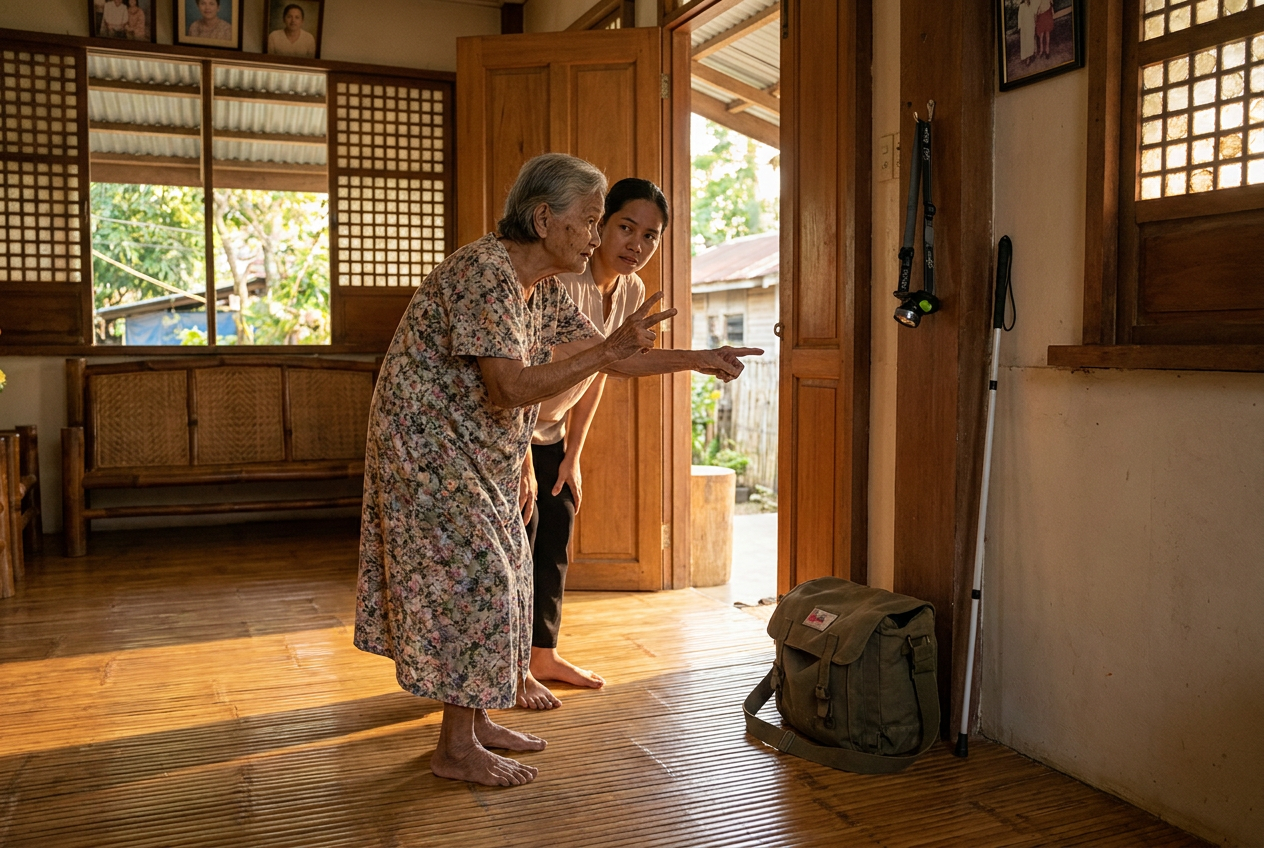
For lolo and lola in the house: the safe spots and drill need to account for mobility. A sturdy table might be too low to get under quickly with bad knees — an interior wall corner away from windows can be the more realistic safe spot. Practice the walk to the meeting point at their pace, not the children’s pace, so everyone knows what “together” actually looks like.
At night: keep a flashlight or headlamp within arm’s reach of each bed, not across the room. Practice the drill once in the dark, lights off, so it is not the first time a child has done this without seeing clearly.
If you live on a high floor: lifts will likely stop working, and stairwells can be crowded and frightening for small children. Practice the stairwell walk in calm daylight so it is familiar, and agree in advance that you do not use the elevator, full stop.
If it happens during a storm or flood season: two hazards rarely arrive perfectly separated. If the meeting point is low-lying and floods easily, agree on a backup meeting point that stays dry, and mention both to your child so neither is a surprise.
Common mistakes
Making the drill feel like a punishment or a test. If a child gets it “wrong,” correct gently and try again — this is a skill, not an exam.
Skipping the out-of-area contact because “we’ll just call each other.” Local networks get congested fast after a real event. A number outside the area is often the only one that gets through.
Packing the child’s go-bag too heavy. If they cannot comfortably wear it on both shoulders and still run, take something out. A bag they cannot carry is a bag that gets left behind.
Only doing the drill once. A drill done once and never repeated fades within months, especially for younger kids. Little and often beats one big serious rehearsal.
Explaining it as something to fear rather than something to prepare for. Kids pick up dread from adults faster than they pick up facts. Calm repetition teaches the lesson better than a serious lecture ever will.
How to practise safely
Start small: one calm conversation, one walk through the house naming safe spots, no drill yet. A week or two later, do the first “Duck-Cover-Hold” game during a quiet moment — announce it is coming, so the first one is not a surprise. Once that feels normal, start doing it unannounced every few months, and add the walk to the meeting point once ducking and covering is second nature.
Revisit the out-of-town contact number every school year — numbers change, and so does a child’s memory of them. And whenever PAGASA or PHIVOLCS is in the news for a real event, however far away, that is a natural, low-pressure moment to ask your child to walk you through the steps again. It keeps the knowledge current without ever needing to say the word “disaster” out loud.