Emergency food ration packs for Filipino households
Build a 72-hour emergency food box from sari-sari and grocery staples, plus a simple twice-a-year rotation system so nothing expires unnoticed.
What you’ll be able to do — and why it matters
After a typhoon passes or the ground stops shaking, the first 72 hours are usually the hardest — not because help isn’t coming, but because it takes time to arrive. Roads get cleared, lines get restored, sari-sari stores reopen once their owners feel safe enough to lift the shutters. In the meantime, an ATM with no power is just a locked metal box, and a delivery app is only as good as the road it needs.
A ration pack is not about surviving in the wilderness. It’s a box or two of food your family already recognizes and would eat on a normal Tuesday, set aside so you’re not the household standing in line at the one open store with everyone else in the barangay. Done right, it costs about what you’d spend on a slightly bigger grocery run, and it sits quietly in a cabinet until the day you need it — or until it’s time to eat it anyway, before it goes near its expiry date.
This guide covers what to store, how much, how to pack it so Philippine heat and humidity don’t ruin it early, and a rotation habit that actually sticks. It does not cover water treatment — see our clean water coverage for that — or cooking during an outage, or pet food, which has its own article in the pets go-bag guide.
What you need
You don’t need anything exotic. Almost everything below is sold at a grocery or your neighborhood sari-sari store already:
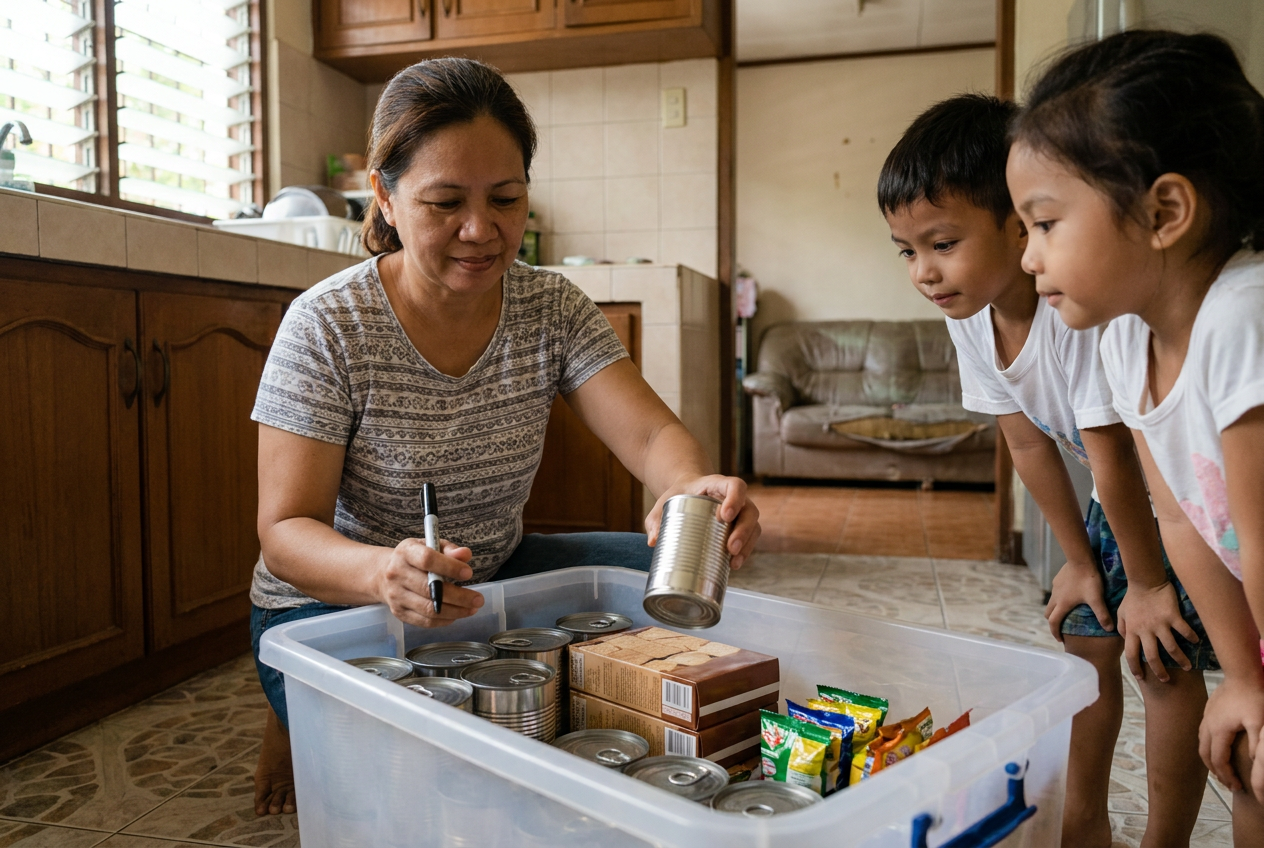
- Canned goods — corned beef, sardines in tomato sauce, tuna flakes, Vienna sausage, canned pork and beans. Pick ring-pull cans where you can; a can opener is one more thing to lose track of, though it’s worth keeping one taped to the box just in case.
- Biscuits and crackers — Skyflakes, Fita, Marie biscuits, or similar. Dense, filling, and they last a long time sealed.
- Instant noodles you can cold-soak — some cup noodles and even some pouch noodles will soften in cool or lukewarm water if you don’t have a way to boil water. It won’t taste like the packet photo, but it’s real food. Worth testing once at home during a calm weekend so you know which brands actually work this way for your family.
- Powdered juice or oral rehydration-style drink mixes — helps plain water go down easier for kids, and gives a small sugar lift when everyone is stressed and tired.
- Ready-to-eat rice in pouches, or crackers with peanut butter or cheese spread — small comfort items matter more than they sound like they would on day two.
- A few sweet items — biscuits, candies, or a small chocolate bar. Morale is not a luxury when the lights are out and a toddler is asking why.
None of this needs to be “survival food” bought from a specialty supplier. In fact, I’d actively avoid dehydrated camping meals here — they’re priced for hikers, need boiling water you may not have, and add nothing that a can of corned beef and a sleeve of crackers doesn’t already do better for less.
The method — step by step
1. Work out your numbers first. A simple rule that holds up in practice: enough canned goods, biscuits, and shelf-stable food for three days, per person, in the household. For a family of four, that’s roughly 12 person-days of food. In practice this looks like about 8–10 cans, two or three sleeves of crackers or biscuits, a few packs of soak-able noodles, and a small stash of powdered juice — sized to what your family actually eats, not a chart. If you have a baby, an elderly parent, or someone on a specific diet, their food is separate and needs its own check, since none of this is medical guidance.
2. Budget it like a slightly bigger grocery trip. For a family of four, a reasonable starting ration box costs somewhere in the ₱1,200–₱1,800 range if you’re buying ordinary supermarket or sari-sari brands and not chasing anything imported. Spread over a few pay cycles, it never feels like a big hit — buy two extra cans and a sleeve of crackers on your regular grocery run for a month or two and you’ll have it built before typhoon season starts in earnest.
3. Pack it to survive heat and humidity, not just sit in a corner. Philippine homes get hot, and a lot of us store things in a garage, a top shelf, or near a window. Humidity is the real enemy of biscuits and crackers — it doesn’t take much for them to go soft and stale months before their printed expiry. So:
- Use a sealed plastic bin with a locking lid, not just a cardboard box, if it’s going anywhere near a garage, laundry area, or ground floor that floods.
- Keep it off the floor — even a low shelf or a couple of wooden pallets underneath buys you protection if water gets in.
- Repack crackers and biscuits into a zip-lock or vacuum bag if the original packaging is thin foil — an opened box left in a hot cabinet degrades fast even if it’s never been opened.
- Store away from direct sun and away from anything that generates heat, like the top of a refrigerator.
4. Label everything with the date you bought it, not just the printed expiry. Write the purchase date on the outside of each can or pack with a permanent marker, or keep a simple list taped inside the lid. Printed expiry dates are sometimes small, sometimes on the bottom of the can, and easy to miss in a hurry. Your own handwriting is faster to check at a glance.
5. Rotate it twice a year, tied to dates you already remember. The habit that actually survives contact with real life is one that piggybacks on a date you’re already marking. Two good anchors for the Philippines:
- Start of typhoon season (May–June, ahead of the June–November peak that PAGASA tracks each year) — check and restock.
- New Year — when a lot of households are already doing a pantry clean-out anyway.
On each rotation date: pull everything out, check dates, cook and eat anything within a couple of months of expiry as part of normal meals, and replace it with fresh stock. Nothing goes to waste — it just becomes dinner a little earlier than planned.
Variations & conditions
Apartment or condo households on a high floor. If the lift goes down, you’re carrying this box down stairs, possibly in the dark. Keep it light enough for one person to manage, or split it into two smaller bins rather than one heavy one.
Households in low-lying or flood-prone barangays. Store the ration box on a shelf, not the floor, and check your area’s flood risk on HazardHunterPH if you’re not sure how exposed your street is. A box that survives an ankle-deep flood is very different from one that needs to survive knee-deep water.
Extended family or shared households. Multiply per-person quantities honestly rather than assuming “there’s usually extra.” Ration packs get raided quietly for everyday snacking if they’re not somewhat separate from the regular pantry — a labeled bin helps everyone recognize it’s the emergency stock, not fair game on a random Tuesday.
No-cook versus minimal-cook. If you know you’ll have a gas stove and matches even without electricity, you have more flexibility — but plan for the scenario where you don’t, since that’s the harder case. Everything on the list above should be edible cold or after a cool-water soak if it absolutely has to be.
Common mistakes
- Buying “survival food” instead of food your family eats. Freeze-dried meals and specialty bars sound impressive but cost more, need water or boiling, and often sit untouched because nobody wants to eat them. Stick to brands your household already likes.
- Storing it and forgetting it entirely. A ration box with no rotation date becomes a box of expired cans within two years. The twice-a-year check is the whole system — skip it and you’ve just built a slow-motion waste pile.
- Packing only canned goods with no opener, no crackers, no easy wins. Variety matters more on day two than it seems on day one.
- Leaving it somewhere it can flood or bake. A ground-floor garage in a flood-prone barangay, or a hot attic, undoes all the careful shopping.
- Assuming the store will just be open. Sari-sari stores and small groceries close for real reasons after a bad typhoon — no power for the fridge, no stock truck yet, the owner’s own house needs attention first. The ration pack exists for exactly that gap.
How to practise safely
The best test of a ration pack is quiet and undramatic: once or twice a year, pick a random evening and eat dinner entirely out of the box — no stove, no extra ingredients, whatever’s inside as-is. It tells you fast whether the noodles actually soften the way you hoped, whether the kids will eat the crackers without complaint, and whether three days of food actually feels like three days once it’s in front of you. Adjust the list based on what came back untouched and what ran out first.
Pair this with your family’s go bag check and your household’s clean water plan so all three habits — food, water, grab-and-go bag — move on the same twice-a-year schedule. None of this needs to be dramatic. It’s closer to checking the fire extinguisher than preparing for the end of the world — routine, quick, and easy to forget precisely because it usually isn’t needed.
Screenshot-ready checklist
Per person, for 3 days:
- 3–4 canned goods (corned beef, sardines, tuna, Vienna sausage)
- 1 sleeve biscuits or crackers
- 1–2 packs soak-able instant noodles
- 2–3 sachets powdered juice or rehydration mix
- Small comfort item (candy, chocolate, peanut butter)
Packing:
- Sealed plastic bin with locking lid
- Stored off the floor, away from heat and direct sun
- Crackers repacked in zip-lock if original packaging is thin
- Can opener taped inside the lid
Labelling:
- Purchase date written on each item or listed inside the lid
- Master list taped to the outside of the bin
Rotation:
- Check at start of typhoon season (May–June)
- Check again at New Year
- Eat anything nearing expiry as normal meals; replace with fresh stock
A ration pack like this won’t feel like much on the shelf — a plastic bin of the same canned goods already in your kitchen. That’s the point. It’s not gear, it’s groceries with a date on them, and the only skill involved is remembering to check twice a year.