Earthquake aftermath: checking your home before re-entry
Earthquake just hit? Learn how to check your home for damage before going back inside — a step-by-step safety guide for Filipino families.
What you’ll be able to do — and why it matters
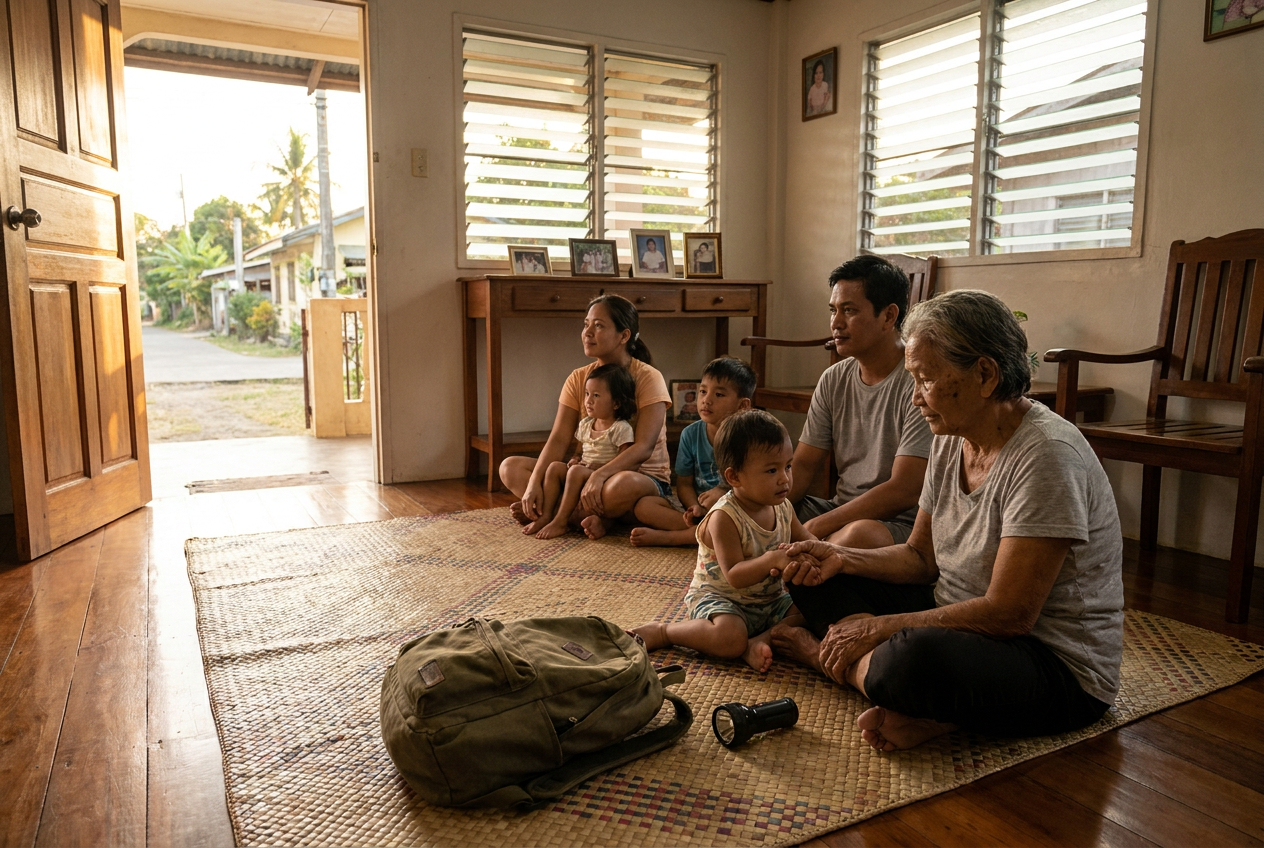
The shaking has stopped. You are standing in the street, maybe in your pajamas, maybe barefoot, and everyone is looking at the house asking the same question without saying it out loud: can we go back in?
This guide is about that narrow, tense window — after the quake, before you cross the threshold again. It will not tell you what to do while the ground is moving (that’s covered in our earthquake-ready guide on preparing for the Big One), and it will not walk you through the days of aftershocks that follow. It is about the ten minutes where a family has to make a call with the information they can gather themselves, and know when that call isn’t theirs to make alone.
I have never pulled a family out of a Philippine building after a quake — my search-and-rescue years were in Australian wilderness, not urban search and rescue. But the discipline is the same one I used before ever stepping onto a search track: check what you can check, trust what you can verify, and never talk yourself into believing something is safe just because you want it to be. That instinct matters more here than almost anywhere else in emergency preparedness, because the cost of guessing wrong is the building coming down on top of you.
What you need
Nothing on this list is exotic. Most of it should already be in your go bag.
- A flashlight or headlamp — battery or hand-crank, not your phone as your only source (phones die fast and you need both hands free). If you haven’t picked one yet, we’ve reviewed a few in our headlamp roundup.
- Sturdy, closed shoes — slippers do nothing against broken glass or nails in fallen debris. Keep a pair by the door or in your go bag.
- A whistle — to signal if you get trapped or need attention, not to use casually.
- A working phone with the barangay hotline and your LGU engineering office number saved. Save these before you need them, not while standing outside a cracked house.
- A basic sense of your home’s normal — this sounds obvious, but knowing what your walls, gas line, and ceiling looked like before is what lets you spot what’s wrong after.
You do not need a hard hat, a gas detector, or a structural engineering background. What you need is patience and a willingness to say “not yet” out loud.
The method: step by step
1. Look at the outside first — before anyone goes near the door
Stand back, far enough to see the whole face of the house, and look for:
- Diagonal cracks wider than a pencil, especially the X-shaped kind that run corner to corner across a wall panel. As a rough rule of thumb, a crack you could slide a coin’s edge into (roughly 5 millimeters or more) is worth taking seriously — this isn’t a precise engineering measurement, just a gut check you can do from where you’re standing. Thin hairline cracks in old plaster are common and usually cosmetic. Wide diagonal or X-shaped cracks are different — they typically mean the wall took real lateral, side-to-side force during the shaking, not just normal settling.
- A wall or post that looks like it’s leaning compared to before. Even a few degrees off vertical is worth taking seriously.
- A roofline that sags or dips where it didn’t before.
- Gaps at the foundation, or a house that looks like it has shifted slightly off its base.
- Anything that looks like it could still fall — loose water tanks, cracked concrete overhangs, hanging electrical wires, a leaning fence or wall next door.
If you see any of these, stay out and call your barangay or city engineering office for a rapid assessment. Don’t try to “just check quickly.” That’s exactly the decision that goes wrong.
2. Do the smell-and-sound check before anyone steps inside
Before opening the door fully, pause at the entrance and use your nose and ears:
- Smell for gas. LPG has a distinct rotten-egg additive smell — if you catch even a faint whiff, do not enter, do not flip any light switch, do not light anything, and do not use your phone or any electronic device near the doorway (a spark from a switch or a phone can ignite gas that has pooled indoors). Back everyone away to a safe distance outside and stay there. Do not go back to open windows or doors “to air it out” — that means walking into the exact space you’re worried about. Call the Bureau of Fire Protection or your LPG supplier’s emergency line and let them handle ventilation and shutoff once they arrive.
- Listen for hissing. A hissing sound near where your gas line or tank sits is a leak until proven otherwise — treat it the same as a smell: back away, don’t touch anything, call for help.
- Listen for structural sounds — creaking, settling, small debris still falling. If the house sounds like it’s still moving, it might be.
If either check raises a flag, that’s your answer. Wait outside.
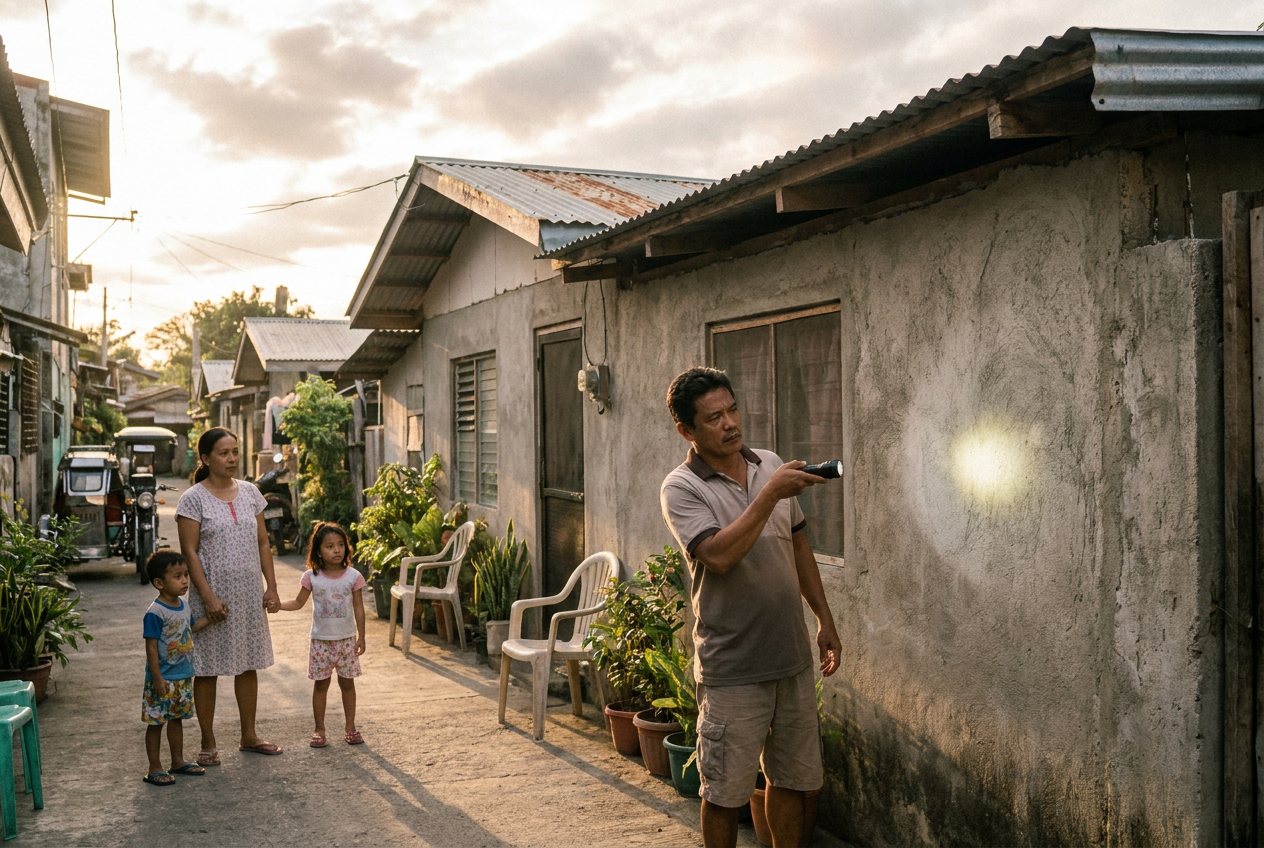
3. Use a flashlight, never an open flame
If the outside looks intact and there’s no smell of gas, you can do a careful walk-through — but light it with a flashlight or headlamp only. Never a candle, lighter, or match. If there is a gas leak you haven’t detected yet, an open flame is how a bad situation becomes a tragedy. This is worth repeating to every member of the household, especially kids who might reach for a lighter out of habit during a blackout.
Walk slowly. Check:
- Ceilings and walls for new cracks, especially near doorframes and corners.
- Whether doors and windows still open and close normally — jamming can mean the frame has shifted.
- The floor for new unevenness or tilting.
- Cabinets and shelves for anything precariously balanced, ready to fall on the next aftershock.
If an aftershock hits while you’re inside, stop the check immediately: drop, cover under something sturdy like a table, and hold on until the shaking stops, then leave the house right away — don’t finish the walk-through, don’t grab anything else, just get everyone back outside and start the outside check over again from scratch.
Don’t linger. This is a quick pass to gather information, not a chance to start cleaning up.
4. Shut off utilities at the main only if you can do it without entering a doubtful area
If you saw or smelled anything concerning, or even if things look fine but you want to be cautious before the family resettles inside, you can shut off utilities — but only if reaching the shutoff doesn’t mean entering a room with visible structural damage, standing water, or exposed wiring:
- Gas — shut off at the tank or main valve if you can reach it safely and it is out in the open (most LPG setups in Philippine homes have the tank outside or in a ventilated area). Use your hand, not a metal tool that could spark. If reaching it means stepping past debris, a leaning wall, or into a room you’re unsure about, leave it and tell the responding team the tank is still on.
- Electricity — turn off at the breaker only if the panel itself looks undamaged, dry, and is not near sparking or exposed wires. Make sure your hands and feet are dry before touching it. If you saw sparking, smell burning, see the panel area wet or cracked, or the wall around it is damaged, do not approach it — leave the power on and wait for an electrician or utility crew instead.
- Water — shut off at the main if you see pipes visibly broken or leaking and the valve is easy to reach without wading through debris; a burst pipe indoors during a stressful night is its own headache, but it is not worth an injury to prevent.
You don’t need to shut everything off if nothing looks wrong, and you should never push into an area that feels unsafe just to reach a valve or a breaker. This step is for damage you can reach and see safely — not a reason to take a risk.
5. Call for a rapid assessment if you have any doubt
This is the step people skip because they don’t know it exists. PHIVOLCS monitors earthquakes and issues intensity and impact information, but it does not send teams to inspect individual homes — that job belongs to your city or municipal engineering office, often working alongside the Association of Structural Engineers of the Philippines (ASEP) and the Office of Civil Defense after a significant quake. Call your barangay hall or your city/municipal engineering office and ask for a rapid safety assessment. It costs you a phone call. It costs a bad guess a lot more.
If your area was hit hard, you may see engineers post a color-coded placard on inspected buildings — commonly green (inspected, safe to occupy), yellow (limited entry, restricted use), or red (unsafe, do not enter). If you see a placard, believe it over your own read of the situation, even if the house looks fine to you from outside.
Your own visual check in this guide is a first filter — a way to decide whether you can safely wait outside near your home, gather your go bag from a doorway, or need to stay well clear entirely. It is not a substitute for a professional inspection, and if a barangay official, engineer, or the LGU posts a placard or tells you the building is not cleared, that overrides anything you concluded on your own. No amount of confidence at home beats a trained eye that has actually assessed hundreds of buildings.
Variations & conditions
At night versus daytime. Night quakes are harder — you can’t see the exterior cracks or leaning walls as clearly even with a flashlight. If it happened at night, be more conservative: wait for daylight or a neighbor’s floodlight before doing even the exterior check, unless there’s an obvious reason (gas smell, visible fire risk) to act immediately.
Apartment or condo living, high floors. If you’re several floors up, going back in to “just check” is riskier because you can’t see the building’s overall structure from inside your unit, and elevators are almost always out anyway — the lift losing power is often the first sign something’s wrong with the building’s electrical systems. Wait for building management or the LGU to clear common areas and the structure itself before individual unit checks.
Heavy rain right after the quake. In flood-prone or low-lying areas, a quake followed by rain complicates things — cracked foundations plus water can equal faster water ingress. If your area is also flood-prone, it’s worth checking HazardHunterPH beforehand (not in the moment) so you already know your baseline risk profile.
Older homes versus newer construction. Older, unreinforced masonry homes are generally more vulnerable to earthquake damage than newer buildings built to updated codes. If your home is older, treat borderline cracks more seriously and lean toward requesting an assessment rather than deciding it’s probably fine.
Common mistakes
- Going back in “just for a minute” to grab valuables. This is how families get hurt during aftershocks. Nothing inside is worth more than everyone staying outside a few minutes longer.
- Using a lighter or candle to check a dark room. If there’s a gas leak you haven’t smelled yet, this is the mistake that turns a structural problem into a fire.
- Going back toward the house to “air it out” after smelling gas. If you smell gas, the answer is to move away and call for help, not to open windows or doors yourself.
- Assuming no visible damage means no risk. Structural damage isn’t always visible from outside. If the shaking was strong and prolonged, get the assessment even if the house looks fine.
- Confusing hairline cosmetic cracks with structural cracks. Not every crack is an emergency — thin, shallow surface cracks in old paint or plaster are common and usually cosmetic. The concerning ones are wide, diagonal, and go through the wall, not just the paint.
- Reaching for a breaker panel or gas valve in a damaged or wet area. If getting to the shutoff means stepping into a room with visible damage, exposed wiring, or standing water, leave it alone and tell the professionals when they arrive.
- Overriding an official “not cleared” notice or placard because the family is tired and wants to go home. I understand the pull. It’s still the wrong call. Wait for clearance.
How to practise safely
You can’t rehearse an actual earthquake, but you can rehearse the decision-making so it isn’t the first time your family has thought about it under stress.
- Walk your own house now, in calm daylight, and note what “normal” looks like — where the hairline cracks already are, how your gas line looks, which walls are load-bearing if you know. This baseline is what makes spotting new damage possible later.
- Save the numbers. Barangay hall, city engineering office, Bureau of Fire Protection emergency line, and your LPG supplier’s hotline. Put them where every adult in the house can find them without needing your phone specifically.
- Do a nighttime flashlight drill. Practice finding and using your flashlight in the dark, from your actual sleeping position, without turning on any lights. Muscle memory beats panic.
- Talk through the “we don’t go back in yet” rule with kids. Make it a simple, repeatable rule they can say back to you: no smell of gas, no big cracks, no leaning walls — and even then, we wait for the flashlight, not fire.
None of this replaces professional judgment when the moment comes. What it does is buy your family a calmer, clearer few minutes to make the right call — and the patience to wait for someone qualified to make the final one.
Galing Gear shares general preparedness and first aid information based on sources such as the DOH, WHO and the Philippine Red Cross. It is not a diagnosis or prescription, and it does not replace a doctor, nurse, pharmacist or trained responder. We never give medicine doses. Follow the latest advice of the DOH, your local health office and your medicine’s label. In an emergency, call 911. Philippine Red Cross: 143. Mental health crisis (NCMH): 1553 (landline). When unsure, get checked.