Landslide warning signs: what to do before the ground gives way
If your barangay sits on a slope, you don't have to wait for an evacuation order. Here are the landslide warning signs Filipino households should watch for, and what to do the moment you see one.
The situation
If you live on a slope, in an upland barangay, or below a cut hillside, rain-triggered landslides are the hazard you plan around every typhoon and habagat season. Knowing the landslide warning signs in the Philippines can matter more than any official order, because slopes can fail faster than a warning can travel.
A landslide is ground that has had enough. After days of steady rain, soil on a slope soaks up water until it’s heavier than the slope can hold.
It doesn’t always happen during the worst hour of a storm. Slides often happen after rain eases a little, once water has had time to soak deep into the ground, so don’t rely on watching the sky to feel safe.
This guide is about slope failure caused by heavy, prolonged rainfall: the kind tied to typhoons and the southwest monsoon (habagat). It isn’t about landslides triggered by earthquake shaking.
It also isn’t a full evacuation checklist. For the logistics of getting out once an order is given, see our guide on barangay evacuation order: what to do in 10 minutes.
What actually matters
A handful of physical signs, read together, tell you more than waiting for an announcement. Watch for these after several days of heavy or continuous rain:
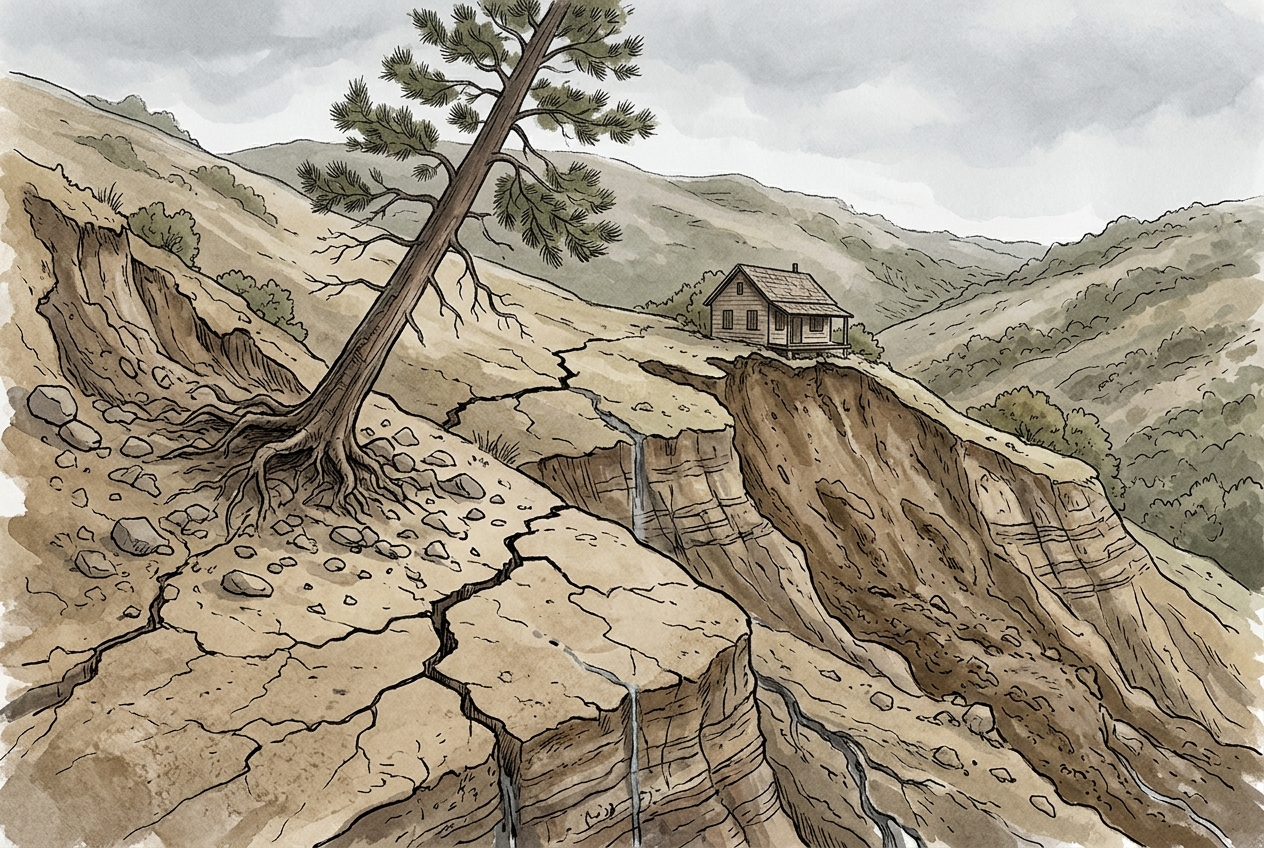
- New cracks. Fresh cracks in the ground, in pavement, in a retaining wall, or along the base of your house, especially ones that form a line roughly parallel to the slope.
- Tilting. Trees, fence posts, utility poles, or lampposts that start leaning in the same direction, when they didn’t before.
- Doors and windows that suddenly stick. If a door or window that used to open and close normally starts jamming or sitting crooked in its frame, the ground under or beside the house may be shifting.
- Water that changes. Spring water or seepage that turns muddy, or water appearing from the ground in a spot where you’ve never seen it before.
- Unusual sounds. A faint rumbling, cracking, or the sound of trees snapping, with no obvious cause.
No single sign is proof on its own. A stuck door might just be humidity. A hairline crack might be old.
But several of these together, after days of heavy rain, in a barangay already known to be prone to landslides, is a reason to move, not to wait and watch.
What to do (and what not to)
If you see these signs, move to higher, safer ground immediately. You do not need to wait for a government order once you see physical signs in your own area. Tell your barangay officials what you saw as you go, so they can check the wider area and warn your neighbors.
What to do:
- Move away from the slope, not along it. Head toward higher ground that isn’t itself part of a hill that could slide.
- Take the people who need the most help first: small children, older household members, anyone with limited mobility, and pets.
- Grab your go-bag if it’s by the door. Don’t go looking for it room by room once you’ve seen a warning sign.
- Tell at least one neighbor and your barangay contact what you saw and where.
What not to do:
- Don’t wait to confirm the sign with someone else first. A crack that widens while you debate is a crack you should have already left behind.
- Don’t go downhill to get a better look. Curiosity has put people in the path of a slide that was still moving.
- Don’t assume a single rainy afternoon is the trigger. Multi-day rain that has soaked into the slope is often the bigger risk, even once the rain itself has let up.
If anyone is injured, trapped, or missing once a slide has happened, call 911 right away. Give your barangay and the nearest landmark so responders can find the spot.
If a slide starts while you’re indoors
Get under sturdy furniture, away from windows, and away from the downhill side of the house. A heavy table or a sturdy bed frame gives some protection from falling debris and shattering glass.
The downhill wall of a house is the one most likely to take the direct force of moving earth. Put as much distance and as many walls between you and that side as you can.
If you have seconds and a clear path to a room on the uphill side or upper floor, away from the slope, take it. If you don’t, stay low, stay covered, and stay put until the movement and sound have stopped.
Once it’s safe to move, call 911 if anyone is hurt or if someone in the house is unaccounted for.
If a slide starts while you’re outdoors
Move away from the slope and away from any drainage channel or ravine, toward higher ground. Landslides and the debris flows that follow them tend to follow existing drainage lines, gullies, and low channels, so moving sideways out of that path matters as much as moving up.
Don’t run straight downhill. Move across the slope and up, away from both the moving ground and the channel it’s likely to follow.
If you or someone near you is caught, injured, or trapped by moving debris, call 911 as soon as you reach safe ground, and alert anyone nearby who can help.
The gear that helps
None of this is about buying your way to safety. A landslide-prone household’s gear list is really a fast-exit list:
- A go-bag by the door, already packed, so you’re not hunting for documents or medicine when a crack appears. See our guide on building one for general evacuation needs.
- A battery or hand-crank radio to catch PAGASA rainfall updates and any advisory for your area, especially useful when a brownout takes out the TV and the signal is weak.
- A headlamp or flashlight, since slope failures often happen at night or during a brownout, when you need both hands free to help someone move.
- Sturdy, closed shoes by the bed, not slippers, for anyone who might need to move fast across wet, uneven, or debris-covered ground.
Common mistakes
Waiting for an official evacuation order before moving. The Mines and Geosciences Bureau issues landslide advisories and hazard information using rainfall data and forecasts from PAGASA, working at the scale of a barangay or a wider area.
That system is built to catch slopes before they fail, but it can’t always see the one crack that’s opened behind your own house. Physical signs on your own property override waiting for a broadcast.
Treating one sign as decisive, or dismissing all of them. A single hairline crack isn’t a reason to abandon your house every rainy season. But a cluster of signs, cracks plus tilting plus a door that suddenly won’t shut, after days of rain, in a barangay already flagged as landslide-prone, is a different picture entirely.
Confusing this with flood evacuation. Floodwater rises and you can often watch it coming. A slope failure can happen in seconds, with little visible lead time once it starts. Don’t assume the same timeline or the same safe spot applies to both.
Going back too soon. Ground that has slid once can slide again, especially if rain continues. Wait for your barangay captain’s announcement or an official advisory from your barangay or city disaster office before returning, not just for the ground to look still.
The one thing to remember
If you see cracks, tilting, or sudden changes in your doors, windows, or water after heavy rain, don’t wait for an order: get to higher ground and tell your barangay right away. If anyone is hurt or trapped, call 911 as soon as you’re safe.
Galing Gear shares general preparedness and first aid information based on sources such as the DOH, WHO and the Philippine Red Cross. It is not a diagnosis or prescription, and it does not replace a doctor, nurse, pharmacist or trained responder. We never give medicine doses. Follow the latest advice of the DOH, your local health office and your medicine’s label. In an emergency, call 911. Philippine Red Cross: 143. Mental health crisis (NCMH): 1553 (landline). When unsure, get checked.