What to expect when you're staying at a barangay evacuation center
Once you've made it to the barangay evacuation center, a new set of problems starts: where to sleep, how to queue, how to keep your family calm and your valuables safe. Here's what actually helps.
So you’ve made the call and packed the go-bag. Your family is now sitting inside a barangay gym, school, or chapel doing duty as an evacuation center. This guide picks up right there.
If you haven’t evacuated yet, read barangay evacuation order: what to do in 10 minutes first. This one is about the hours and days after you arrive, when the question shifts from “ano ang dapat dalhin sa evacuation center” to how you actually live here for a while.
The situation
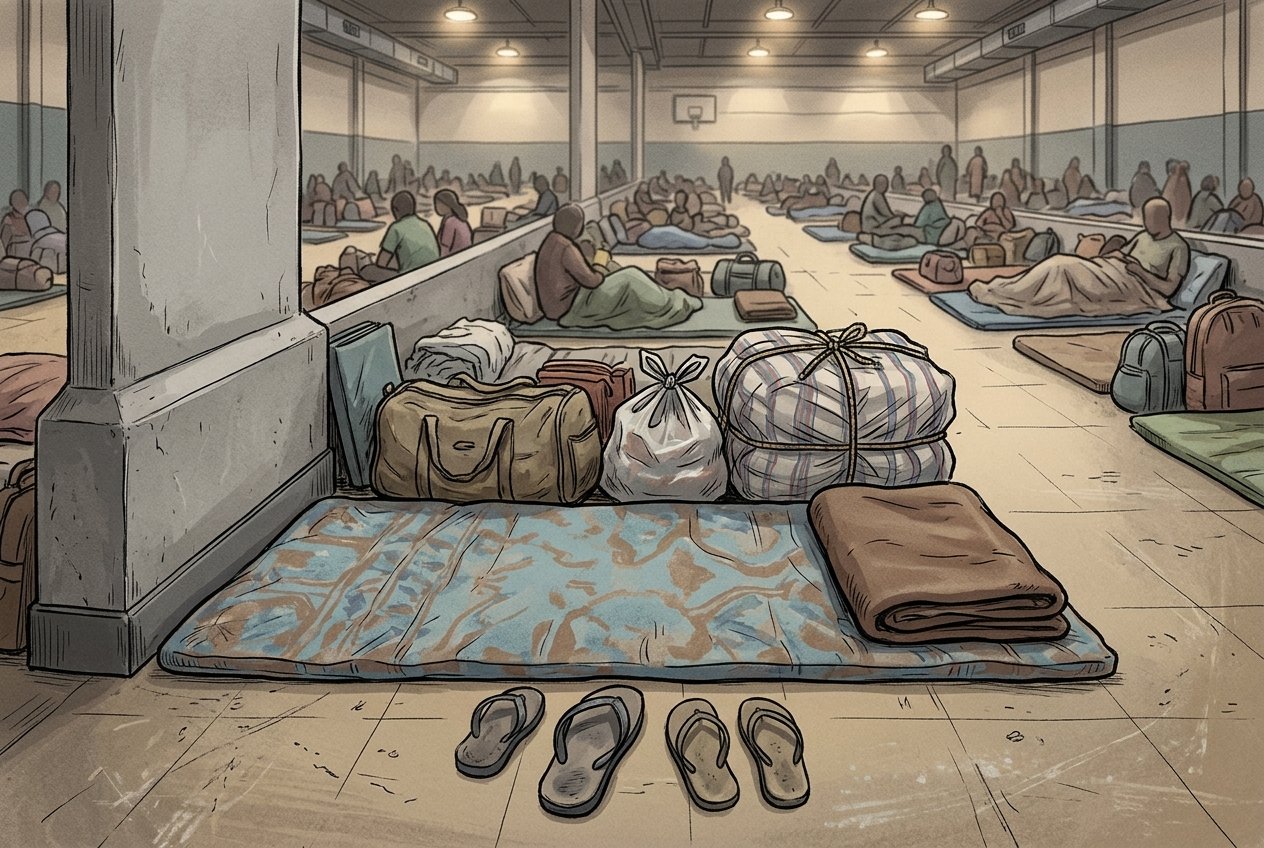
An evacuation center is shared space under stress. You might be sharing a basketball court floor with twenty other families, a single line of toilets, and one or two outlets for charging phones. Nobody assigned you a nice corner, and nobody promised you three meals.
You get what the barangay can provide, and that varies a lot from one center to another. This is shelter, not comfort. You’re not entitled to a bigger corner than the next family, but you’re not obligated to stay quiet if something is genuinely unsafe. Flag it to the barangay staff or the center coordinator on duty.
How long you’ll stay is impossible to predict from here. It depends on the floodwater, the weather update from PAGASA, and your barangay’s own assessment of when it’s safe to go home. Pack and plan as if it could be a few days, even if you hope it’s one night.
What actually matters
A few things make the difference between a rough night and a genuinely hard one.
A sleeping surface. Concrete and tile floors pull heat out of a body fast, and a thin blanket does not stop that. A foam sleeping mat, a thick folded blanket, or even flattened cardboard under a mat makes a real difference, especially for lolos, lolas, and small children.
Something for your feet. Shared floors get wet, muddy, and sometimes have broken glass or nails tracked in from outside. Bring slippers you don’t mind getting dirty, plus a spare dry pair for sleeping.
A scrap of privacy. A sarong, a thin curtain, or even a large cloth strung on a line gives you a visual boundary for changing clothes, breastfeeding, or just a few minutes of not being watched. Many families bring a length of cloth and two safety pins for exactly this.
Basic hygiene kept separate from the go-bag. Pack a small pouch with soap, a toothbrush and toothpaste, sanitary pads, diapers if you have a baby, and hand sanitizer. Shared toilets run out of supplies quickly, and you don’t want to depend on what’s left.
A way to keep your documents and cash on your body. More on this below, but the short version: don’t leave it in your bag on the floor.
What to do (and what not to) inside the evacuation center
Claiming space. Pick a spot near a wall or post if you can. It gives you a backrest, a place to hang the privacy cloth, and one less side to watch for people stepping over your things. Set your mat down early and keep your family’s bags stacked together as a visible boundary.
Queuing for relief goods and water. Centers usually run some kind of line system for food packs, drinking water, or hygiene kits, often organized by barangay staff or volunteers with a list of households. Expect waiting.
Send one adult to queue rather than the whole family. Keep an eye on young children and elderly relatives left behind at your spot.
Charging stations. If the center has power at all, expect one shared outlet or a small bank of them, and a queue for that too. Charge in short turns rather than leaving a phone plugged in all afternoon so others get a turn. A small power bank from your go-bag covers the gap between turns.
Shared toilets. Bring your own tissue, a small bottle of water for flushing or rinsing if the plumbing is unreliable, and slippers dedicated to toilet use only. Wash your hands with soap after, and remind children to do the same.
What not to do: don’t block aisles or exits with your belongings, don’t let children wander toward stairwells or parking areas unsupervised, and don’t assume the center has supplies for every need. Bring what you can for your own household.
Keeping valuables and documents secure
A crowded room with dozens of families and constant movement is not a place to leave a bag unattended. A few habits help:
- Keep a small waterproof pouch with ID, cash, and copies of important documents on your body, not in your sleeping bag or backpack.
- Split your cash: a little on hand, the rest tucked somewhere less obvious. Our emergency cash envelope guide covers how to prepare this before you ever leave home.
- Keep photos and scans of IDs, land titles, insurance papers, and medical records on your phone, backed up somewhere else too. See our digital document vault guide for how to set this up in advance.
- Take turns with your spouse or an older child watching your spot when you queue, rather than leaving it empty.
- Don’t wear or display jewelry or anything that marks you as worth targeting. An evacuation center is mostly neighbors helping neighbors, but it’s still a crowd under stress.
Keeping children and elderly relatives comfortable
A multi-day stay is hard on the people at either end of the age range. A few things help without needing special equipment:
- Keep a routine where you can: similar wake times, similar meal times, a familiar bedtime object like a stuffed toy or blanket for small children.
- Bring a few quiet activities for kids: a deck of cards, a coloring book, a small toy. Boredom turns into tears and tantrums faster than hunger does.
- For elderly relatives, check in on their comfort often. A hard floor and crowded noise are tiring in a way that’s easy to underestimate. If someone is on maintenance medicine, keep it with them, together with a written list of what they take, so another adult can speak up if that person can’t.
- If someone wants to talk about what they’ve just been through, stay close and listen if they’re willing. Don’t push a child or an older relative to describe it in detail; listening is their choice, not something to draw out of them. This is the core of psychological first aid: look, listen, link. If anyone talks about ending their life, call the National Center for Mental Health crisis line at 1553 (landline) or 911.
- If a family member has a disability or a mobility limit, the adaptations are specific enough that we’ve covered them separately: see disaster prep for families with a member with a disability and the go-bag guide for a bedbound or mobility-limited family.
The detail that matters most for people under stress is almost never the big gesture. It’s the small, repeated thing: a warm drink, a dry pair of socks, someone checking in every hour.
The gear that helps
Beyond your go-bag, a short supplementary kit for the center itself is worth packing separately:
- A foam sleeping mat or two, rolled and strapped, one per adult if you can manage the bulk.
- A sarong or lightweight curtain with a length of cord and some pins or clips.
- Extra slippers: one outdoor pair, one dedicated toilet pair, one dry pair for sleeping.
- A hygiene pouch: soap, toothbrush, toothpaste, sanitary pads or diapers, hand sanitizer, tissue.
- A small power bank, already charged, for the gap between turns at a shared outlet.
- A waterproof document pouch to wear under clothing.
- A few quiet activities for children: cards, a small toy, a coloring book.
None of this needs to be expensive. Most of it you likely already own. The sleeping mat is the one item worth buying ahead of typhoon season if you don’t have one, since it does the most to make a hard floor survivable.
Common mistakes
Packing only the go-bag and nothing for comfort. The go-bag gets you out the door safely. It usually isn’t built for sleeping on tile for two nights.
Leaving bags unattended while queuing. A moment of inattention in a crowded hall is when things go missing, not usually from malice, just from the sheer number of people moving through.
Assuming the center will have everything. Services, supplies, and capacity differ by barangay and even by which school or gym is being used. Don’t build your plan around a specific expectation you haven’t confirmed with your own barangay.
Ignoring hygiene until someone gets sick. Shared toilets and crowded sleeping areas make it easier for stomach illness and skin infections to spread from one family to the next. Washing hands with soap before eating and after the toilet matters more here than at home.
Not checking on quiet family members. The person who says “I’m fine” and goes quiet in a corner, whether a teenager or a lolo, is often the one who needs a check-in most.
The one thing to remember
Bring what makes the floor, the toilet, and the waiting bearable: a mat, slippers, a hygiene pouch, and a way to keep your documents on your body, not in a bag on the ground.
Galing Gear shares general preparedness and first aid information based on sources such as the DOH, WHO and the Philippine Red Cross. It is not a diagnosis or prescription, and it does not replace a doctor, nurse, pharmacist or trained responder. We never give medicine doses. Follow the latest advice of the DOH, your local health office and your medicine’s label. In an emergency, call 911. Philippine Red Cross: 143. Mental health crisis (NCMH): 1553 (landline). When unsure, get checked.