Protecting your car or motorcycle before the floodwater rises
Paano iligtas ang sasakyan sa baha: a plain, step-by-step plan for moving your car or motorcycle to higher ground and protecting the electrics before the water comes up, not during.
What you’ll be able to do, and why it matters
This guide covers paano iligtas ang sasakyan sa baha: deciding, hours ahead of flooding, where to move your car or motorcycle and how to protect it. The short version is to act early, while roads are still dry enough to drive.
A flooded engine is often a write-off. If water gets pulled into the engine through the air intake, it can’t compress the way air does, and the engine can seize or bend internal parts in seconds. This is called hydrolock, and it’s why driving into deep water, even briefly, is a real risk to the engine itself.
Electrics are just as unforgiving in a different way. A modern car or motorcycle has computers, sensors and wiring harnesses mounted low in the body, and silty or salty floodwater corrodes those contacts long after the water itself is gone. Neither problem is fixed by anything you do once water is already at your tires. The only real fix is not being there.
What you need
- A charged phone with PAGASA for rainfall and typhoon updates, and your local government’s flood advisories.
- Knowledge of at least one higher, drier parking option near you: an elevated carport, a mall’s upper-level parking, a relative’s sloped driveway, or higher ground within your barangay.
- A basic tool kit if you plan to disconnect your battery: usually a wrench for the terminal nut, gloves, and a rag.
- Your vehicle’s comprehensive insurance policy details, including whether it covers flood or typhoon damage, kept somewhere you can find them quickly.
- A way to document your vehicle’s condition before and after, such as your phone camera. For the claims step itself, see our article on documenting typhoon or flood damage to your home for insurance and aid, which covers the same documentation habits that apply to a vehicle.
No special gear is required. What matters is deciding early and moving while it’s still safe to drive.
The method: moving your vehicle before it floods
1. Watch the signs early, not late. Check PAGASA rainfall warnings and your local government’s flood bulletins as soon as a typhoon or habagat rain is forecast. In low-lying barangays, water can rise faster than the news updates. Decide your move before the street outside is already wet.
2. Scout higher ground while the roads are dry. Think through your realistic options now, not when water is rising:
- An elevated carport or upper floor of your own building, if you have one.
- A nearby mall or commercial building with upper-level parking that stays open during storms.
- A relative or friend’s house on a sloped driveway or higher elevation.
Pick the option closest to you that you can reach on dry roads, not the “best” one three towns away.
3. Move the vehicle while it is still safe to drive. Once you’ve chosen a spot, go. Don’t wait for the water to start rising on your own street before deciding to leave.
If roads are already flooding when you check, it may be safer to leave the vehicle on the highest available ground near you and focus on your family’s safety instead. Even shallow moving water can stall an engine or push a parked car sideways into a canal. Worth saying twice: move before it floods, never during.
4. Protect the electrics where it’s practical. If your parking spot is still at some risk of shallow water, or if you simply have the time, disconnect the negative battery terminal before you leave the vehicle. This cuts power to the electrical system and lowers the chance of a short circuit if water does reach the battery tray.
A few things to know before you do this. It will reset things like the clock, radio presets, and sometimes an alarm system, which is a fair trade against flood damage. For a motorcycle, check whether the battery and electrical box sit low on the frame. If they do, ask a trusted mechanic about options like relocating the battery box or sealing connectors, done ahead of typhoon season, not during one.
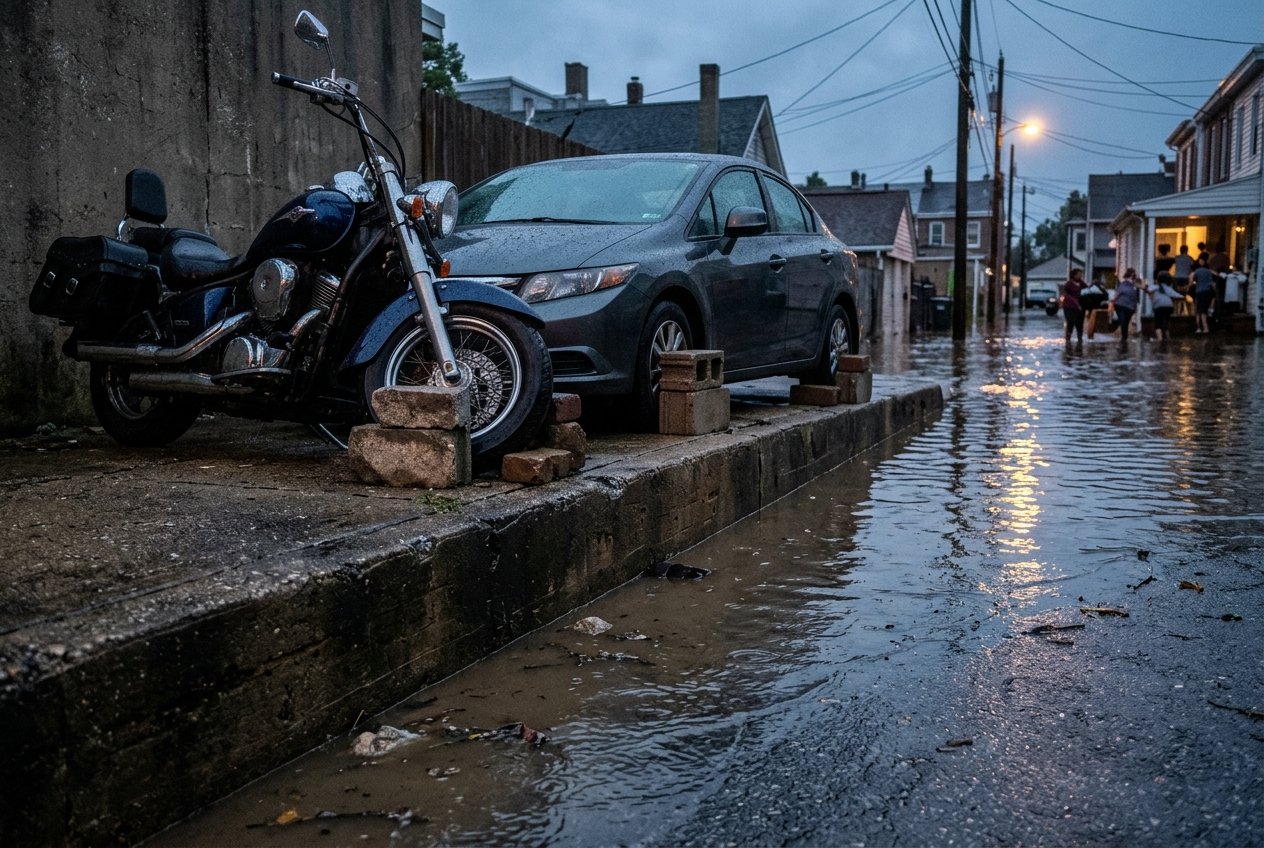
5. Raise what you can, if the vehicle must stay low. If you have no choice but to leave a vehicle somewhere that might see shallow water, use bricks, blocks or a raised platform under the wheels if it’s safe to do so.
Move anything removable, like floor mats or loose boxes, to a higher shelf or indoors. This isn’t a fix for serious flooding, only a way to buy a few extra centimeters of clearance.
6. Check your insurance before the season starts, not during it. A standard “comprehensive” policy doesn’t always include flood or typhoon damage automatically. Call your insurer or check your policy document before typhoon season to confirm what’s covered and what documentation they’ll need afterward. Whether a specific claim is covered depends on your own policy wording, so treat this as a prompt to check, not a guarantee of coverage.
Variations and conditions
Family car in a flood-prone street. If you live somewhere that floods most years, build a standing plan: a confirmed parking arrangement with a relative or a nearby building, so you’re not scrambling to find space when everyone else on the street has the same idea.
Daily commuter motorcycle. A motorcycle is lighter and easier to move than a car, which is an advantage: you can often carry it up a few steps or onto a porch. The trade-off is that its electrics and air intake usually sit lower, so even modest flooding is riskier for a motorcycle than for many cars.
Tricycle or livelihood vehicle. If the vehicle is how you earn a living, treat the moving decision as urgent, not optional. Talk to your tricycle operators’ group or barangay about any shared covered parking arranged for typhoon season, since this is often organized collectively rather than per household.
No safe higher ground nearby. If you truly have nowhere higher and dry to go, prioritize your family’s safety over the vehicle.
A car or motorcycle can be repaired or replaced; a decision to drive through rising water to “save” it can put people at risk. For decisions about staying put at home as water rises, see our guide on sheltering in place when flood water traps you at home.
Common mistakes
- Waiting to see how bad it gets. By the time water is visibly rising on your street, your safest routes to higher ground may already be cut off.
- Assuming comprehensive insurance automatically covers flood damage. Check your policy wording now, not after the water recedes.
- Driving through moving water to reach a parking spot. Even water that looks shallow can hide a stalled vehicle, an open manhole or a strong current. Local disaster offices and traffic authorities routinely advise against entering floodwater, whether in a vehicle or on foot.
- Forgetting the motorcycle because the car got all the attention. A motorcycle’s lower electrics mean it can take damage from water that a car would survive untouched.
- Leaving the battery connected “just in case” you need to move again. If you’ve already decided the vehicle will sit through risky water, a disconnected battery lowers electrical risk even if you can’t move the vehicle further.
How to practise safely
Walk the route to your chosen higher ground on a dry day and time how long it takes. Note any low points along the way that flood before the rest of the street. Do this once before typhoon season starts, so the decision on a stormy night is just “go,” not “where.”
If you plan to disconnect your battery, practise it once in calm weather. Locate the negative terminal, loosen it with the right tool, and reconnect it, so you’re not learning the process for the first time in the rain.
The one thing to remember
Move your vehicle to higher ground while it is still safe to drive. Once the water is rising on your street, the time for driving anywhere has passed, and your focus should shift to your family’s safety, not the vehicle’s.
Galing Gear shares general preparedness and first aid information based on sources such as the DOH, WHO and the Philippine Red Cross. It is not a diagnosis or prescription, and it does not replace a doctor, nurse, pharmacist or trained responder. We never give medicine doses. Follow the latest advice of the DOH, your local health office and your medicine’s label. In an emergency, call 911. Philippine Red Cross: 143. Mental health crisis (NCMH): 1553 (landline). When unsure, get checked.