Vacuum-sealing rice for long-term storage in the Philippines
Vacuum-sealing rice for go-bags and pantry storage: what it protects against, what it doesn't, and how to do it right with gear sold in the Philippines.
This is one part of a series on keeping rice safe for months or years in a Filipino household. If you are still deciding which storage method fits your situation, start with our hub guide: Long-term rice storage: the complete guide for Filipino households. This article goes deep on one method — vacuum sealing — and where it earns its place in a go-bag, car kit, or emergency box.
Why this matters
Rice does not usually fail because it “goes bad” the way fresh food does. It fails because of three slow enemies: moisture, oxygen, and pests. Moisture invites mold and gives insect eggs the humidity they need to hatch. Oxygen lets any weevil eggs already inside the grain develop, and it slowly degrades flavor and quality even when nothing is visibly wrong. Pests — mainly rice weevils and, if storage is careless, rodents — get in through any gap they can find, including a bag that is not actually sealed shut.
Vacuum sealing goes after oxygen specifically. Pulling most of the air out of a bag creates a low-oxygen environment that halts the development of any weevil eggs or larvae already in the grain, and it slows the oxidation that would otherwise dull the rice over time. A home edge sealer will not pull as deep a vacuum as a commercial chamber machine, so treat it as strong suppression of pest activity and staleness — not a guaranteed kill of every egg in every grain. Freezing rice for a few days before sealing is a more reliable way to kill any hidden eggs outright, and it is worth doing if you are starting with rice of uncertain origin. That is the whole trick of vacuum sealing, and it is a good one. But it is not a complete trick, and knowing what vacuum sealing does not do is just as important as knowing what it does.
For a go-bag, car kit, or emergency box, this matters twice over. That rice might sit untouched in a hot car trunk or a cramped storage bin for a year or more before anyone opens it. It needs to survive not just time, but neglect.
What vacuum sealing actually protects against — and what it doesn’t
It protects against:
- Oxidation and staleness, by removing most of the air around the grain
- New insect activity, since most pests that matter to rice need oxygen to develop
- Moisture creeping in, as a good seal is also airtight against humidity, provided the bag material itself is a proper moisture barrier
It does not protect against:
- Light. Standard vacuum bags are usually clear plastic. UV light degrades rice quality over time and can support condensation cycles if the pack sits somewhere with temperature swings, like a car dashboard area or a windowsill. Store sealed packs somewhere dark, or inside an opaque secondary container.
- Crush damage. A vacuum-sealed pack is not armor. Drop something heavy on it, or let it sit at the bottom of a poorly packed bag, and it can puncture or split at the seal.
- Rodents. A rat or mouse will chew through vacuum bag plastic without hesitation — thin plastic film offers no resistance to rodent teeth, which is standard pest-control guidance for any soft packaging, not just rice. Vacuum sealing keeps oxygen and insects out; it does nothing to stop teeth.
This is why we always recommend a secondary container for finished packs — more on that below.
What you need
You do not need commercial-grade equipment to do this well at home. Here is what matters, described in general terms so you can compare what is on Lazada, Shopee, or your local appliance store without chasing a specific model.
Edge sealers vs. chamber sealers
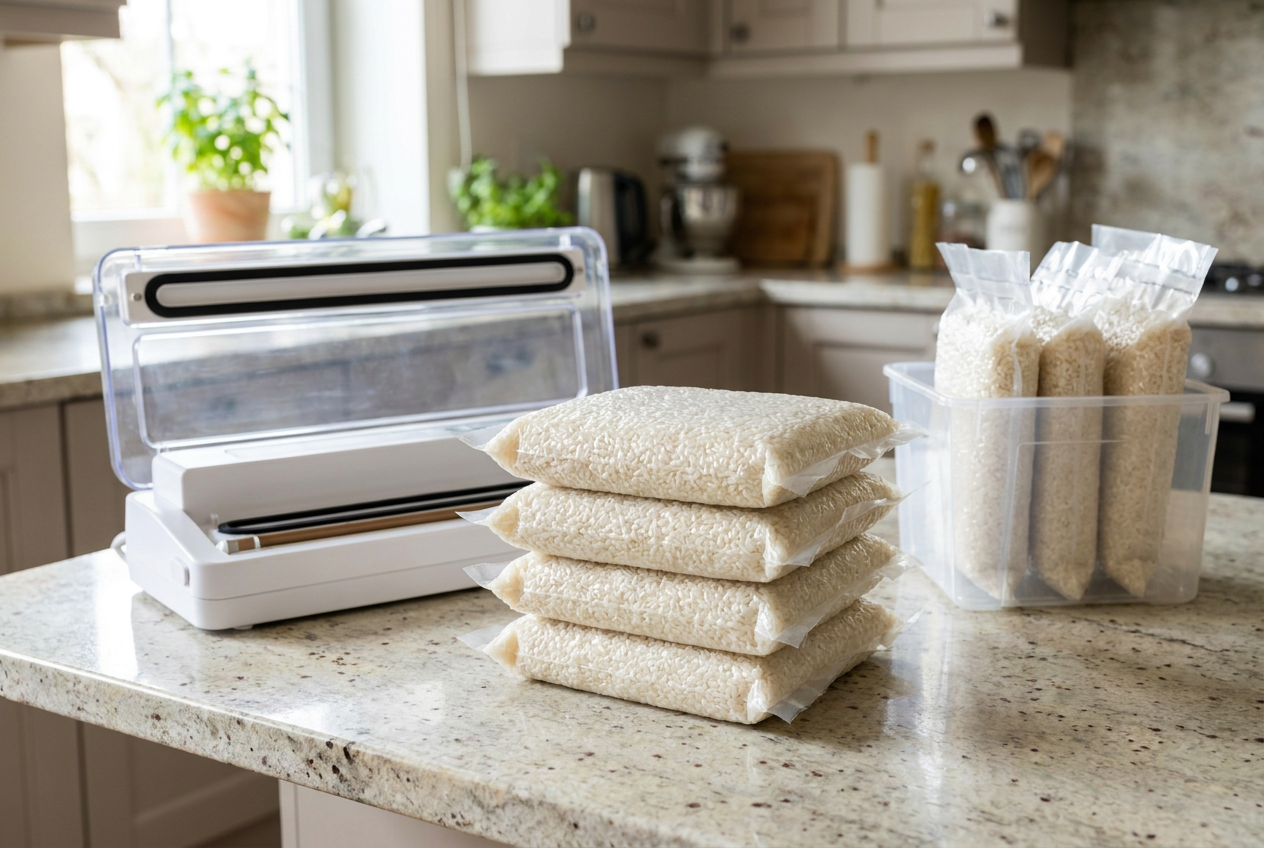
Edge sealers are the countertop machines most households already picture — you lay the open end of a bag across a sealing strip, the machine draws air out through a nozzle, then seals the edge. They are affordable and compact enough to store in a kitchen cabinet, and completely adequate for rice. Prices move around on Lazada and Shopee, so treat any figure as a rough guide rather than gospel — check current listings before you buy, and be wary of unusually cheap units from unrated sellers. Their limitation: they need a textured or channeled bag to let the air escape evenly, so you cannot use plain flat plastic.
Chamber sealers place the entire bag inside a chamber, pull a vacuum on the whole chamber (not just through a nozzle), then seal. They can use ordinary smooth bags, which are usually cheaper per piece, and they generally give a stronger, more consistent seal. The tradeoff is cost and size — chamber machines start well above what most households spend on kitchen equipment and take up real counter space. Unless you are sealing rice in real volume, an edge sealer is the sensible choice for a family.
Bags and rolls
You will see pre-cut bags and rolls you cut and seal yourself. Rolls cost less per portion and let you size each pack exactly to what you need — useful when you want distinct 1 kg packs versus smaller meal-sized ones. Whichever you buy, check the bag is rated for the sealer type you own (textured for edge sealers) and look at the material thickness, listed in microns or mils. For rice specifically, look for bags rated at least 3 mil (about 75 microns) thick — milled grain has hard, angular edges that will find their way through the thinnest bags on the market, the kind made for delicate items rather than grain.
If you are buying from Lazada or Shopee, read the actual listing specs rather than trusting the product photo — thickness and bag type vary a lot between sellers, and counterfeit or mislabeled listings are common enough that it pays to check seller ratings and reviews before committing to a bulk pack of rolls.
The method, step by step
1. Start with good rice. Vacuum sealing preserves whatever condition the rice is already in. Before portioning, check for any musty or rancid smell, visible mold, or signs of infestation like small holes or webbing in the grain. If you see any of that, discard that batch — do not seal it and hope the vacuum fixes it. It will not.
2. Portion into sensible amounts. For go-bags and emergency boxes, 1 kg packs are a practical default — enough for a family meal or two, small enough to fit into a bag pocket without dominating the space. For car kits or smaller emergency boxes, consider meal-sized packs of 200–300 grams instead, since you may only want to open one portion at a time without exposing the rest to air.
3. Fill carefully, leaving a clean seal area. Pour rice into the bag without spilling grains onto the area you are about to seal. This sounds minor, but a stray grain caught in the seal line is one of the most common reasons a seal fails months later. Wipe the inside of the bag opening dry and dust-free before sealing — any moisture or rice powder there will weaken the seal.
4. Watch for sharp edges. Milled rice grains have hard, sometimes slightly angular edges. Overfilling a bag, or folding it awkwardly during sealing, increases the chance a grain works its way into the seal or pokes through a stressed fold. Do not overfill — leave enough slack that the bag is not stretched tight once sealed.
5. Seal, then seal again. Run the seal once, then run a second seal line just inside the first. This is a small extra step that costs a few seconds and meaningfully lowers the chance of a slow leak going unnoticed. For packs headed into a go-bag or car kit — places you might not check for months — double-sealing is worth doing every time.
6. Label every single pack. Write the contents and the sealing date directly on the bag with a permanent marker, or use a printed label. “Rice — 1kg — sealed [date]” takes five seconds and saves real confusion later, especially if you have multiple emergency supplies packed together and everything is wearing the same clear plastic.
Protecting the finished packs
Once sealed, do not just toss the packs loose into a bag or cabinet. Put them inside a secondary container — a hard plastic bin, a heavy-duty stackable box, or at minimum a thick dry bag — for three reasons: it blocks light, it adds a real barrier against rodent teeth, and it protects the seal from getting crushed or punctured by everything else you are carrying. For a go-bag specifically, a rigid container is often impractical, so at least push the rice packs toward the center of the bag, cushioned by soft items, away from the edges where a fall or a jostle does the most damage.
Vacuum sealing vs. Mylar with oxygen absorbers
These two methods are often compared, and each has a place.
Vacuum sealing is faster, cheaper to start with if you already own a countertop sealer, and easy to do in small batches whenever you have time. It is well suited to rotating stock — packs you intend to use and replace within a year or two, including go-bag and car-kit rice that you will periodically check and refresh.
Mylar bags with oxygen absorbers use a thicker, opaque, light-blocking barrier and a chemical absorber that actively removes oxygen from inside the bag rather than relying on a vacuum pump. Done right, Mylar generally gets a longer realistic shelf life and better protection from light and minor punctures, since the material is tougher and opaque. It takes more setup — buying oxygen absorbers, usually heat-sealing rather than vacuum-sealing — and is better suited to rice you are putting away for years rather than rotating through a go-bag every season.
Plain guidance: if you are prepping rice you will actively rotate — go-bag, car kit, a shelf you draw from regularly — vacuum sealing is simpler and fits that rhythm. If you are laying down rice for genuinely long-term storage you do not expect to touch for several years, Mylar and oxygen absorbers are the stronger choice.
Using the packs in go-bags, car kits, and emergency boxes
For a go-bag, 1 kg packs strike a good balance between usefulness and space. Keep at least one pack per household member if your bag size allows it, tucked centrally and cushioned.
For a car kit, remember the pack will face heat swings far worse than a cabinet at home — a parked car in Metro Manila traffic gets hot enough to stress plastic and accelerate any slow degradation. Check car kit rice more often than pantry stock, every few months rather than once a year, and keep it out of direct sun through a window.
For an emergency box at home, vacuum-sealed packs stack well and are easy to grab a portion from without opening the whole stash — pull one 1 kg pack, use it, and the rest stay sealed and untouched.
Checking for lost vacuum
Check your packs periodically — every few months is reasonable for go-bag and car-kit rice, since those live in tougher conditions than a kitchen shelf. A good natural trigger for Filipino households: check your go-bag rice at the start of the wet season and again at the end of it. Those humidity swings are exactly when a marginal seal fails, and it gives you a reliable twice-a-year habit instead of trying to remember an arbitrary date.
A properly sealed pack should be rigid, tight against the rice, with no give when you press it. Two signs tell you the seal has failed:
- The bag has loosened and is no longer pulled tight against the grain — air has gotten back in. This is a mechanical seal failure. Inspect the rice for smell, mold, or infestation. If it looks and smells fine, re-portion it into a fresh bag and reseal. If there is any doubt — off smell, discoloration, visible pests — discard it.
- The bag has puffed up or feels soft with visible air space. Treat this differently and more seriously than a simple loose seal. Gas building up inside a sealed, low-oxygen, moist environment can mean anaerobic bacterial activity, including the type of bacteria responsible for botulism, which can grow without any obvious mold, off-color, or visible spoilage. A bulging or puffed sealed pack, especially if it also smells off, is not a “smell it and decide” situation. Do not taste the rice, do not cook and serve it to check, and do not simply reseal it. Discard the entire pack. This is one of the few food-safety situations where the safe move is to throw it away without further testing, even if it means losing rice that looks otherwise fine.
Expected shelf life
Vacuum-sealed white rice, stored somewhere cool, dry, and out of direct light, is commonly rated for around 4 to 5 years of good quality under typical food-storage references — that figure assumes a good seal, decent storage conditions, and rice that was in good shape to begin with. It is shorter than the 10-plus years sometimes claimed for Mylar with oxygen absorbers, because a vacuum-sealed bag is thinner, lets in more light, and cannot fully match the oxygen removal of a chemical absorber. Brown rice and other whole-grain varieties carry their natural oils in the bran layer, which turns rancid faster than milled white rice — plan to rotate brown rice within about 6 to 12 months even when vacuum-sealed, regardless of how well the pack looks. Treat any shelf-life figure as a planning guide, not a guarantee — the checks above matter more than the calendar.
Common mistakes
- Sealing rice that already had a problem. Vacuum sealing cannot undo mold, rancidity, or an existing infestation. Check before you seal, every time.
- Using the wrong bag for the sealer. A smooth bag in an edge sealer, or a bag rated too thin, often leads to weak or partial seals that fail early.
- Skipping the double seal. It costs seconds and meaningfully reduces the chance of a slow, unnoticed leak.
- Leaving packs in direct light or a hot car dashboard. The seal may hold, but quality degrades faster than it should.
- No secondary container. A vacuum-sealed pack alone will not stop a determined rat or survive being crushed at the bottom of a bag.
- Treating a puffed bag like a loose one. A loosened seal is a mechanical problem you can often fix by re-portioning. A puffed, bulging bag is a food-safety problem — discard it, do not taste-test it.
- Never checking again. A pack sealed and forgotten for years without inspection is a pack you are trusting blindly. Check it — the start and end of wet season is an easy pair of dates to remember.
Pros and cons
Pros
- Cheap and fast to set up if you already have a countertop sealer
- Compact, flexible packs that fit well into a go-bag or car kit
- Effective against oxidation and new insect activity
- Easy to portion exactly to household needs
Cons
- No protection against light on its own — needs an opaque secondary container
- Vulnerable to punctures and crush damage
- No defense against rodents
- Shorter realistic shelf life (roughly 4 to 5 years) than Mylar with oxygen absorbers for true long-term storage
- Needs periodic checking, not a “seal it and forget it for years” method
Related in this series
- Long-term rice storage: the complete guide for Filipino households
- Bulk rice storage in 25kg food-safe containers
- Storing rice in airtight containers on a shelf
Vacuum sealing is a good, practical middle ground for a household that wants its go-bag and car-kit rice fresh, insect-free, and easy to portion — as long as you pair it with a secondary container and an honest habit of checking on it. It is not a substitute for Mylar if what you actually want is rice that sits untouched for years, and it is not a substitute for common sense if a pack ever turns up puffed and off-smelling — that one goes in the trash, no exceptions. Match the method to how you actually plan to use the rice, and it will do its job quietly and well.