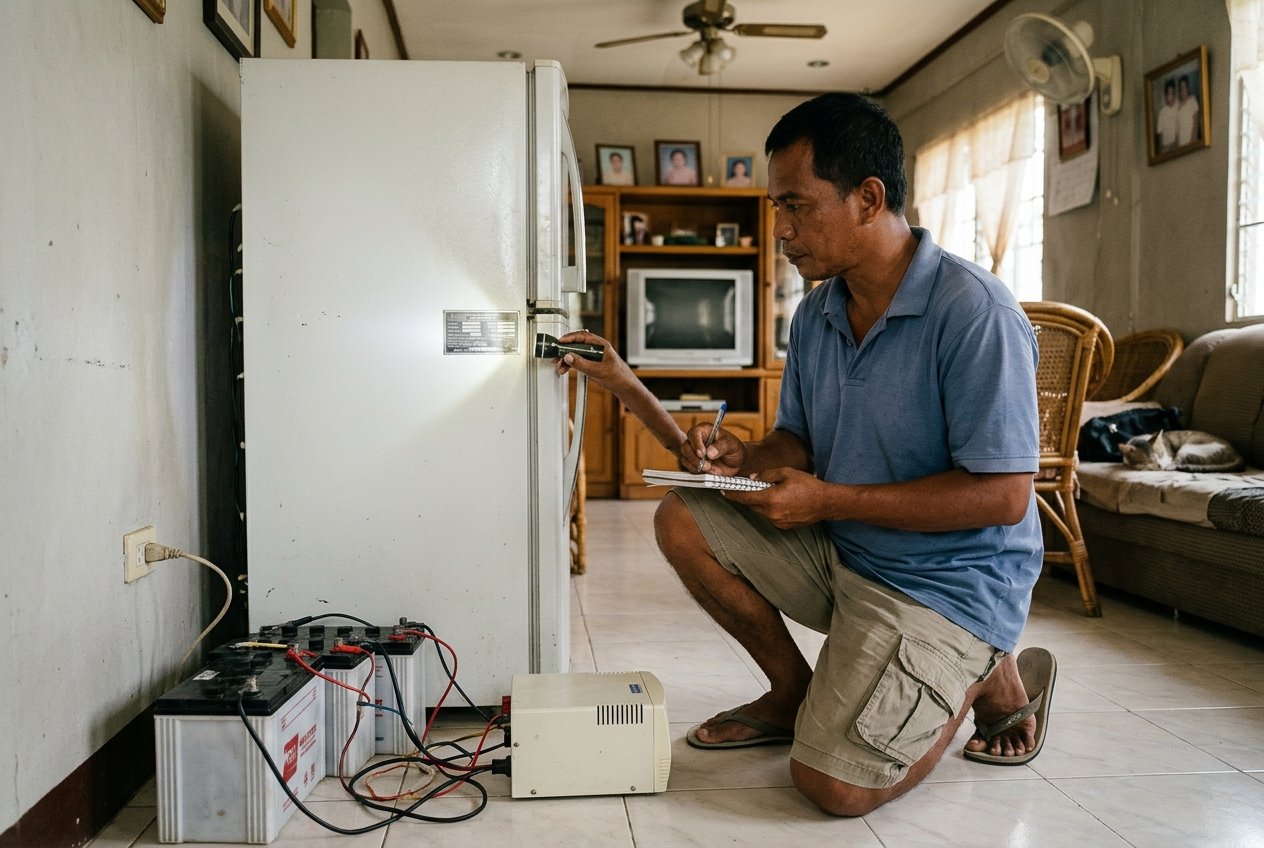
Backup batteries for solar setups: picking the right type and capacity
A plain-language guide to choosing between lead-acid, AGM, and lithium LiFePO4 batteries for a home solar setup in the Philippines, covering capacity math, lifespan trade-offs, and safe placement.

What you’ll be able to do, and why it matters
By the end of this guide, you’ll be able to pick a battery type and size for a home solar setup, without guesswork. You’ll know how to turn your appliance list into watt-hours, how to judge a battery’s real lifespan, and where in the house it’s actually safe to keep one.
This matters because the battery, not the panel, is usually where people overspend or under-protect themselves. A panel just sits there and takes sun. A battery is different.
It stores power, heats up, ages with every cycle, and in the wrong spot can be a genuine hazard. Get it wrong and you either run out of power on the second night of a brownout, or pay for capacity you never use.
This guide assumes you already have a sense of your panel size and inverter setup from earlier parts of this series. We’re not touching wiring or panel math here. This is about the box that holds your power: what kind to buy, how big, and how to keep it alive through a Philippine wet season.
What you need
A few things before you start comparing batteries:
- Your appliance list with wattages. Check the sticker or manual on each device you plan to run: phone chargers, a fan, a router, a small fridge, CPAP machines, lights. Add up the watts.
- A rough idea of run time. How many hours a day, and for how many days of brownout, do you want this battery to cover?
- A multimeter or a plug-in watt meter, if you want to measure actual draw instead of relying on nameplate numbers, which often overstate real use.
- A ventilated, shaded spot in the home already picked out, or at least a few candidate locations to assess.
- A sense of your budget tier, since the three main battery chemistries sit at very different price points, covered below.
If you haven’t yet picked an inverter or sized your panels, this is the wrong article to start with. Come back once those numbers exist, because battery capacity depends on what you’re actually running.
The method
Step 1: Work out your daily watt-hour need
Watt-hours (Wh) is the unit that actually matters, not the battery’s amp-hour (Ah) rating by itself. Here’s the simple math:
Watts × hours of use = watt-hours.
Example: a 10-watt LED bulb run for 5 hours a day uses 50 Wh. A 65-watt fan run for 6 hours uses 390 Wh. A router at 10 watts running all day (24 hours) uses 240 Wh. Add these up across everything you want to power during an outage, and you get your daily Wh target.
A modest household load (lights, fans, phone charging, a router, maybe a small TV for a few hours) often lands somewhere between 500 Wh and 1,500 Wh a day. Write your own number down. Don’t borrow someone else’s.
Step 2: Convert that into battery capacity, with headroom
A battery’s capacity is usually listed in Ah at a certain voltage (commonly 12V). To get Wh, multiply:
Ah × V = Wh.
A 100Ah, 12V battery holds roughly 1,200 Wh on paper. But you never get to use all of it, and here’s why that matters for your choice:
- Lead-acid (flooded) batteries: most manufacturers recommend keeping discharge to no more than about 50% of rated capacity to get a reasonable service life. Go deeper regularly and you shorten the battery’s life. So a 1,200 Wh flooded battery gives you roughly 600 Wh of usable power per charge, as a planning figure, not a guarantee from any single brand.
- AGM (sealed lead-acid) batteries: many datasheets allow a similar 50% depth of discharge, with some makers rating their units to 60% for occasional use. Always check the specific product’s datasheet rather than assuming.
- Lithium LiFePO4 batteries: many manufacturers rate these for 80 to 90% depth of discharge with minimal life penalty, which is the main reason they outperform lead-acid chemistries on usable capacity. That same 1,200 Wh battery could give you roughly 960 to 1,080 Wh usable, but confirm the figure on your specific unit’s spec sheet.
This is the single biggest reason lithium costs more upfront but often works out cheaper per usable watt-hour over its life. You need a bigger, heavier lead-acid bank to match the real-world output of a smaller lithium one.
Rule of thumb: take your daily Wh need, divide by the usable fraction (roughly 0.5 for lead-acid and AGM, 0.8 for lithium, confirmed against your chosen product’s datasheet), and that’s the battery capacity in Wh to shop for. Want two days of backup instead of one? Double it.
Step 3: Match chemistry to your situation
Flooded lead-acid is the cheapest per Ah, and it’s familiar. It’s what’s in a lot of UPS units and tricycles. But it needs the battery kept upright, needs occasional water top-ups, and vents gas when charging, so it can’t be sealed into a tight closet.
Cycle life for flooded lead-acid varies a good deal by brand and how deep you discharge it, but many manufacturer datasheets quote a few hundred cycles at a moderate depth of discharge. Check the specific datasheet before buying, since daily cycling can wear a budget unit out within a year or two.
AGM (absorbed glass mat) is sealed, so no water top-ups and no fumes to vent the same way. It tolerates heat a bit better than flooded lead-acid and can sit on its side. It costs more than flooded but less than lithium.
Cycle life claims for AGM also vary by brand and depth of discharge, generally landing somewhere above flooded lead-acid when discharge is kept shallow. Ask the seller for the manufacturer’s cycle-life figure at a stated depth of discharge, not just a round number.
Lithium LiFePO4 costs the most upfront, often two to three times an equivalent AGM. Manufacturers commonly claim cycle counts well into the thousands, though the exact figure depends heavily on the maker, the battery management system, and how deep you discharge it each time.
For a household running the battery most nights through typhoon season and ordinary brownouts, a well-specified LiFePO4 unit can reasonably outlast several lead-acid replacements. It’s also lighter for the same capacity, which matters if you’re moving it between rooms or floors. Always check the manufacturer’s own datasheet rather than relying on a general number, since claims vary widely between brands.
If your budget is tight and you only need backup a few nights a year, AGM is a reasonable, unglamorous choice. If you expect to cycle the battery often, lithium’s longer cycle life usually pays for itself over time.
Step 4: Choose where it lives in the house
Heat is the main enemy of battery lifespan here, more than in most other climates.
- Keep any battery out of direct sun and away from a hot tin roof or a west-facing wall that bakes in the afternoon. Heat accelerates aging in all three chemistries, lithium included.
- Choose a spot with airflow, not a sealed cabinet. Flooded lead-acid releases hydrogen gas while charging and needs ventilation to let it disperse safely. Never put a flooded lead-acid battery in a bedroom or anywhere people sleep.
- If you run a generator for backup power, keep it outdoors only, well away from windows, doors and vents. Carbon monoxide builds up fast in enclosed spaces, and a battery room or garage with the door cracked open is not a safe exception.
- Avoid the lowest floor in flood-prone barangays. If your area floods even shin-deep, raise the battery off the floor on a shelf or sturdy stand. When PAGASA issues a heavy rainfall warning for your area, that’s a good prompt to check the battery is elevated and the area around it is clear.
- Keep it away from where children or pets can knock it over or reach terminals. A battery on the floor next to a play area is a bad idea regardless of chemistry.
- Humidity corrodes terminals and connectors over time on any type. Wipe them down occasionally and check for a white or greenish crust, which signals corrosion starting.
A ventilated utility area, a garage with airflow, or a covered, shaded outdoor nook with a locked cover all work better than a bedroom corner or an airtight closet.
Step 5: Check the numbers that actually matter when comparing listings
When you’re comparing batteries on Shopee or Lazada, or talking to a hobbyist group about what they run, look past the headline price and check:
- Rated capacity in Ah and voltage, so you can calculate real Wh.
- Depth of discharge the maker recommends, not just the maximum the battery can technically survive.
- Cycle life at a stated depth of discharge. A number without a depth of discharge attached isn’t comparable across brands.
- Built-in battery management system (BMS) for lithium units, which protects against overcharge, overheat and short circuits. A lithium battery without one is a battery I’d avoid.
- Warranty length, since a maker confident in a long cycle life usually backs it with a multi-year warranty. A vague or missing warranty is a signal worth noticing.
Variations and conditions
If you’re on a tight budget and only need a few hours of backup for lights and phone charging, a smaller AGM battery paired with a basic inverter covers that without the lithium premium. Expect a rough price range in the lower tens of thousands of pesos for a modest AGM setup, varying by brand, capacity and current promotions.
If you run a CPAP machine, a nebulizer, or other medical equipment overnight, prioritize enough usable capacity for a full night without deep discharge. Consider lithium even on a tighter budget, since its longer cycle life reduces the risk of a sudden failure on the night you need it most. Talk to whoever supplies your medical device about its specific power draw.
If you live somewhere that floods regularly, elevation and placement matter more than chemistry. Even the best lithium battery is useless submerged. Plan the shelf or stand before you plan the battery.
If you’re building a bigger system to run a refrigerator or a window-type air conditioner through outages, the Wh numbers get large fast. That usually means stacking multiple batteries or going straight to a purpose-built lithium power station.
That’s a bigger budget conversation, often well into six figures in pesos depending on scope. It’s worth getting written quotes rather than estimating on your own.
If you already own a lead-acid battery from a previous project, you don’t need to replace it immediately. Use it within its safe depth of discharge, watch for a swollen case or reduced runtime as signs it’s aging out, and plan your next purchase around lithium once it needs replacing.
Common mistakes
- Buying by Ah alone, ignoring voltage and depth of discharge. Two “100Ah” batteries can deliver very different usable power depending on these factors.
- Draining lead-acid or AGM batteries past the maker’s recommended depth of discharge regularly. This is the fastest way to turn a three-year battery into a one-year battery.
- Storing a flooded lead-acid battery in a sealed room. The gas it vents during charging needs somewhere to go.
- Placing any battery in direct sun or against a hot wall. Heat shortens life across every chemistry, and the effect compounds over a Philippine dry season.
- Skipping the BMS check on lithium units. Cheap, unbranded lithium batteries without proper protection circuits are a real fire and safety risk. Buy from sellers who can show the specification sheet.
- Ignoring corrosion on terminals. A loose or corroded connection can cause voltage drop, overheating, or a battery that simply stops delivering power when you need it.
How to practise safely
Test your setup before an actual outage, not during one. Run your essential loads off the battery for a few hours on a normal day and track how much it discharges against your Wh calculation. This tells you whether your real-world numbers match the math.
Once a quarter, inspect the battery: check terminals for corrosion, confirm it’s still elevated and ventilated, and glance at the case for swelling or leaks. If it’s AGM or flooded, check the charge level stays within the safe depth of discharge range you planned for.
A strong sulfur or rotten-egg smell near a lead-acid battery, a swollen case, or a battery that’s hot to the touch while charging are warning signs, not something to investigate up close. Get everyone out of the room and leave the door or window open for airflow, but do not lean over the battery to inspect or handle it.
If you can do so safely from a distance, such as a switch outside the room, cut power to the charging circuit. If there’s any smoke, a burning smell, or visible swelling that looks like it could rupture, leave the area, do not re-enter, and call 911 or the Bureau of Fire Protection right away. A hot, gassing or swollen battery can be a fire or explosion risk, and it’s not a problem to manage alone once it’s reached that point.
The one thing to remember
Buy capacity based on your actual watt-hour need and the battery’s real usable fraction, confirmed against its own datasheet rather than a generic rule, and keep it ventilated, shaded, and off the floor if your area floods.
Galing Gear shares general preparedness and first aid information based on sources such as the DOH, WHO and the Philippine Red Cross. It is not a diagnosis or prescription, and it does not replace a doctor, nurse, pharmacist or trained responder. We never give medicine doses. Follow the latest advice of the DOH, your local health office and your medicine’s label. In an emergency, call 911. Philippine Red Cross: 143. Mental health crisis (NCMH): 1553 (landline). When unsure, get checked.
Free downloads
From the series: Going Off-Grid: A Filipino Household's Guide to Backup Power