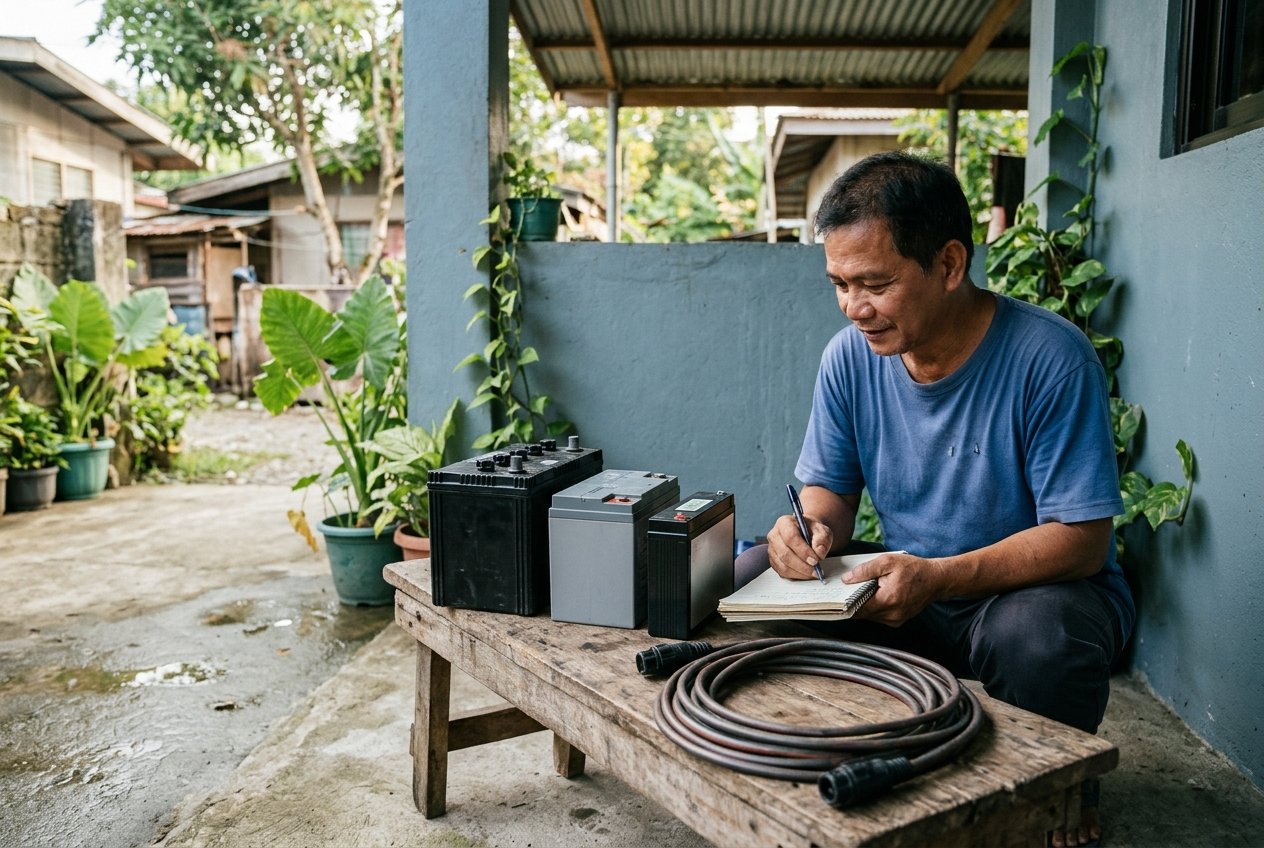
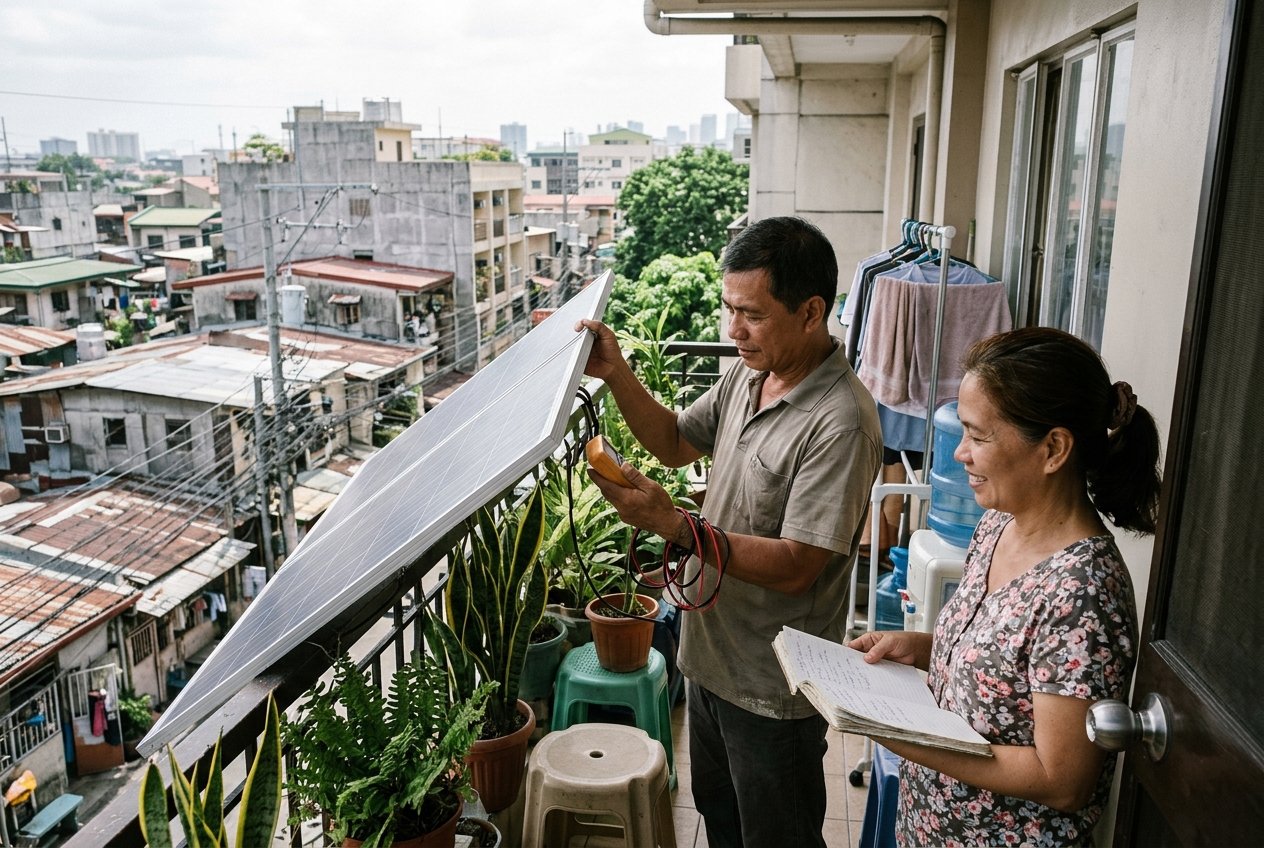
Inverters explained: matching your inverter to your home's appliances
A practical guide to choosing the right inverter type and wattage for Filipino households already set up with solar panels and batteries, covering pure sine wave versus modified sine wave, reading appliance nameplates, and avoiding undersized or counterfeit units.
What you’ll be able to do
By the end of this guide, you’ll be able to size an inverter to the appliances you actually plan to run. You’ll be able to tell pure sine wave from modified sine wave, and spot a listing online that’s trying to sell you less than it claims.
This matters because the wrong inverter either wastes your money on power you don’t need, or damages a refrigerator compressor or a laptop charger in the first week of use.
This guide assumes you already have panels and a battery bank in place. I’m not covering how to wire the whole system together or how to size the battery itself. This is about the one box in the middle that turns stored battery power into the alternating current (AC) your appliances expect.
What you need
- A list of every appliance you intend to run off the inverter, with its nameplate wattage (more on finding this below).
- A basic idea of which appliances you need to run at the same time, since that decides your total load, not just your biggest single item.
- A multimeter or clamp meter is useful but not required for this guide; a notebook and a calculator will get you through it.
- If you haven’t chosen panels or a battery yet, that’s a separate decision from this one. This guide only covers the inverter.
The method
Step 1: Understand the two inverter types.
A pure sine wave inverter produces smooth, clean AC power that looks just like what comes out of a wall socket from the grid. Almost everything with a motor, a compressor, or sensitive electronics wants this.
A modified sine wave inverter produces a rougher, stepped approximation of that wave. It’s cheaper, and it runs simple resistive loads fine, like a light bulb, a basic fan, or an electric kettle. It struggles or causes problems with anything that has a motor or a microprocessor.
In a Philippine household, that difference matters for:
- Refrigerators and freezers: these have compressors. A modified sine wave inverter can make the compressor run hotter, hum louder, and wear out sooner. Pure sine wave only, if you can manage it.
- Air conditioning units: same compressor issue, at a much bigger wattage. Most window or split-type aircon units need pure sine wave and a large enough inverter to handle their startup surge (I’ll get to surge below).
- Rice cookers: the heating element itself doesn’t care much, but many modern rice cookers have a small circuit board for timing and keep-warm functions. Pure sine wave avoids glitchy behavior.
- Routers, modems, and laptop chargers: these have switching power supplies. They’ll often run on modified sine wave, but some units buzz, run hot, or shorten their own lifespan over time. Pure sine wave is the safer, quieter choice.
- Simple loads: an incandescent bulb, a basic electric fan, a soldering iron. These don’t care which type you use.
If your household has a refrigerator and you want it protected during a brownout, that alone is often reason enough to pay the extra for pure sine wave rather than save on a modified sine wave unit.
Step 2: Read the nameplate wattage, not the brand name on the box.
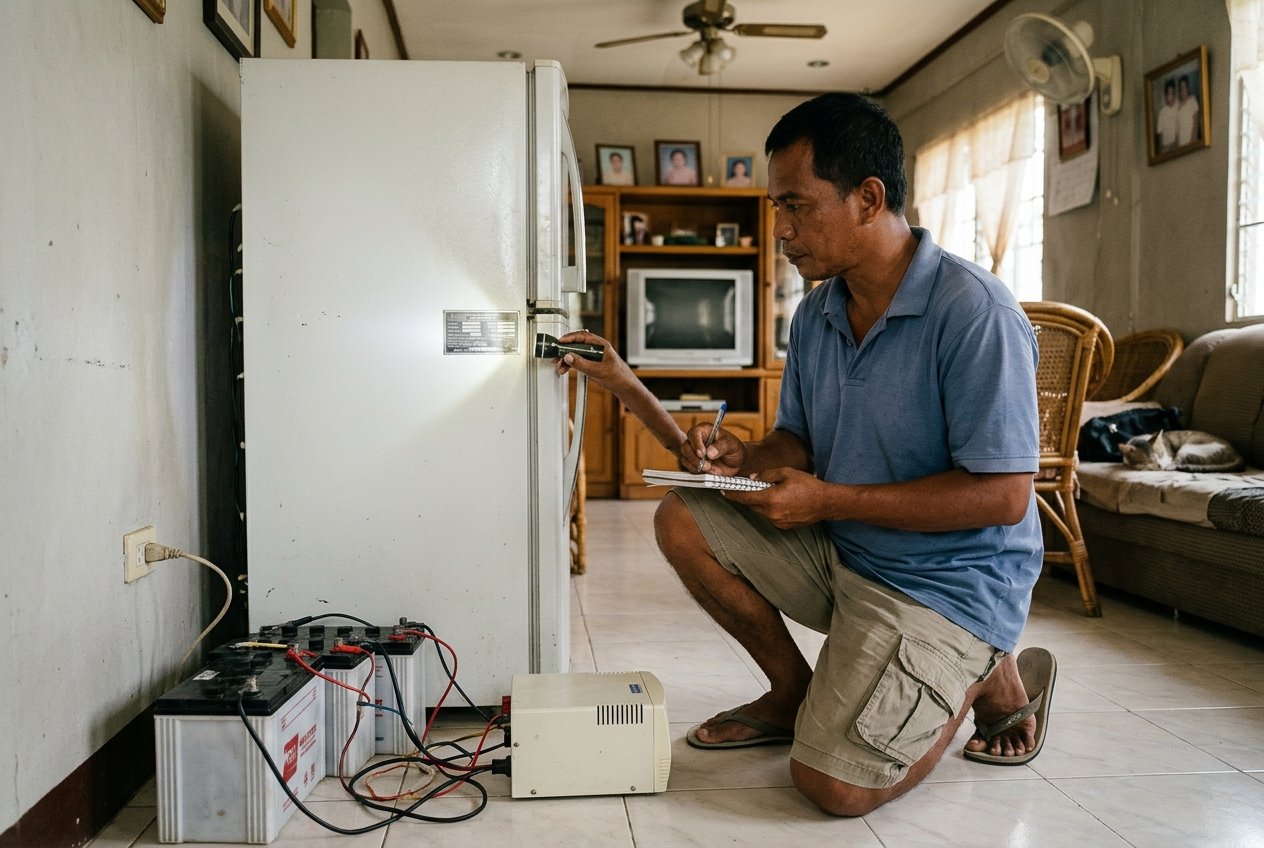
Every appliance has a small metal or plastic plate, usually on the back or underside, listing its electrical rating. Look for a number in watts (W).
If only amps (A) and voltage (V) are given, multiplying them gives you apparent power in volt-amps (VA), not always the same as real watts. For motors and compressors, the power factor is less than one, so this multiplication can overstate the true wattage. Treat it as a rough estimate, and prefer the watts figure when the nameplate states one directly.
A few things to watch for:
- The nameplate number is usually the running wattage, the power it draws once it’s going. It is not the startup or surge wattage.
- Motors and compressors (refrigerators, aircon, water pumps) commonly draw two to three times their running wattage for a second or two when they first switch on. Some aircon compressors can briefly surge even higher, up to five times or more, depending on the model.
- If the nameplate doesn’t state a surge figure, use three times the running wattage as your planning number for anything with a compressor, and check the appliance manual or manufacturer’s page for a firmer figure before you buy.
Step 3: Add up your running loads, then check your biggest surge.
List every appliance you’d realistically run at the same time, and add their running wattages together. That total is your continuous load, and your inverter’s continuous wattage rating needs to comfortably exceed it.
Separately, check the single highest surge wattage among those appliances. This is usually the refrigerator or the aircon. Your inverter’s surge rating needs to cover that number on top of whatever else is already running, because the surge happens on top of your existing load, not instead of it.
Step 4: Choose an inverter with headroom, not a tight fit.
Pick a continuous wattage rating with some margin above your calculated total, not an inverter sized exactly to it. Equipment run at its limit is the equipment that fails when you need it most.
A little headroom costs more now, but it saves you an inverter replacement later.
Step 5: Match the inverter to your battery voltage.
Inverters are built for a specific battery system voltage, commonly 12V, 24V, or 48V for home battery banks. Confirm your battery bank’s voltage and buy an inverter built for it.
This isn’t adjustable after purchase. An inverter built for the wrong voltage won’t just fail to work: a mismatched or forced connection risks overheated wiring, blown fuses, or fire. Get the voltage right before you order.
Step 6: Set it up simply, and test before you depend on it.
Connect the inverter to your battery bank following the manufacturer’s manual. Keep cable runs short, keep connections tight, and give the unit space to ventilate.
Use the correctly rated fuse or circuit breaker between battery and inverter, as the manual specifies. A loose connection, an undersized cable, or a missing fuse on a battery bank can cause a short circuit, and a battery short circuit can start a fire fast. If your setup needs anything beyond plugging in a manufacturer-supplied connector, that is, if you’re running new cabling, adding a breaker, or tying into your home’s wiring, have a licensed electrician do that part.
Before a brownout actually happens, plug in your refrigerator or your router and let it run for a while so you know it behaves normally. Better to find out on a calm day than during a typhoon.
Variations & conditions
If your budget is tight. You might be tempted to run everything on a cheaper modified sine wave inverter. A workable compromise is a small pure sine wave inverter just for the refrigerator and router, and a separate modified sine wave unit or none at all for simple resistive loads like lighting.
As a rough guide, small pure sine wave inverters (around 300 to 500W continuous) commonly run from roughly ₱2,000 to ₱5,000 on Lazada and Shopee, while a 1000W pure sine wave unit able to handle a refrigerator often runs ₱6,000 to ₱12,000 or more, depending on brand and surge rating. A comparable modified sine wave unit typically costs less, roughly half as much at a given wattage. Prices shift often, so treat these as a planning range, not a quote, and check current listings before buying.
If you’re mainly protecting medical equipment. Nebulizers, CPAP machines, and similar devices almost always need pure sine wave power. Check the device’s own manual for its specific power requirement, since this can vary by model and isn’t something a general guide can state for you.
If you only need light, fans, and phone charging. A smaller modified sine wave inverter can be perfectly adequate and considerably cheaper. Don’t pay for pure sine wave capacity you don’t need.
If you’re running an aircon unit off-grid. This is the heaviest common household load by far. Confirm the aircon’s actual surge wattage with the manufacturer or a technician before buying an inverter for it, since undersizing here is the most common expensive mistake I see described in local hobbyist groups.
If you’re timing your test runs. Brownout risk rises with typhoon season, roughly June through November, when storms tracked by PAGASA can knock out the grid for hours or days. Test your inverter setup well before a storm signal goes up in your area, not after.
Common mistakes
- Sizing to the biggest appliance alone, and forgetting the rest. Your refrigerator’s surge plus your running lights plus your router load all happen at once sometimes. Add them up.
- Trusting a listing’s wattage without checking reviews or specs elsewhere. Some listings on Lazada and Shopee state a continuous wattage that is actually closer to the unit’s surge capability, or inflate the number entirely. Cross-check the listed wattage against the physical weight and price of the unit: a genuinely large pure sine wave inverter is neither light nor cheap.
- Buying a modified sine wave inverter for a refrigerator to save money. This is the mistake I’d actively warn a neighbor against. The savings upfront can cost more later in a shortened compressor life or a service call.
- Ignoring battery voltage mismatch. An inverter built for 24V will not work safely on a 12V bank. Forcing a connection risks damaged wiring and fire, not just a non-working inverter. It’s not a shortcut worth taking.
- Skipping fuses or breakers to save a few pesos. A battery bank without correct overcurrent protection is a fire risk waiting for a loose wire or a short. Follow the manufacturer’s fusing specification every time.
- Assuming all “1000W” inverters are equal. Build quality, surge handling, and genuine continuous rating vary widely between brands at the same stated wattage. A counterfeit or no-name unit may state a wattage it cannot actually sustain.
How to practise safely
Test your inverter setup before you need it, not during a typhoon. Run your refrigerator and router off it for a few hours on a calm day, listen for unusual noise, and feel whether the inverter or appliance runs hotter than normal.
No special equipment is needed beyond what you already have. If something seems off, a local electrician or a knowledgeable member of a solar hobbyist group can often confirm whether it’s the inverter, the wiring, or the appliance before brownout season sets in.
If you smell burning, see scorch marks, or notice a connection that’s hot to the touch, disconnect the battery and stop using the inverter until a qualified electrician checks it. Anything beyond plug-and-play wiring, including running new cable or adding breakers, is an electrician’s job, not a DIY one.
The one thing to remember
Pure sine wave protects anything with a compressor or a circuit board, your inverter’s rating needs to cover your added-up running load plus your single biggest surge with margin to spare, and any wiring beyond the manufacturer’s plug-and-play connectors belongs to a licensed electrician.
Galing Gear shares general preparedness and first aid information based on sources such as the DOH, WHO and the Philippine Red Cross. It is not a diagnosis or prescription, and it does not replace a doctor, nurse, pharmacist or trained responder. We never give medicine doses. Follow the latest advice of the DOH, your local health office and your medicine’s label. In an emergency, call 911. Philippine Red Cross: 143. Mental health crisis (NCMH): 1553 (landline). When unsure, get checked.
Free downloads
From the series: Going Off-Grid: A Filipino Household's Guide to Backup Power