How to put together a car go-bag for flood season
A plain, sensible kit to keep in the car for the days when floodwater cuts the road ahead — and a clear rule about why the bag is for waiting, not for driving through water.
This article is archived: some details may be out of date.
What you’ll be able to do — and why it matters
By the end of this, you’ll have one bag living in your car that lets you sit out one to two days of being cut off: enough water, food that needs no cooking, light, power for your phone, basic first aid, small cash, and the unglamorous things that make a night in a parked car bearable.
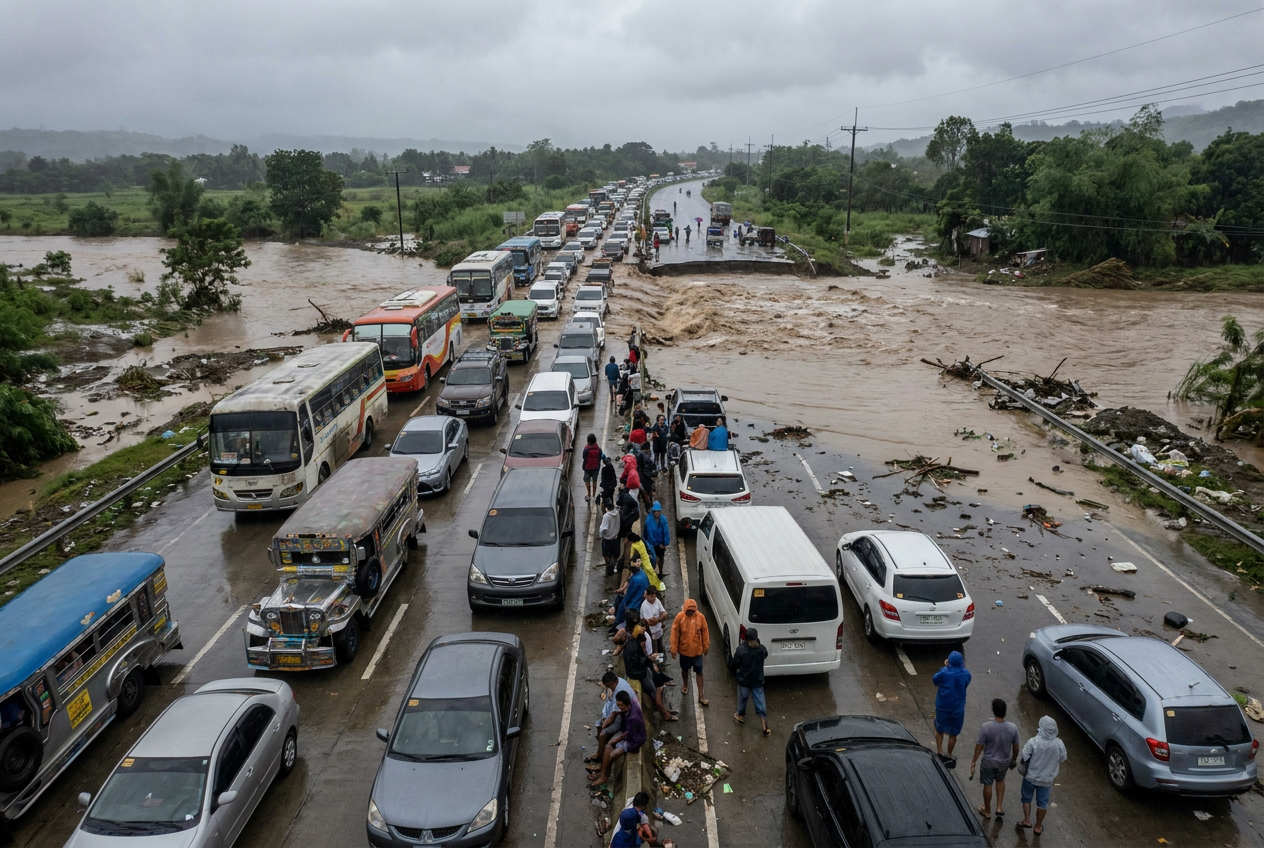
This matters because the common Philippine problem isn’t dramatic rescue. It’s much duller than that. You leave Quezon City for Nueva Ecija on a Friday, the habagat sits over Central Luzon, and by Bulacan the road ahead is brown water with a queue of buses in front of it. Nobody is drowning. You’re simply not getting through, the petrol stations are packed, the sari-sari store has sold out of bottled water, and the power in the town is down so the card readers don’t work. That is the situation this bag is for.
It is not a bug-out bag, and it isn’t a survival kit for the wilderness. It’s two days of ordinary comfort and safety, packed in advance so you’re not buying it at three times the price in the middle of it.
The rule the bag does not change
Never drive, walk, ride, or swim through floodwater. Not once, not slowly, not because the van in front made it.
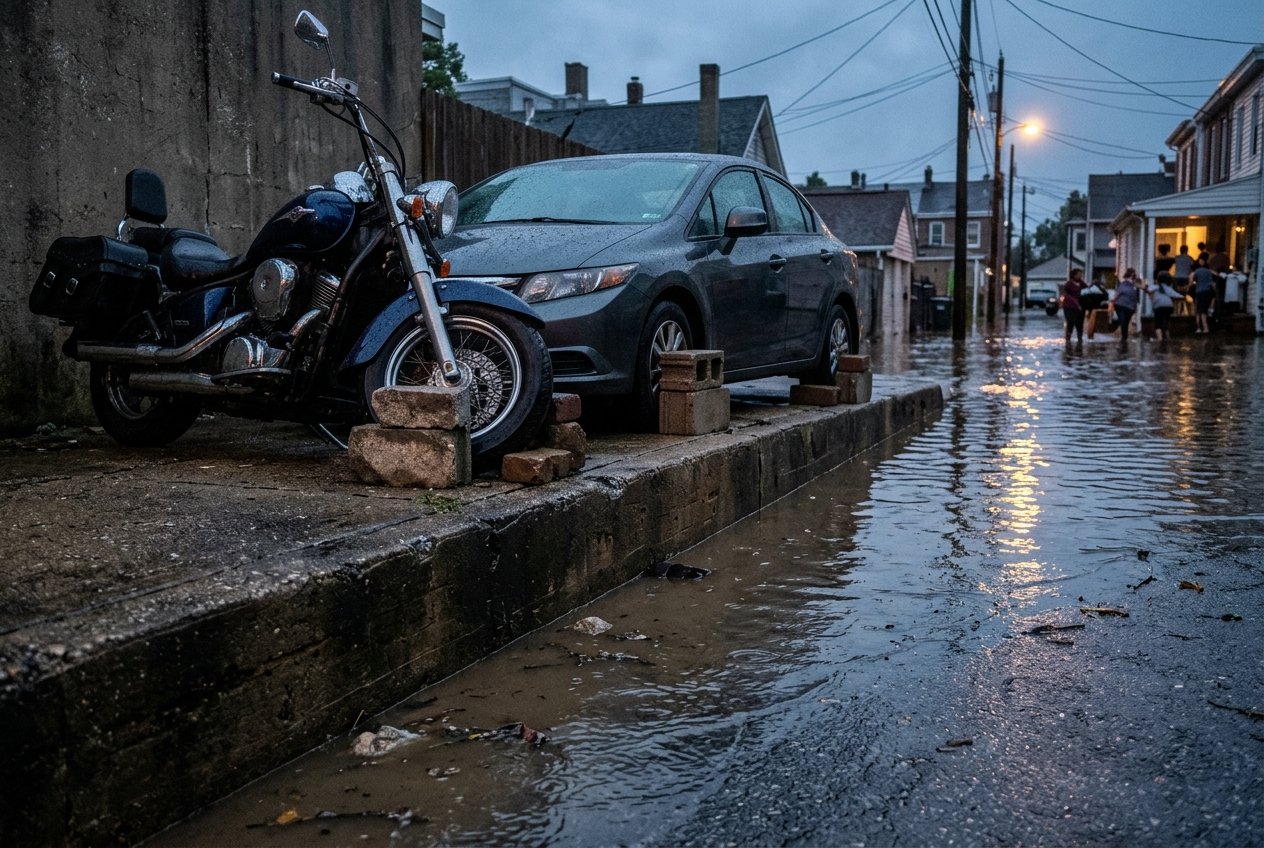
The water hides everything: an open manhole, a washed-out shoulder, a downed line, a canal with no kerb to tell you where the road ends. It’s also moving. Commonly cited figures put it at about 15 centimeters of moving water to take an adult off their feet, and around 30 centimeters to start floating a typical sedan — and once a car floats, it steers nothing and goes where the water goes. Most vehicles on our roads are not built to wade. They stall, they take water through the intake, and then you are standing on the roof of an expensive problem.
In search-and-rescue, the jobs that ended badly almost never started with someone doing something reckless. They started with someone deciding the water looked shallower than it was, usually because another vehicle had just gone through. That’s the whole mechanism. It looks survivable right up to the moment it isn’t.
So be clear with yourself about what this kit is. It buys you the patience to turn around and wait somewhere sensible. It does not buy you passage. A well-packed car is not a more capable car.
What you need
One bag per car, not one per person. A 30–40 liter duffel or an old rucksack is perfect — the point of a bag rather than loose items rolling round the boot is that if you ever have to leave the vehicle and walk to a barangay hall or evacuation center, you can pick up everything in one movement.
Water. Two liters per person per day, plus a couple of 6-litre jugs in the boot as the pool you draw from. A six-liter jug runs about ₱60–₱100. Water is heavy and boring and it’s the thing you’ll be glad of first.
Food that needs no cooking. Crackers, peanuts, dried mangoes, tuna and corned beef with pull-tab lids, biscuits the kids actually eat. Skip instant noodles — hot water is exactly what you won’t have. A small jar of instant coffee and a few sachets does more for morale than it has any right to.
Light. A head torch per adult and one hand torch, with spare batteries. Around ₱400–₱900 each for something honest. Your phone torch is not lighting; it’s an emergency and it eats the battery you need for information.
Power. A 20,000mAh power bank (₱1,200–₱2,000 from a brand you’ve heard of) and a decent car charger with two ports and a long cable. Be careful here — power banks and jump starters are the two categories on Lazada and Shopee where counterfeits are common, and a fake cell is a dead weight at best. Buy the boring brand.
Information. A small AM/FM radio with spare batteries, because when the local network is congested the radio still tells you what the LGU is doing. Download offline maps for your route before you leave, and keep a printed sheet in the glovebox: alternate routes, the towns along the way, and phone numbers for family, your insurer, and roadside assistance.
Health. Your own prescribed medicines and a written list of them, ORS sachets (mixed exactly as the packet says), plasters, gauze, and povidone-iodine. Ask your pharmacist which over-the-counter medicines suit your family. A basic kit is ₱800 or so; the prescriptions are the part people forget.
Sanitation and comfort. Loo roll, wet wipes, hand gel, a roll of bin bags, and a bucket. Yes, a bucket — two days is long enough that this stops being funny. Mosquito repellent, because standing water means mosquitoes by evening. A towel, a change of clothes each, and closed shoes.
Sleeping in the car. Our problem is heat, not cold. A malong or light blanket, an inflatable pillow, and a sunshade for the windscreen. If you can rig mesh over two windows you can sleep with them cracked open without feeding the mosquitoes.
Cash in small notes. ₱2,000–₱3,000 in twenties, fifties and hundreds, plus coins. During an outage the card terminals are down and nobody in a flooded town has change for your ₱1,000.
Documents. Photos of your OR/CR, license, IDs and insurance on your phone, and paper copies in a zip-lock bag in the bag itself.
Car-specific items. Jumper cables or a jump starter, a tyre gauge and a small inflator, a basic tool roll, gaffer tape, spare fuses, your early warning device, and a hi-vis vest. A seatbelt cutter and window breaker belongs in the cabin, within reach of the driver’s seat — a tool in the boot is a tool you don’t have.
The method
1. Decide the trip before you pack for it. Check the PAGASA forecast and any rainfall or flood advisory for the provinces you’re crossing, not just the one you live in. If the answer is “heavy rain warning over the whole route”, the correct kit is not going. Leaving early or postponing beats every item on this list.
2. Pack by function, not by product. Five pouches or bags-within-the-bag: water and food; light and power; health; papers and cash; car tools. You will be finding things in the dark with tired children in the back seat. Labels help.
3. Load it properly. Water jugs and car tools in the boot. The main go-bag behind a seat where you can reach it without getting out. Window breaker and one torch in the cabin.
4. Run the half-tank rule. On a long trip, refuel at half a tank, not at the warning light. Fuel is what lets you run the aircon in bursts, charge phones, and — more importantly — backtrack 40 kilometres to a town with dry ground.
5. Note your bail-out points as you drive. Petrol stations, malls, town centers on higher ground. You’re building a mental list of places you could stop, so that when you need one you’re not improvising.
6. When you meet water, stop and turn around. Don’t join the queue at the edge to see what happens. Reverse out, go back to the last dry, high, well-lit place you passed, and park there. Not under big trees, not beside a river or creek, not in a basement car park, not at the low end of a car park.
7. Settle in deliberately. Tell family where you are by text — texts get through when calls won’t. Ration water from the start rather than when it’s short. Keep one phone switched off as a reserve. Crack the windows, charge phones from a power bank, and don’t run the engine while anyone is inside the car. Take turns sleeping if you’re two adults.
8. Walking out is a last resort. In daylight, with the bag, along a route you can see, to a known destination — a barangay hall, an evacuation centre, a relative’s place. And still no wading. If the only way out is through water, you are not going; you’re waiting for the water to drop or for someone with a boat.
Variations and conditions
At night. Everything is harder and the water reads shallower than it is. Streetlights are usually out in the exact places that have flooded. My own rule is simple: after dark, I don’t attempt any crossing at all, even one I’ve seen in daylight. Stop earlier in the evening than feels necessary.
With children or older parents. Double the comfort items and halve your tolerance for waiting it out in a bad spot. Medicines, nappies, and familiar snacks matter more than anything technical. A car park with a working toilet and light beats a lay-by with a better view of the road.
Metro Manila versus provincial roads. In the city you’re rarely far from a mall, a hospital, or a barangay hall, so the bag is mostly about the hours you’ll spend stationary. On a provincial highway — Cagayan Valley, Bicol, the Pampanga plains — the gap between towns is real, and so is the gap between petrol stations. Pack more water for the provinces.
Habagat versus a named typhoon. A named storm gives you notice, and the honest answer is usually to cancel the trip. The southwest monsoon is sneakier: no storm on the map, and a barangay underwater by mid-afternoon. Most of the times I’ve been stuck, there was no storm name involved at all.
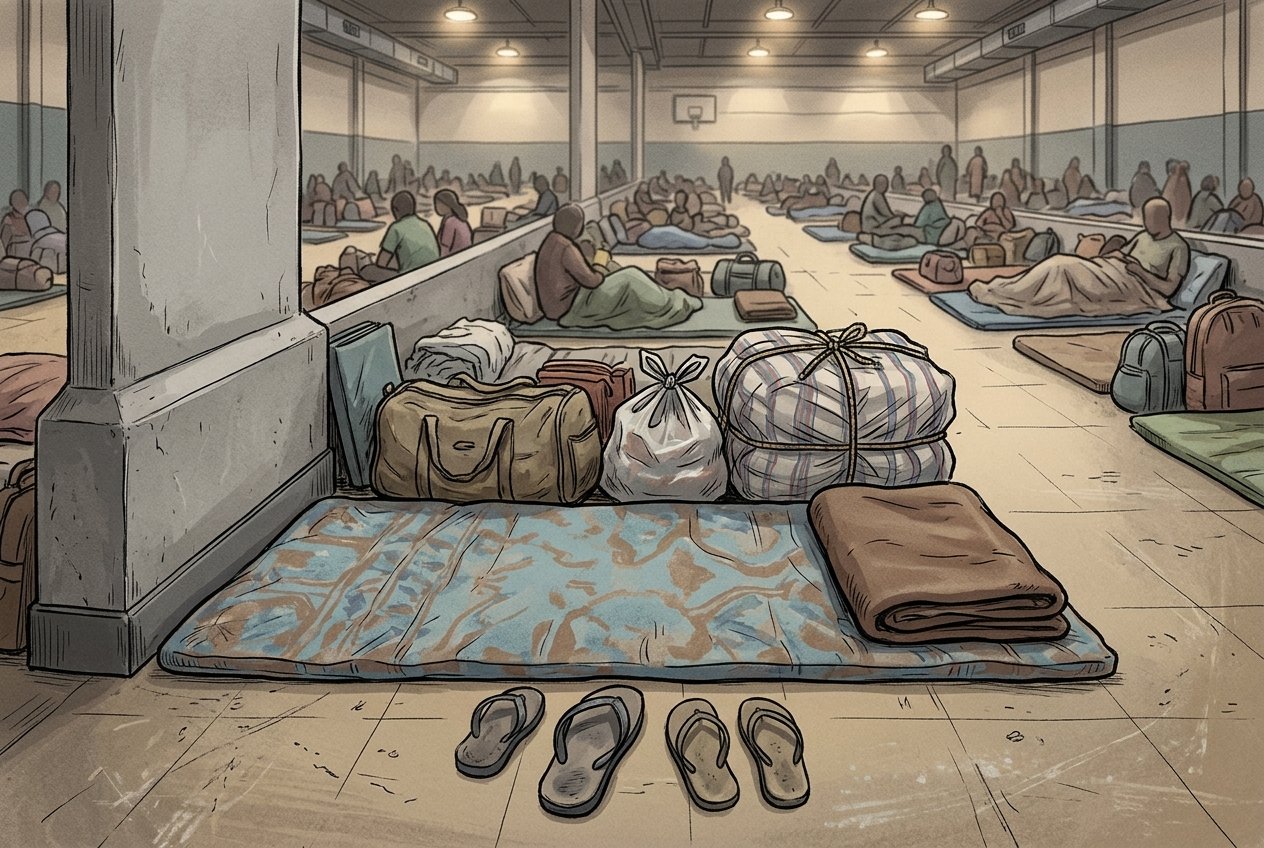
If it stretches past two days. Then you’re not waiting any more, you’re relocating. Get to an evacuation centre or a relative’s house and let the LGU know where you are. The bag was never meant to be a week.
Common mistakes
Keeping everything in the boot. If you can’t open the boot — because you’re parked nose-in, or it’s raining sideways, or water is already over the sill — you have no kit. Split it.
A power bank that’s been flat since March. Charge it monthly. Set a phone reminder. A dead power bank is one of the most common ways a kit lets you down when you need it.
Only big notes. ₱1,000 bills are almost useless in a town with no power.
Following the vehicle in front. A lorry with high clearance and a heavy chassis tells you nothing about what your sedan will do. Neither does the tricycle — he knows that particular street and you don’t.
Going around a barrier. If the LGU or DPWH has closed a road, it’s closed. The detour is annoying. The alternative is a recovery.
Treating the phone as light, map and radio all at once. One device, one battery, one point of failure.
Food you can’t eat cold. Check your kit honestly: if it needs boiling water, it’s decoration.
Water that’s been baking in the boot for a year. Rotate it. Plastic in a hot car does not improve with age.
Thinking the bag is permission. This is the one that actually hurts people. A well-stocked car makes you feel prepared, and feeling prepared makes crossing look reasonable. It isn’t. The bag exists so that turning back costs you nothing but time.
How to practice safely
You don’t need a drill ground for this. You need one uncomfortable evening.
Spend a night in the car in your own driveway or garage, with only what’s in the bag. You’ll learn within two hours where you get cramp, whether the torch is reachable, and that you forgot a phone cable long enough to reach the back seat. That’s the whole exercise, and it’s worth more than any amount of reading.
Run a brownout evening at home using only the kit’s light and power. See how long the power bank really lasts with two phones and a radio.
Before the rains properly start, drive your usual long route and consciously name three bail-out points — the petrol station with the canopy, the mall car park on the high side of town, the covered court near the barangay hall. Say them out loud to whoever’s in the car. When it matters, you want the decision already made.
Check and rotate the bag twice a year: once in late May before the rains, once around December. Water out, medicines checked for dates, batteries tested, power bank charged, cash still there.
Nothing in this list is clever. It’s water, light, power, medicine, cash and patience, packed where you can reach it. The cleverness, such as it is, sits entirely in the one decision it supports: when the road ahead is under water, you stop, you turn around, and you wait. Everything else in the boot is just what makes the waiting tolerable.
Galing Gear shares general preparedness and first aid information based on sources such as the DOH, WHO and the Philippine Red Cross. It is not a diagnosis or prescription, and it does not replace a doctor, nurse, pharmacist or trained responder. We never give medicine doses. Follow the latest advice of the DOH, your local health office and your medicine’s label. In an emergency, call 911. Philippine Red Cross: 143. Mental health crisis (NCMH): 1553 (landline). When unsure, get checked.