How to storm-proof a rented condo or flat before a typhoon
Renting a condo or flat? Step-by-step typhoon prep for the 24 hours before — drains, sliding doors, water storage. No drilling, no new gear needed.
What you’ll be able to do — and why it matters
By the end of this, you’ll have a routine you can run in about two hours, using things you already own, that makes a rented flat or condo measurably safer and drier in a typhoon. Not typhoon-proof. Drier, calmer, and less likely to lose something you cannot replace.
Renters and condo owners get told a lot of advice that assumes a house. Board up the windows. Trim the branches near the roof. Check the gutters. None of that is available to you. You cannot drill into the developer’s glass, you cannot touch the building’s drainage, and you certainly cannot rewire anything. What you can control is the small stuff: what’s loose on your balcony, whether your floor drain is clear, where your laptop sits relative to the window, and how much water you have when the rooftop tank runs dry at 2am.
That last one surprises people. In most Metro Manila and Cebu high-rises, water reaches your tap by gravity from a rooftop tank, and that tank is refilled by an electric pump. Lose power, and you have whatever is in the tank — often a few hours of normal use across the whole building, less if everyone panics and fills their bath at once. The lifts go at the same moment. If you’re on the 21st floor, your building just became a walk-up with no running water.
None of this is a reason to panic. It is a reason to do a couple of hours of unglamorous work while the sky is still bright.
What you need
Almost nothing you’d have to buy. Go through the flat and gather:
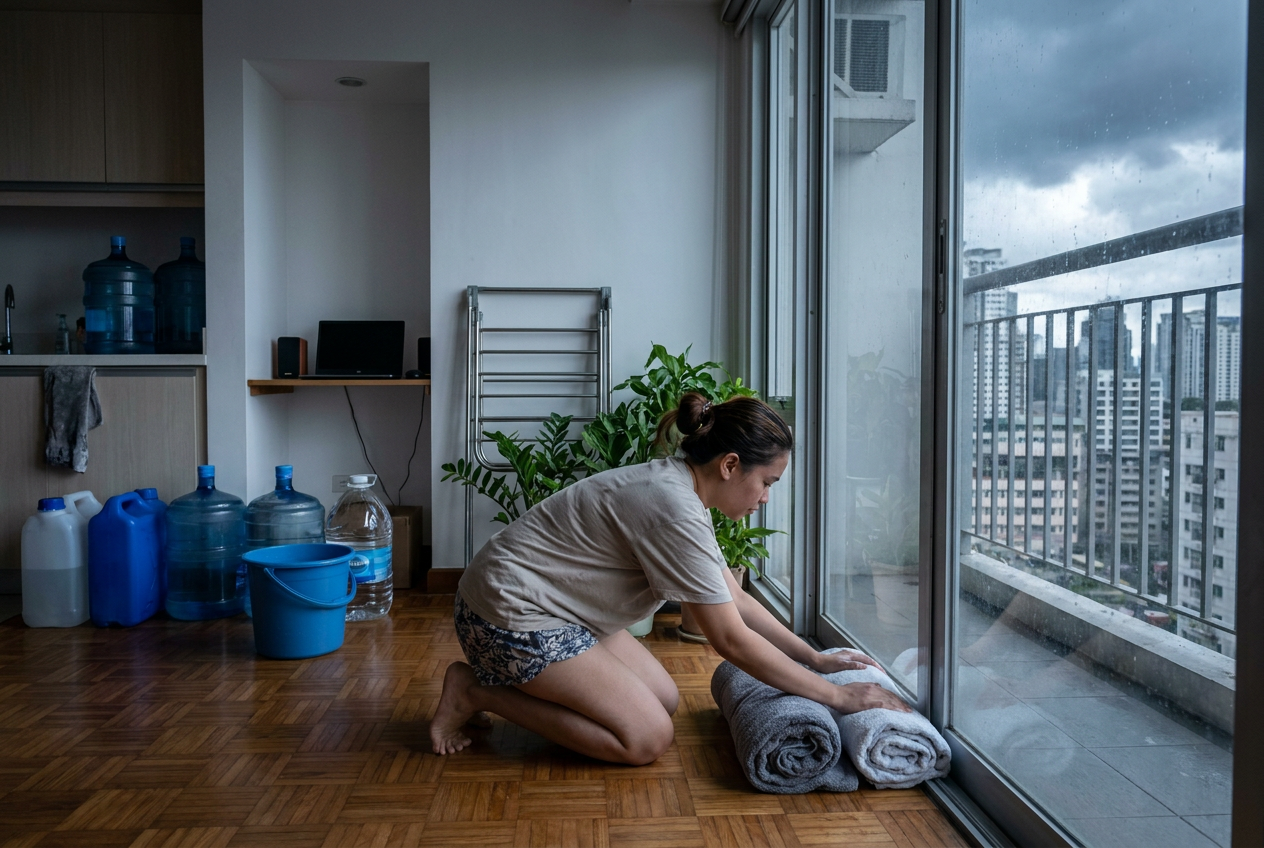
- Old towels and rags. Four or five. Rolled towels along a leaking sliding door track are the single most effective thing in this whole guide.
- A rolled-up mat or yoga mat, or a folded blanket, as a second barrier behind the towels.
- Zip-lock bags and a plastic storage tote. Passports, PRC and PhilHealth cards, land titles, birth certificates, spare cash, external drives. A decent lidded tote runs about ₱300 to ₱600 on Lazada or Shopee, but a large zip bag inside a rice sack works too.
- Containers for water. Clean pails, the bath if you have one, empty 6-litre mineral bottles, a large basin (₱150 to ₱250 in any hardware shop). Two kinds: drinking water and flushing water. Keep them separate and label them.
- Bin bags, the thick black ones. They cover a mattress, wrap a desktop PC, or line a leaky windowsill.
- A torch per person, not your phone. Phone battery is communications, not lighting.
- Masking or packing tape — for labelling and for sealing bags, not for your windows. More on that below.
- A wire or a stiff brush for the balcony drain, and gloves if you’re squeamish about what comes out of it.
If you buy one thing this week, make it a second water container, not a gadget.
Talk to the landlord or admin office first
Do this before the storm signal goes up, ideally on a normal Tuesday. Walk down to the admin office, be friendly, and ask five questions:
- Does the generator cover the lifts, and how many? Many buildings run one lift on emergency power, sometimes only intermittently, sometimes only for scheduled evacuation windows. Knowing the answer changes how you plan your last trip up the stairs.
- Does the generator cover the water pumps? This is the one people forget to ask. Some buildings back up the lifts and hallway lights but not the domestic pumps. If the answer is no, you’ll want more water stored than you think.
- Where do residents shelter if upper floors are unsafe? Usually a lower-floor function room, a podium level, or the car park mezzanine. Know the floor number now.
- Who do I actually call at 3am? Get the guardhouse landline and the building engineer’s mobile written on paper and stuck to the fridge. Mobile data goes; a number you memorised is better than a number in a dead phone.
- Is my unit in a flood-prone part of the site? Ground-floor units, basement parking and podium retail are a different risk from the 18th floor. If you park in the basement, ask when they close it and move the car out early. You can also check your address yourself on HazardHunterPH, which is free and takes two minutes.
For tenants: if a window seal has been leaking since the last habagat, report it in writing — email or the building’s app — well before the storm. A documented request protects you and occasionally actually gets fixed.
When the storm comes, follow what building management and your barangay or LGU tell you. They know things about the structure and the surrounding drainage that you don’t.
The method: 24 hours out to the first strong gusts
T-24 hours: decide, then shop
Check the PAGASA bulletin — the actual bulletin, not a screenshot on Facebook. Note the signal number expected for your province and the forecast track. If you live in a low-lying area or a ground-floor unit and there’s a genuine chance of flooding, the decision to leave is made now, in daylight, not later in the dark. No amount of preparation inside a unit replaces leaving early.
Do your shopping today. Cooking gas, rice, batteries, medicines, pet food, cash in small denominations because card terminals die with the power. Charge every power bank and every device, and keep charging them right up until the power goes.
T-12 hours: clear the balcony completely
This is the job that matters most and the one people leave too late. In a typhoon a balcony is a wind tunnel, and anything on it becomes either a projectile or a drain blockage.
- Plants come inside. All of them, pots included. A 10-inch clay pot off the 15th floor is lethal. If they truly won’t fit, lay them flat in a corner against the parapet wall, clustered together — but inside is better.
- Laundry racks, clothes lines, drying poles, folding chairs, brooms, dustpans — inside.
- Aircon covers and decorative screens. Those fabric or vinyl covers over split-type outdoor units catch wind like a sail. Take them off. Check that the outdoor unit’s bracket bolts aren’t obviously rusted through; if they look bad, report it to admin now, because you are not the person to fix it.
- Hanging pots, wind chimes, fairy lights, bamboo blinds. Down, all of it.
- Sweep the balcony floor properly, then clear the drain. Balcony drains are small and they clog with leaf litter, potting soil, hair and lint. Poke it clear with a wire, run a pail of water down it, and watch it go. A blocked balcony drain during sideways rain is how water gets under a sliding door and into your living room.
While you’re at it, clear the floor drain in the bathroom and the kitchen sink trap. Drains back up under pressure in bad weather.
T-8 hours: the glass and the water line
Sliding doors and casement windows in Philippine condos leak in two places: the bottom track, and the rubber gasket around the pane. Wind-driven rain doesn’t fall on them, it is pushed at them at 100kph.
- Lock every sliding panel and window. Locked means compressed against the seal. A latched-but-not-locked slider leaks far more.
- Roll a towel tight along the inside of the bottom track, pressed hard into the corner. Behind it, lay a rolled mat or folded blanket as a second line. Put a shallow basin at the lowest corner of the room if the floor slopes that way.
- Do not seal the weep holes. Those little slots on the outside of the track exist to let water drain back out. Tape them shut and you turn the track into a bathtub that overflows inwards. I’ve watched people tape them in good faith and flood their own floor.
- Draw curtains and close blinds, and keep them closed for the duration. If glass does break, fabric slows the shards considerably. Heavy curtains do more good than any tape ever will.
On taping an X across the windows
It doesn’t work. It’s a habit passed down through generations and it has no physics behind it. Tape does not meaningfully strengthen a pane against wind pressure or an impact. What it does do is hold the glass together into bigger, heavier pieces when it fails, and large shards are worse than small ones. It also takes an hour to scrape off afterwards.
If you want to do something useful with that hour, spend it clearing the balcony and moving furniture away from the glass. If you have a room with no exterior windows — an interior bathroom, a walk-in wardrobe, a service area — that is your shelter room during the worst of it. Put a torch, water and your documents tote in there.
T-6 hours: move things away from the glass
Work from the window inwards. The rule is simple: anything you’d hate to lose should be at least two metres from any pane, and preferably not on the floor either.
- Unplug and move the TV, desktop, router, consoles, printer. Wrap them in bin bags and put them on a table or a bed, not the floor.
- Lift power strips off the floor. Water finds extension cords.
- Documents and drives into zip bags, zip bags into the tote, tote into the interior room or a high cupboard.
- Move the bed away from the window if it’s pushed up against one. Sleep somewhere else that night.
- Ground-floor and second-floor units: raise everything you can onto tables and beds now, in the light.
In search-and-rescue we learned to do the fiddly work early, because your hands, your light and your patience all get worse at the same time. Threading a cable behind a cabinet at 4pm is a task. At midnight by torchlight with the windows howling, it’s a two-person argument. Front-load the fiddly jobs.
T-4 hours: fill everything
Assume the pumps stop the moment the power does.
- Drinking water: at least 4 litres per person per day, three days if you can store it. Clean bottles, filled to the brim, capped, kept out of the sun.
- Flushing and washing water: fill the bath if you have one, plus every pail and basin. One full pail flushes a toilet roughly twice. A family of four will get through more than you’d guess.
- Cook something now that keeps well without refrigeration — rice, adobo, hard-boiled eggs. Eating is a morale job as much as a fuel job.
- Set the fridge and freezer to their coldest setting and then stop opening them.
- Fill your phones, power banks and torches to full. Then top up the power banks again.
T-2 hours: last walk-round, then stay in
One final loop: balcony clear and drain running, all windows locked, towels in place, curtains closed, torches distributed, documents in the interior room, water stored, numbers on the fridge, everyone knows where the shelter room is.
Then go inside and stay inside.
Do not go out on the balcony once the wind is up. Not to rescue a plant, not to check the drain, not for a photo. Balcony doors in strong gusts are extremely difficult to pull closed once open, and the pressure change when you open one can pop other glass in the unit. Whatever is out there, let it go.
Variations and conditions
High floors. Wind speed increases with height, and upper floors sway, creak and whistle in a way that is unnerving but usually normal. Expect the lifts to be locked out before the storm, not just during it. Make your last trip up early with your last load of shopping.
Ground floor, podium level and basement parking. Your risk is water, not wind. Move the car out of the basement early — building management usually gives a deadline and it’s usually earlier than you expect. Raise furniture on blocks. Know the route to the upper-floor shelter area.
Older buildings with window-type aircon units. These sit in a wall sleeve and they leak. Put a towel and a basin under the indoor side, and check that the drain pipe on the outside isn’t blocked. If the sleeve rattles, report it before the storm, not during.
Long brownouts after the storm. This is the part that drags on. Water is the constraint, then phone battery, then food. Ration flushing water, keep one phone off as a reserve, and check with the guardhouse before hauling water up twenty floors — many buildings organise a ground-floor refill point.
Storms that fizzle. Most of them do, for any given address. Put the plants back out, rinse the towels, say nothing clever about how it was all for nothing. The one time it isn’t nothing, you’ll be glad the routine was already familiar.
Common mistakes
- Taping the windows and calling it preparation. It buys you nothing and costs you the hour you needed for the balcony.
- Leaving the plants for last. They’re heavy, they’re awkward, and by the time you decide to move them the wind has already started.
- Forgetting the balcony drain. This is the leading cause of indoor water in condos that never actually lost a window.
- Blocking the weep holes on the sliding door track. Well-intentioned, actively harmful.
- Storing only drinking water. Two days without flushing water is genuinely miserable and it happens more often than broken glass.
- Relying on the phone torch. It eats the battery you need for the family group chat and for the NDRRMC and LGU advisories.
- No cash. No power means no ATMs, no card terminals, no e-wallet top-ups at the sari-sari store. Keep a few thousand pesos in small notes.
- Assuming the generator covers the pumps. Ask. Don’t assume.
- Going out to look. Every typhoon season, someone opens a balcony door to see how bad it is. Don’t be that person.
How to practise safely
You don’t need a storm to rehearse this.
Run a dry version this weekend. Time yourself doing the full balcony clear and drain check. Most people find it’s 40 minutes the first time and 20 thereafter. Knowing the real number stops you from leaving it too late.
Do a four-hour water-off drill. Turn off the valve to your unit, use only stored water, and see how far a filled bath and four pails actually go with your household. It’s a more honest answer than any calculation.
Walk the stairs once, in daylight, from your floor to the ground and back. Count the landings. Note where the emergency lighting is and whether it works. If someone in your household can’t do that climb, that’s information you need long before a storm, not during one.
Test your torches every three months. Alkaline cells leak in the humidity here and quietly destroy the torch they’re sitting in. Pull them out if you’re storing a torch unused.
Keep a one-page plan on the fridge. Guardhouse number, building engineer, barangay hotline, shelter floor, where the documents tote lives, who calls whom. Update it when you move or when the numbers change.
None of this is expensive and none of it is clever. It’s towels, pails, and a habit of doing the awkward jobs while it’s still bright out. That’s most of preparedness, honestly — not the gear, but the order you do things in.
We buy our own gear and we say what we actually think of it. This guide costs you nothing but an afternoon.