Rotate your dried food stash: a FIFO system for typhoon prep
A simple FIFO system to rotate dried food stock in small Filipino kitchens, so nothing expires unnoticed before the next typhoon season hits.
The situation
Every family that stocks up for typhoon season eventually finds the same thing at the back of a cabinet: a bag of dried fish or tinapa flakes that expired eleven months ago, quietly forgotten behind the rice. It is not a dramatic failure. Nobody’s fault, really. It is just what happens when food goes in but nothing pushes it back out again.
In a small Quezon City condo or a one-room apartment, there is no walk-in pantry to lose things in — which you would think makes this easier. It does not, automatically. A cramped kitchen actually hides expired stock better than a big one, because everything gets stacked on everything else, and the oldest bag ends up at the bottom of the pile instead of the back of a shelf. I have pulled out dried mangoes so brittle they crumbled to dust, from a shelf I checked “regularly.”
The point of a dried food reserve is that it is ready when a typhoon signal goes up and the wet market is out of stock or too flooded to reach. That only works if the stock is actually good on the day you need it. A rotation system is not extra work bolted onto your emergency prep — it is the only thing that makes the prep real instead of theoretical.
What actually matters
Three things decide whether your dried stash stays trustworthy: you can see the dates, you know which one to grab first, and you are actually eating from it on a normal Tuesday.
Visible dates beat memory every time. Nobody remembers when they bought the dilis. Write it down, right on the bag or container, the day it goes on the shelf.
First in, first out (FIFO) has to be physical, not mental. If rotation depends on you remembering which bag is older, it will fail. The shelf itself has to force the old stock to the front.
Dried food has to be part of regular cooking, not a sealed emergency-only stash. A reserve you never touch is a reserve you never trust. The families who get this right are the ones who cook with their dried stock often enough that old bags never get the chance to sit for a year.
Everything below is just those three ideas made practical for a kitchen with one shelf and no extra space.
What to do (and what not to)
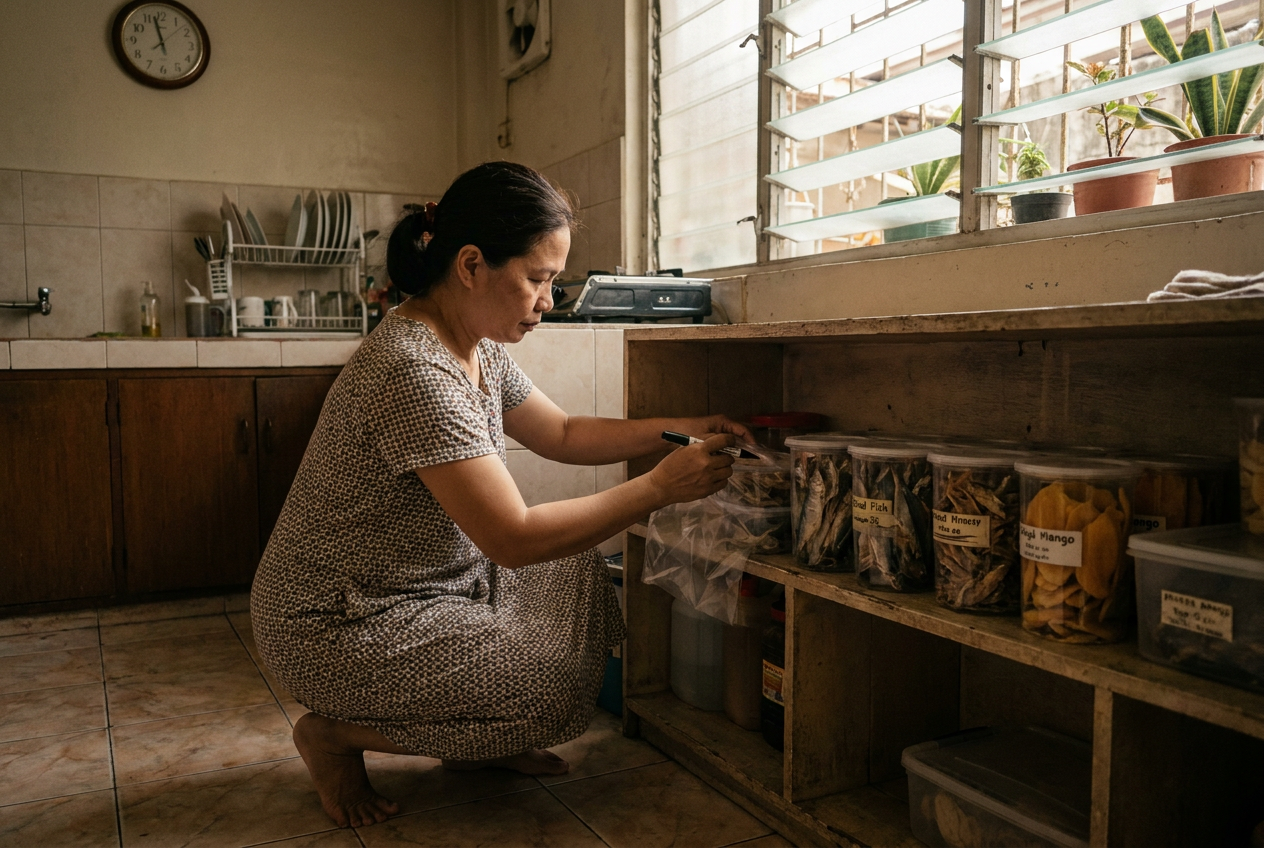
Label the moment it comes home. Use a permanent marker or a sticker, and write two things: the date it was bought or dried, and a rough “use by” if the packaging does not already have one. Do not trust your memory for this, even for a week. I have tried “I’ll remember, it’s just this one bag” and lost that bet more than once.
Set up a two-zone shelf. One small shelf or bin section is “front stock” — oldest items, closest to the edge, first thing your hand touches when you reach in. Behind it is “back stock” — anything newer. When you buy or dry a new batch, it goes to the back, always. When you need dried fish for adobo or sinigang, you take from the front, always. This is the whole system. It costs nothing and takes ten seconds per grocery run.
Cook with it on ordinary days, not just during a signal. Tinapa flakes fold into fried rice. Dried dilis makes a fine bagoong-style side or goes straight into a vegetable soup for saltiness and body. Dried squash or malunggay powder goes into everyday soups the same way it would in an emergency meal. If your family eats this way even twice a month, your stock turns over on its own and you never have to “remember” to rotate — you are already doing it.
Do a monthly five-minute check. Not a deep audit — just pull the front-zone items forward, glance at dates, and note anything getting close to its use-by so it gets cooked that week, not next month.
What not to do: do not buy in bulk just because it is on sale if you have no back-stock space to put it — a jammed shelf is a shelf nobody rotates properly. Do not store dried food near the stove or a sunny window; heat and light shorten shelf life fast, no matter how good the packaging is. And do not reseal opened bags with a rubber band and hope — a proper clip or a decanted airtight container keeps moisture and bugs out far better.
The gear that helps
You do not need a pantry renovation. A few small, cheap pieces do almost all the work:
- Stackable airtight containers, sized to fit your actual shelf, not the biggest ones you can find. Clear containers let you see what is inside without opening, which matters when you are doing that five-minute monthly check.
- A permanent marker and masking tape or small sticker labels, kept right next to where you store dried food, so labeling happens the moment stock comes in, not “later.”
- A simple wire or plastic shelf riser or bin, just to physically separate front stock from back stock. It does not need to be fancy — the separation is the whole point.
- A small dedicated go-bag pouch of ready-to-eat dried staples, separate from your rotating kitchen stock, for the first 24 to 48 hours of an actual outage when you may not want to cook at all. If you are still building that kit, our go bag guide covers what belongs in it.
This article is about managing food you already have dried and packaged. If you have not gotten to drying and sealing your own stock yet, that is a separate step we cover elsewhere — this is only about keeping it honest once it is on the shelf.
Common mistakes
Buying more than the shelf can rotate. A sale on dried mangoes is not a good deal if half of them expire unrotated because there was nowhere for new stock to go behind them.
Writing the date on the outer plastic wrap, then transferring the food to a container without copying it over. I have done this. The date disappears with the wrapper, and you are back to guessing.
Treating the emergency stash as untouchable. Sealed and set aside “for the typhoon” sounds responsible, but food that never gets cooked never gets checked, and never gets replaced until it is already spoiled.
Skipping the after-season restock check. Once the rains ease off and the signals stop, it is tempting to just move on. That is exactly when a stash quietly runs down without anyone noticing, because the urgency that made you check it weekly during PAGASA warnings is gone.
A short restock checklist for after typhoon season:
- Pull everything forward, check every date, cook or discard anything past its window.
- Note what you used most during the season — that is what to restock heaviest.
- Note what you never touched — that is what to buy less of next time.
- Re-label anything whose sticker faded or smudged over the wet months.
- Check containers and lids for cracks or loose seals before refilling them.
- Top up back stock only to a level your shelf can actually rotate, not to the ceiling.
The one thing to remember
A dried food reserve is not a monument you build once and leave alone — it is more like a small, slow-moving river through your kitchen: new stock in the back, old stock out the front, into tonight’s adobo or sinigang. Do that, check it once a month, and restock honestly after the season ends, and you will never again find a crumbling bag of something at the back of the shelf wondering how long it has been there. No storage system replaces watching the actual dates — but a shelf that forces FIFO on you means you barely have to try.